
partnerships

Content tagged with "partnerships"

Related Topics
Displaying 21 - 30 of 362

Rancho Cucamonga Cultivates Greenfield Fiber Vineyard
In the 1980s, Rancho Cucamonga proclaimed itself “The City with a Plan.” Back then, the plan was to remake this once rural enclave known for its vineyards into more than just one of the many sunny suburbs of Los Angeles. The vision was to leverage its stretch of the famed Route 66 highway as a branding and economic development tool and transform the city into a premier destination within the Inland Empire metropolitan area along the foothills of the San Gabriel Mountains.

That forward-looking spirit was revived again 30 years later as city leaders looked to cultivate a digital vineyard with the creation of a “Fiber Optic Master Plan” – a six-year $13 million investment plan that targets the city’s new development.

Today, Rancho Cucamonga (its name was derived from a Native American word meaning “sandy place”) owns and operates Rancho Cucamonga Municipal Broadband in partnership with Onward, a local private Internet service provider.

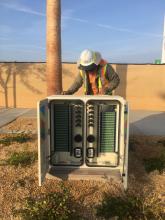
The city built, owns, and maintains the physical infrastructure, which is managed by the Rancho Cucamonga Municipal Utility (RCMU). Onward, which is based in the city, provides gigabit speed Internet access to the network’s 525 mostly residential subscribers as the network slowly expands to reach yet-to-be-built residential developments.

Targeting Greenfield Projects and Businesses

The move toward municipal broadband began in earnest in 2016 when the city hired Magellan Advisors to develop a plan that would leverage the city’s existing fiber assets and expand its municipal utility fiber network to “greenfield projects” and the city’s business parks (see the map below that shows blue areas where service exists and orange areas where service is coming).  
Empowering Municipalities in New York - Episode 510 of the Community Broadband Bits Podcast

This week on the podcast Christopher is joined by Scott Rasmussen, Acting Director of the New York State ConnectALL Office. During the show, the two dive into how New York will spend its broadband funds to support municipal networks and partnerships, the challenges of public-public partnerships between local governments working together on deployments, and what we can expect success to look like in the near future.

This show is 25 minutes long and can be played on this page or via Apple Podcasts or the tool of your choice using this feed

Transcript below. 

We want your feedback and suggestions for the show-please e-mail us or leave a comment below.

Listen to other episodes here or view all episodes in our index. See other podcasts from the Institute for Local Self-Reliance here.

Thanks to Arne Huseby for the music. The song is Warm Duck Shuffle and is licensed under a Creative Commons Attribution (3.0) license.

Colorado Springs Embarks on Citywide Network with Ting as Anchor Tenant

Back in January, Colorado Springs Utilities (CSU) announced it was going to begin building a city-wide, open access fiber network owned, and that Ting would be its first anchor tenant. Construction of the network is expected to begin in the third quarter of this year, with a target completion date of 2028 (originally planned for fifteen years). The network will provide multi-gigabit service to roughly 200,000 homes as well as city businesses and anchor institutions. It’s still early in the process, but projections at the moment have the utility spending $45 million to $100 million a year for the next six years to complete the project. The first phase will see 225 new fiber route miles laid.

CSU Has Long Used Fiber

For thirty years CSU has built fiber across Colorado’s second-largest city. CSU’s dramatic  expansion of this existing network directly benefits the utility by reducing overall costs, improving infrastructure monitoring, and boosting overall utility network resiliency. And it all will come with no rate increases to CSU electric customers.

But the company’s decision to lease access to this fiber expansion also directly aids the local community by lowering consumer utility costs, and delivering universal, affordable, high-speed Internet access. It’s a significant boon to Colorado’s second largest city that’s now an attractive, high-tech growth market

Mansfield, Louisiana Marches Toward Municipal Fiber Network

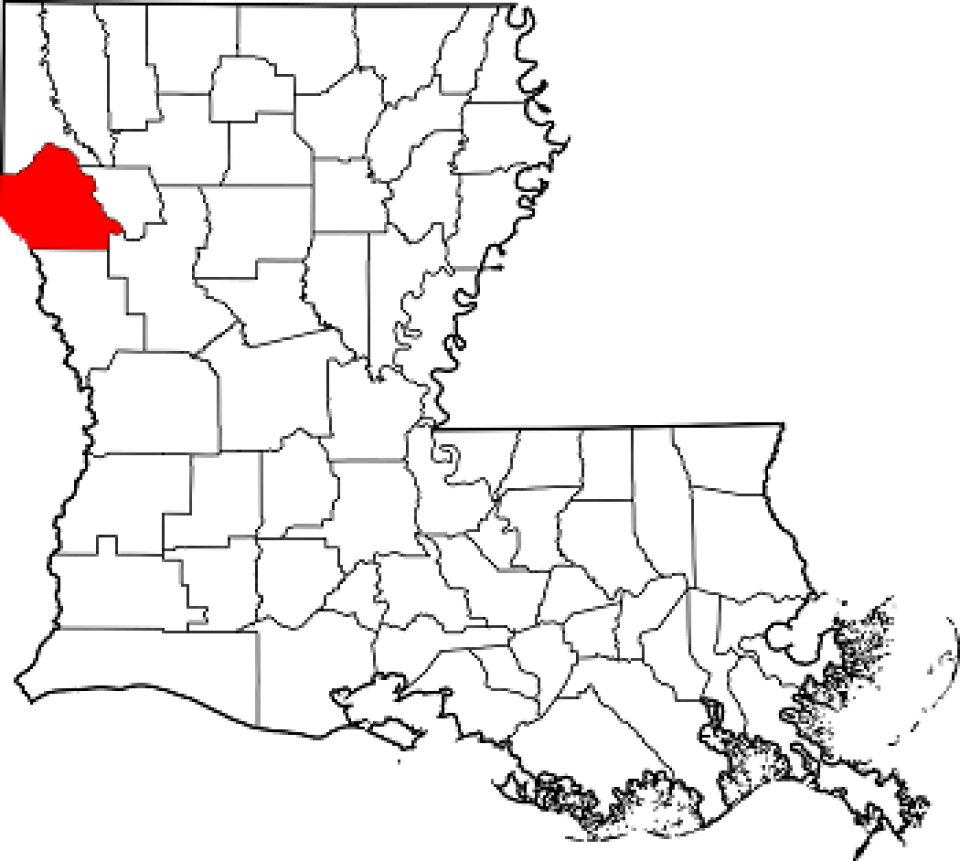
Consultants working with the City of Mansfield – the seat of DeSoto Parish – are nearing completion of a comprehensive community assessment as the small northwest Louisiana community of about 4,500 is setting the table to build a municipal fiber network.

In October 2021, Mansfield’s five-member city council voted unanimously to hire Louisiana Connected to lead the study in partnership with Lit Communities. After the council vote, Mansfield Mayor John H. Mayweather, Sr. described the decision as the first step in establishing a public-private partnership to bring reliable and affordable high-speed Internet access to every household and business in the city.

In a press statement released after the October vote, Mayor Mayweather said:

Representatives of Louisiana Connected were allowed to make a presentation to the City Council at one of our meetings earlier this year regarding a consideration to build our own broadband system. After hearing the advantages of bringing such a network to Mansfield, we were on board then. And now after listening further, we are even more excited about this opportunity. This will be good for all the citizens of Mansfield.

Pandemic Push to Action

As with many communities around the county now considering building their own municipal broadband network, a major motivator for Mansfield was the number of students in this majority African-American city who struggled to participate in distance learning triggered by the pandemic.

Image

In a press release after the vote to move forward with the community assessment, Mansfield parent LaKimberly Edwards spoke to the need for universal access to high-speed Internet connectivity.

Yellow Springs’ Fiber-to-the-Home Project is No Joke

Named for its iron-rich natural springs, Yellow Springs is a hip and diverse village of approximately 3,600 Central Ohioans that most recently made headlines because of the controversy over comedian and actor Dave Chappelle’s opposition to a housing development proposal in the hometown of its most famous resident.

While the Village Council ultimately sided with Chappelle and other resident opponents in scaling back the planned development, in January the council gave their unanimous support for a different project that promises to connect village residents.

The vote gave the green light to move forward with a plan to bring municipal fiber-to-the-home (FTTH) service that will offer more affordable and reliable high-speed Internet connectivity (and competition) in a market already served by AT&T and Spectrum about 30 minutes east of Dayton.

Last fall, as Yellow Springs pursued state grant funding, Village Manager Josué Salmerón told WHIO-TV they were moving forward because “we felt we needed to do this from a business perspective and a human rights perspective. There’s a problem when our folks couldn’t do the essential things. They couldn’t go to work online. They couldn’t go to school online, and they couldn’t visit their doctors online. That’s a problem we were trying to solve. That’s why we went down this path.”

Thinking Big, Starting Small

The plan is to start with a small pilot project by connecting to the fiber backbone of the Miami Valley Educational Computer Association (MVECA), which has been expanding a 44-mile fiber ring in the region, having built one of the country’s first multi-jurisdictional networks, the GATEWay Public Fiber Network.

CUDs are Connecting Rural Vermont - Episode 494 of the Community Broadband Bits Podcast

This week on the podcast, Christopher is joined by Will Anderson, Program Coordinator at Vermont Communications Union Districts Association (VCUDA) and Evan Carlson, Board Chair at NEK Broadband (Northeast Kingdom, VT). During the conversation, the three discuss the origins and progress of Vermont’s Communications Union District (CUD) model, how the Department of Public Service has worked to support CUDs with better broadband mapping and data, and NEK Broadband’s journey from identifying a need to connecting their first customers. Christopher, Will and Evan also talk about how CUDs establish partnerships with local ISPs to keep broadband money circulating in the local economy and how CUDs are primed to take advantage of federal COVID relief money.

This show is 35 minutes long and can be played on this page or via Apple Podcasts or the tool of your choice using this feed

Transcript below. 

We want your feedback and suggestions for the show-please e-mail us or leave a comment below.

Listen to other episodes here or view all episodes in our index. See other podcasts from the Institute for Local Self-Reliance here.

Thanks to Arne Huseby for the music. The song is Warm Duck Shuffle and is licensed under a Creative Commons Attribution (3.0) license.

Waverly Muni Fiber Another Success Story for Iowa - Episode 493 of the Community Broadband Bits Podcast

This week on the podcast, Christopher is joined by Jeff Magsamen, Telecom Director at Waverly Utilities in Waverly, Iowa. During the conversation, the two discuss Waverly’s journey building a municipal network, how triple play take rates have changed in the last few years, and the benefits of partnering with neighboring municipal networks to reduce startup costs. Christopher and Jeff also take some time to highlight Waverly’s impressive take rate in the community, and what it takes to build a network people love.

This show is 20 minutes long and can be played on this page or via Apple Podcasts or the tool of your choice using this feed

Transcript below. 

We want your feedback and suggestions for the show-please e-mail us or leave a comment below.

Listen to other episodes here or view all episodes in our index. See other podcasts from the Institute for Local Self-Reliance here.

Thanks to Arne Huseby for the music. The song is Warm Duck Shuffle and is licensed under a Creative Commons Attribution (3.0) license.

Join Us Thursday, February 3rd at 5pm ET, for a Reality Check: Scaling Networks in 2022 - Episode 32 of the Connect This! Show

Join Us Thursday, February 3rd at 5pm ET, For A Reality Check: Scaling Networks in 2022 - Episode 31 of the Connect This! Show.


In this episode of the Connect This! Show, co-hosts Christopher and Travis Carter (USI Fiber) are joined by Monica Webb (Ting) and Robert Boyle (Planet Networks) to talk about the realities of expanding network infrastructure in 2022.


The panel will dig into supply chain issues, challenges faced in scaling up, and what type of partnerships help grow networks quickly.


Subscribe to the show using this feed on YouTube Live or here on Facebook Live, or visit ConnectThisShow.com.


Email us broadband@muninetworks.org with feedback and ideas for the show. Watch here on YouTube Live, here on Facebook live, or below.

Join Us Thursday, January 27th at 5pm ET, When The Monopolies Strike Back! - Episode 31 of the Connect This! Show

In this episode of the Connect This! Show, co-hosts Christopher and Travis Carter (USI Fiber) are joined by Kim McKinley (UTOPIA Fiber) and Doug Dawson (CCG Consulting) to talk current events in broadband.

The panel will dig into recent attacks on munis, states that are providing outside plant materials as grant awards, and how partnerships can get creative with using milestones rather than upfront cash.

Subscribe to the show using this feed on YouTube Live or on Facebook Live, or visit ConnectThisShow.com

Email us broadband@muninetworks.org with feedback and ideas for the show.

Watch here on YouTube Livehere on Facebook live, or below.

Last Year and Next Year: Predictions Evaluated and Recharged - Episode 488 of the Community Broadband Bits Podcast

In this episode of the podcast, we're back for another staff conversation about all that 2021 had to offer and serve up some predictions for the coming year. Joining Christopher on the show are Senior Reporter and Editor Sean Gonsalves, Community Broadband Outreach Team Lead DeAnne Cuellar, Senior Researcher Ry Marcattilio-McCracken, GIS and Data Visualization Specialist Christine Parker, and Associate Broadband Researcher Emma Gautier.

Christopher, Ry, and Sean reckon with their predictions from a year ago, with DeAnne, Christine, and Emma joining the podcast for the first time. During the conversation, we talk about the number of preemption laws we hope to see disappear in 2022, the strides taken in small and medium-sized cities to take control of their telecommunications infrastructure future, mapping, and the impact the unprecedented amount of federal money is likely to have across the country in the coming year.

This show is 50 minutes long and can be played on this page or via Apple Podcasts or the tool of your choice using this feed

Transcript below. 

We want your feedback and suggestions for the show-please e-mail us or leave a comment below.

Listen to other episodes here or view all episodes in our index. See other podcasts from the Institute for Local Self-Reliance here.

Thanks to Arne Huseby for the music. The song is Warm Duck Shuffle and is licensed under a Creative Commons Attribution (3.0) license.