
partnerships

Content tagged with "partnerships"

Related Topics
Displaying 81 - 90 of 362

Cooperative Partnership Brings Fiber to Pilot Area in Warren County, Kentucky

A collaboration between cooperatives is bringing fiber connectivity to hundreds of unserved homes in southern Kentucky. Warren Rural Electric Cooperative Corporation (WRECC) and North Central Telephone Cooperative (NCTC) will be working together to connect 800 homes in the endeavor, which will also be used to gauge the feasibility of further buildout in the region down the road.

The project is situated in the southern part of Warren County, along U.S. Route 231 and just south of the city of Bowling Green near the unincorporated community of Alvaton. It began with a franchise agreement in 2017 between WRECC and NCTC, with KentuckyWired paying NCTC to build north into Warren County where the telephone cooperative’s fiber subsidiary could partner with WRECC to expand inside a pilot service area. The electric cooperative will supply backbone fiber and lateral lines via its existing assets, with NCTC funding the remainder of the build that will bring residents online.

A Welcome Venture

More than 60,000 people live in the county outside of the city limits of Bowling Green, and many of them — especially in the southern portion— have limited or no connectivity options. WRECC and NCTC make a natural pairing, with the latter (founded in 1938) serving power to more than 67,000 members today (about half of them in Warren County). NCTC (founded 1953) serves 20,500 members mostly in Tennessee.

WRECC President and CEO Dewayne McDonald said of the project

Our board of directors has challenged us to find a way to bring high-speed Internet [access] to our members. After extensive research, we decided that partnering with others was the best route.
New Report Shows How Two Tribal Networks in New Mexico Brought Faster Speeds and Lower Prices

A new report out by the American Library Association shows how community anchor institutions — and libraries in particular — can serve as central players in expanding tribal connectivity efforts around the country. “Built by E-rate: A Case Study of Two Tribally-Owned Fiber Networks and the Role of Libraries in Making It Happen" [pdf] looks at the striking success of tribal efforts in New Mexico in putting together a coalition of actors to dramatically improve Internet access in the region.

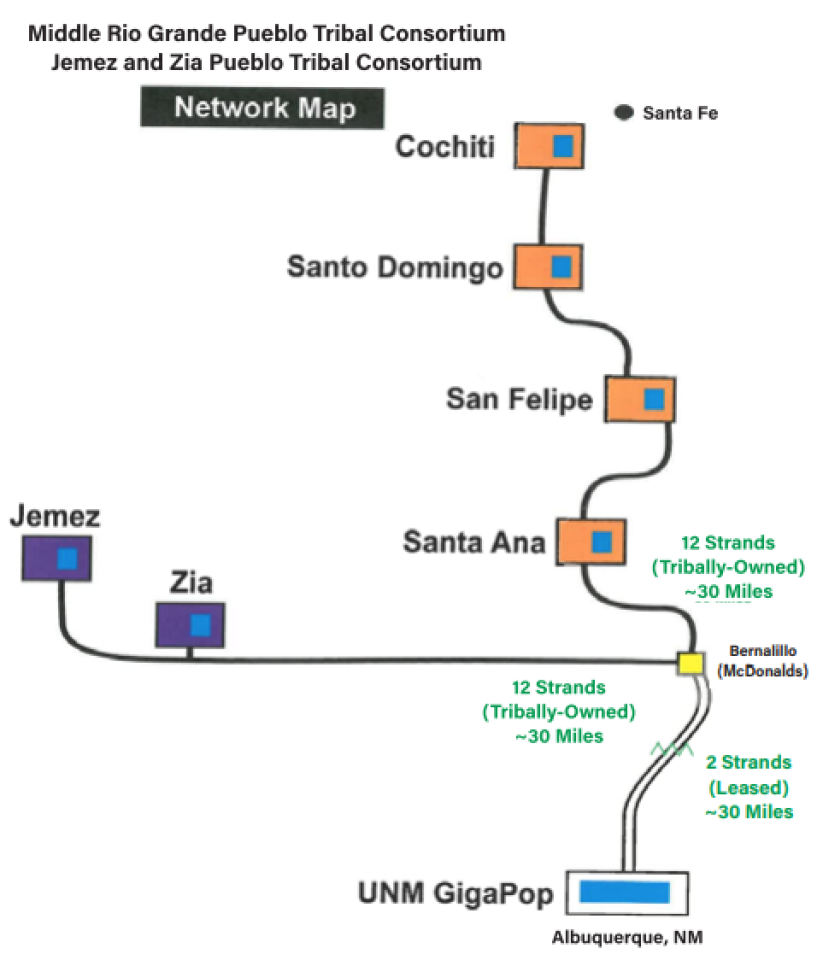
The report examines networks built by two consortiums situated in the middle of the state in the summer of 2018: the Middle Rio Grande Pueblo Tribal Consortium and The Jemez and Zia Pueblo Tribal Consortium. An endeavor initially spearheaded by the Santa Fe Indian School (which long ago recognized the need for virtual learning, the value of fast, affordable Internet and the ongoing cost of slow, poor, high monthly costs), “Built by E-Rate” details how they came into being and the obstacles they faced along the way, and offers policy recommendations moving forward.

Image

Faster Speeds, Lower Costs

Whip City Fiber’s Next Phase: Connecting Hill Towns in Western Massachusetts — Community Broadband Bits Podcast Episode 429

This week on the podcast Christopher talks with IT Manager John Leary and Customer Experience, Marketing, & Communications Manager Lisa Stowe from Westfield Gas & Electric, the municipal utility for the city of 40,000 in the southwestern quadrant of the Massachusetts. The topic of the day is Westfield's municipally owned fiber arm — Whip City Fiber — which is doing some wonderful things as it enters its next phase of life.

First, John and Lisa share their thoughts on the history of the network and what they see as key characteristics of its early success: Whip City embraced a model of incremental buildout in its early years, managing expectations and pursuing careful growth during its $2 million pilot project before transitioning, thanks to a $15 million municipal bond, to expanding so that today the network covers 70% of the city. 

The group then digs into Whip City Fiber’s next phase of life: bringing municipally owned gigabit Internet to twenty Western Massachussetts Hill Towns over the next few years, including (but not limited to) Alford, Ashfield, Chesterfield, Leyden, New Ashford, New Salem, Otis, Plainfield, Rowe, Washington, Wendell, and Windsor. With Whip City’s help now and eventual role as Internet Service Provider (ISP) and network operator, nine are already online, with the rest to follow by the end of next year. 

The group ends by talking about the future and getting to 100% coverage in Westfield, and the utility’s commitment to closing the digital divide.

This show is 35 minutes long and can be played on this page or via Apple Podcasts or the tool of your choice using this feed

Transcript below. 

We want your feedback and suggestions for the show-please e-mail us or leave a comment below.

Listen to other episodes here or view all episodes in our index. See other podcasts from the Institute for Local Self-Reliance here.

Thanks to Arne Huseby for the music. The song is Warm Duck Shuffle and is licensed under a Creative Commons Attribution (3.0) license.

Broadband Grant and Dark Fiber Swap Equal a Win-Win for Janesville, Wisconsin

Janesville, Wisconsin (pop. 64,000) Information Technology Director Gordon LaChance has been investing in fiber infrastructure for city needs for the last 12 years, but he’s been hoping it would lead to something more. That day may have come, with the recent award of a $114,000 grant from Wisconsin Public Utility Commission.

The grant allows the city to participate in a public-private partnership that will bring fiber to a handful of unserved or underserved commercial locations in town. The move is the first of its kind for the city, and involves an exchange of capacity that will allow WIN Technologies — a private Internet Service Provider (ISP) — to bring service to two SHINE Medical Technology locations (a small headquarters downtown as well as a large, new development being built south of town), the Janesville Centennial Business Park, the Beloit Avenue Corridor Business Park, and the Janesville Innovation Center. 

The grant application was spearheaded by the city’s Economic Development Office, which gathered the players and helped iron out the details. LaChance described how the deal would work in a phone interview. The city will give WIN access to some of its dark fiber, which WIN will make use of along with the grant funds and additional private investment to build south and connect those areas of town. In return, WIN will lay extra fiber as it goes and hand it over the LaChance’s office, allowing the city plant to expand in that direction when it otherwise would not be able to justify the cost. It remains early, but the city estimates that around a dozen businesses will be connected with the expansion. Better connectivity will also spur the revitalization of the Janesville Assembly Plant, a General Motors factory decommissioned in 2008 that is being turned around by a commercial developer to bring manufcaturing production and jobs back to the area. 

The Fruits of Forethought

Something for Everyone at Broadband Communities' 2020 Annual Summit

Another year of the Broadband Communities annual summit is behind us, and it’s worth revisiting the most salient moments from the panels that touched on the wealth and variety of issues related to community broadband regulation, financing, and expansion today and in the future. We weren’t able to make it to every panel, but read on for the highlights.

Last Mile Infrastructure and the Limits of CARES Funding

The first day of the program saw some heavyweight sessions from Coalition for Local Internet Choice (CLIC) on last mile digital infrastructure. For communities at all stages of broadband exploration and investment — whether exploring an initial feasibility study, putting together an RFP, or already planning for the future by laying conduit as part of other projects — partnerships dominated the discussion, with timing and debt also serving as common themes. 

ILSR’s Christopher Mitchel helped kick off the conference by moderating the first panel in the Rural/Editor's Choice track, and was joined by Peggy Schaffer from Maine's Broadband Office (ConnectME), Monica Webb from Internet Service Provider (ISP) Ting, and Roger Timmerman, CEO of Utah middle-mile network UTOPIA Fiber

The group discussed the open access models to start, and the benefits that could be realized from two- or three-layer systems. UTOPIA Fiber has seen some explosive growth and spearheaded significant innovation recently as it continues to provide wholesale service to ISPs that want to deliver retail service on the network. Ting, which recently signed on to be one of two providers on SiFi Network’s first FiberCity in Fullerton, California, also acts as an example of what can happen when we break away from thinking about infrastructure investment and Internet access as one-entity-doing-it-all.

How Monticello, MN's FiberNet Weathered the Storm and Brought Community Savings — Community Broadband Bits Podcast Episode 428

In this episode of the podcast Christopher talks with Jeff O'Neill, City Administrator of Monticello, MN, about FiberNet, which is owned by the city but today operates in a public-private partnership with local telecommunications provider Arvig. 

Christopher and Jeff delve into the history and development of the network over the last fifteen years. They discuss how business leaders began calling for the city to look for a solution to poor Internet speeds all the way back in 2005, why the city ultimately decided to build its own network, and how FiberNet persevered in the face of an early lawsuit so that incumbent provider TDS could slow competition as it began its own fiber buildout. Jeff and Chris then talk about the network subsequently weathering a vicious price war with Charter Spectrum which contributed to the fracturing of its relationship with early partner Hiawatha Broadband, but which also brought significant savings and better customer service from incumbent providers to everyone in town.

They end by discussing the multitude of community benefits realized today by having three competing providers in Monticello — two offering Fiber-to-the-Home (FTTH) in the city of 14,000 — and what it means for community savings and economic development for the city moving forward. Jeff ends by sharing some of the work he’s most proud of being involved in and what he sees as important for FiberNet in the years ahead.

We want your feedback and suggestions for the show; please e-mail us or leave a comment below.

This show is 35 minutes long and can be played on this page or via Apple Podcasts or the tool of your choice using this feed

Transcript below. 

We want your feedback and suggestions for the show-please e-mail us or leave a comment below.

Listen to other episodes here or view all episodes in our index. See other podcasts from the Institute for Local Self-Reliance here.

Thanks to Arne Huseby for the music. The song is Warm Duck Shuffle and is licensed under a Creative Commons Attribution (3.0) license.

Broadband Communities Summit 2020 Goes Virtual, Running September 22-24

This year’s Broadband Community Summit has gone digital to adapt to the ongoing public health crisis, but will still offer a wealth of information on and seasoned experts speaking to all sorts of topics relevant to community broadband networks. It runs this week from Tuesday to Friday, and interested parties can register here.  

Something for Everyone

Note that the Coalition for Local Internet Choice program has two panel sessions on partnerships of all colors and one on federal and state incentives on the first day of the summit. Other topics include:

  • Financing
  • Public-Private and Public-Public Partnerships
  • Telehealth
  • Funding Opportunities
  • Broadband Mapping

Speakers

Image
The program also features a wide-ranging list of industry folks, equipment manufacturers, consultants and legal advisors, and others experts. See the full list here, but some notable names include:
  • Deb Socia — President CEO, The Enterprise Center
  • Roger Timmerman — CEO, UTOPIA Fiber
  • Jim Baller — President, CLIC
  • Dorothy Baunach — CEO, DigitalC, Cleveland, Ohio
  • Matt Dunne — Founder and Executive Director, Center on Rural Innovation
  • Ben Fineman — President & Co-Founder, Michigan Broadband Cooperative
  • Nancy Werner — General Counsel, National Association of Telecommunications Officers Advisors
  • Dr. Christopher Ali, PhD — Assistant Professor, Department of Media Studies, University of Virginia

What is Chris Up To?

Georgia Co-op Teams Up With Windstream to Expand Internet Access

Over the summer, Windstream and Colquitt Electric Membership Corporation announced that the two entities will work together to expand fiber optic Internet access throughout the electric co-op’s service territory in rural south Georgia. Windstream, the fifth largest telephone company in the nation, will maintain ownership of the newly deployed network and use it to offer its Kinetic broadband services to residents and businesses, while Colquitt, which has more than 45,000 members, will take advantage of the fiber connectivity to improve the management of its electric grid.

The announcement came one year after Georgia lawmakers clarified that electric cooperatives in the state are able to invest in broadband infrastructure to serve their members and established guidelines for co-ops that want to get into the business.

Working Out the Details

According to Telecompetitor, the project will expand Fiber-to-the-Home connectivity and gigabit speeds to Colquitt members who currently have access to Windstream’s much slower DSL services.

Image

Windstream plans to use Colquitt’s labor force and its Rights-of-Way and electric poles to help deploy the network, but the telephone company will own the actual fiber optic lines. Colquitt will receive an indefeasible right of use (IRU) for some of the fiber capacity for internal uses and smart grid applications.

Tri-County Rural Electric is Going Big as First Electric Cooperative To Do Fiber in Pennsylvania

When Craig Eccher, CEO Tri-County Rural Electric Cooperative, joined Christopher on the podcast last fall, he had an exciting project to talk about: the electric cooperative, after strong calls from its membership asking their utility to deliver broadband, stepped up and committed to an $80 million, 3,250-mile fiber build across the rugged terrain of rural Pennsylvania, the first leg propelled by $52.6 million in federal and state grants. Tri-Co Connections, the subsidiary building the network and serving as provider, has begun connecting residents in an aggressive plan to serve 10,000 users in the next three years. The move makes Tri-County the first electric co-op in Pennsylvania to enter the fiber space, and it's doing so in dramatic fashion.

More Humble Beginnings

West Des Moines is Building a Citywide Conduit System and Google Fiber is First in the Door – Community Broadband Bits Podcast Episode 426

In July we wrote about West Des Moines’ announcement that it would build an open access citywide conduit system to spur broadband infrastructure investment, and how Google Fiber became the Iowa city’s first partner. 

In this episode of the Community Broadband Bits Podcast, Christopher is joined by Jamie Letzring, Deputy City Manager for West Des Moines, Iowa, and Dave Lyons, a consultant with the city, to discuss in more detail how things unfolded behind the scenes.

Together, the group digs into the how West Des Moines started with a long-term vision—called West Des Moines 2036—that, in part, brought local leaders together to discuss universal high-speed Internet access as a path to equity, economic vitality, and citizen engagement. Jamie and Dave share the challenges that came with a rapidly congesting right of way (ROW) landscape, and how that ultimately led to the decision to commit to a citywide conduit model that has attracted Google Fiber. Finally, Chris, Jamie, and Dave talk about what the citywide conduit system will do for business development and city residents once it’s complete. 

We want your feedback and suggestions for the show; please e-mail us or leave a comment below.

This show is 40 minutes long and can be played on this page or via Apple Podcasts or the tool of your choice using this feed

Transcript below. 

We want your feedback and suggestions for the show-please e-mail us or leave a comment below.

Listen to other episodes here or view all episodes in our index. See other podcasts from the Institute for Local Self-Reliance here.

Thanks to Arne Huseby for the music. The song is Warm Duck Shuffle and is licensed under a Creative Commons Attribution (3.0) license.