
partnerships

Content tagged with "partnerships"

Related Topics
Displaying 71 - 80 of 362

Launch of Michigan Moonshot Community Access Network Brings Wi-Fi to Critically Unserved Areas
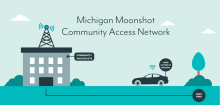
A new project borne out out of the Michigan Moonshot Initiative promises to help thousands of families and students without home Internet access get online. Led by the Merit Network, a coalition of partners (including Toyota, Cisco, the Detroit Public Library, the Washtenaw County Broadband Task Force, and county school districts) is installing Wi-Fi hardware at 50 sites around the southeastern part of the state to bring broadband access to thousands. Nine locations are up and running, with more soon to follow. 

The effort is taking place in the cities of Detroit, Inkster, Flint, as well as Washtenaw County. Toyota and Cisco are providing funds and hardware, and the project takes advantage of the Merit Network’s extensive fiber backbone running throughout the state (4,000 miles in total). Wayne State University is also participating, and inviting students and faculty and staff to participate in a broadband survey. Funds are being dispersed in the form of grants which will go to community organizations to boost existing Wi-Fi networks at schools and other anchor institutions across participating areas.

West Jasper School District in Mississippi Uses CARES Funds to Connect Students' Homes to Fiber

States have gotten creative over the last half year in making use of CARES Act funding to improve connectivity for families and students, but one project in Mississippi shows that oftentimes a good old Fiber-to-the-Home (FTTH) build is best.  The West Jasper School District (enrollment 1,700), sixty miles southeast of Jackson, partnered with telephone and network operator TEC to do just that with a project aimed at bringing Internet access to 125 families that do not have it in the area. 

Reaching the Unconnected

The effort is funded by $390,000 in CARES funding via the Mississippi Pandemic Response Broadband Availability Act managed by the Mississippi Department of Education. The initiative was established by HB 1788, which aimed at “providing payments to eligible Mississippi public school districts, independent schools and Native American tribal school districts . . . as equitably and efficiently as possible after determining the unserved areas of the state . . . to increase or gain broadband access.” It passed both chambers unanimously in July, allocating $50 million for the effort. 

Ten miles of new fiber were installed along County Road 12 to bring 135 previous unconnected homes online to TEC’s (a regional telephone and broadband company which offers services in Tennessee, Alabama, Louisiana, and Mississippi) network at the end of November. Current users connected to its fiber infrastructure can choose between symmetrical 250 Mbps, 500 Mbps, and gigabit tiers for $55/month, $65/month, and $80/month respectively. 

School District Superintendent Warren Woodrow said of the project:

We felt like the best use of it would be to put fiber in the ground and to serve our students and our community.

Kankakee Valley Hopes New Wireless Broadband Network Takes Flight

Four times a week, from 1960 to 1968, a plane marked with the insignia of the Midwest Program on Airborne Television Instruction (MPATI) took off from the Purdue University Airport in West Lafayette, Indiana and flew a figure-eight pattern above Montpelier. At an altitude of 23,000 feet, the DC-6AB aircraft used onboard Stratovision to broadcast pre-recorded courses to schools in Indiana, Illinois, Kentucky, Michigan, Ohio and Wisconsin. The 200-mile radius of the broadcast was estimated to cover 5 million students in 13,000 schools, though only about 1,800 schools became paying members.  

With seed money from the Ford Foundation, it sparked hope that the MPATI program, which predated widespread cable or satellite TV, would serve as a model for how educators could use the cutting-edge technology of the day to make top-flight education more accessible to students in rural America. The experiment lasted for eight years until the two-plane fleet was permanently grounded due to financial difficulties and, ironically, a National Association of Educational Broadcasters study that argued MPATI used too much of the UHF television spectrum.

Today, the Purdue Research Foundation's Innovation Partners Institute (IPI) has resurrected the spirit that gave wings to MPATI in an effort to reach students in the Kankakee Valley School Corporation with a pilot program of a different sort. Instead of using Stratovision and airplanes, IPI has partnered with Wabash College, SBA Communications, Watch Communications, and the State of Indiana to connect 500 households to a wireless broadband network in support of remote learning.

New Governors Association Report Covers Familiar Ground, Lacks Depth

The failure of policy and leadership at the federal level in addressing the digital divide was ever more clearly exposed as Covid-19 restrictions were put into place last spring. And, as the pandemic continues to rage, daunting connectivity challenges remain. 

Yes, the Connect America Fund (CAF) II program has doled out over $11 billion since 2015 in subsidies to the big telcos like AT&T, CenturyLink, Frontier, Windstream, and Consolidated ostensibly to upgrade rural broadband to speeds of at least 10/1 Megabits per second (Mbps). But, as Doug Dawson, president of CCG Consulting notes, it’s been a massive subsidy failure given that “even in 2015, it was ludicrous to spend money to build 10/1 Mbps broadband” – the same year the FCC defined broadband as 25/3 Mbps, which means “the FCC was investing in new Internet infrastructure in 2015 that didn’t qualify as broadband at the time of the award of funding.”

And there is reason to doubt that those subsidized upgrades were even completed, even as the FCC just extended the CAF II program for a seventh year.

So as states — and in many instances, local municipalities — step into the breach, the National Governors Association has released a new report that outlines a list of strategies governors can use to increase broadband access in underserved communities. 

Published just before Thanksgiving, the report first lays out the challenge:

According to the FCC, in 2018, at least 18.3 million people lacked access to fixed broadband in the United States that meets minimum [I]nternet access speed of 25/3. 1 Of those 18.3 million people, representing 6 percent of the total population, 14 million live in rural areas and 1 million live on Tribal lands, which amounts to 22 percent and 28 percent of those respective geographic populations [even as] studies have claimed that the FCC data is undercounting the number of people in the U.S. without fixed broadband access, and that the total may be as high as 42 million people.

West of Lake Placid, Tupper Lake is Tackling Monstrously Bad Service by Building Its Own Network

Residents in the village of Tupper Lake, New York, will soon enjoy a municipally owned broadband option to get online. With the awarding of a grant by the Northern Border Regional Commission matched by local funds, a hybrid Fiber-to-the-Home (FTTH) and fixed wireless network will bring faster speeds and more reliable service to homes and businesses in the northern part of the Empire State by the middle of next summer.

Unreliable Service

Image

The village of Tupper Lake (which sits within the boundaries of the town of Tupper Lake) is located in the foothills of the Adirondack Mountains not too far from Lake Placid. It’s an overwhelmingly rural area, and a little more than 3,500 people call the village home. 

Broadband Access is a Health and Social Justice Issue — Episode 437 of the Community Broadband Bits Podcast

This week on the podcast, Christopher is joined by Jennifer Hawkins, President and Executive Director of One Neighborhood Builders (ONB), a community development organization based out of Rhode Island. She talks about about the Olneyville neighborhood, situated on the west side of Providence, and how significant health disparities in that community led her organization to jump into action over the summer to build a free wireless network for the residents. Jennifer and Christopher talk about mapping the network, placing hardware on ONB-owned buildings, and putting up 12 access points to cover more than half of the community with robust wireless. She shares why the project’s been worth it, and the health outcomes they hope to achieve once it goes online. 

This show is 32 minutes long and can be played on this page or via Apple Podcasts or the tool of your choice using this feed

Transcript below. 

We want your feedback and suggestions for the show-please e-mail us or leave a comment below.

Listen to other episodes here or view all episodes in our index. See other podcasts from the Institute for Local Self-Reliance here.

Thanks to Arne Huseby for the music. The song is Warm Duck Shuffle and is licensed under a Creative Commons Attribution (3.0) license.

A Pilot Project in Pittsburgh Solves the Problem of Low-Income Internet Access Programs

We’ve written a lot over the last half year about communities around the country that have built fixed wireless networks to bridge the digital divide. Most recently, we’ve seen approaches which look to tackle particular inequalities that fast, affordable Internet access can help to alleviate: in Providence, Rhode Island, for instance, nonprofit One Neighborhood Builders built a network to tackle health disparities among Olneyville residents.

Today we’re covering a project in Pittsburgh that confronts another aspect of the digital divide laid bare by the pandemic: communities where connectivity options exist and low-income programs like Comcast’s Internet Essentials are available, but the minimum speeds offered are insufficient for households where multiple users need to work and attend school simultaneously. In a world where upload speed remains just as important as download speed, asymmetrical 25/3Mbps (Megabits per second) connections don’t cut it anymore. 

Free Community Wi-Fi as a Health Imperative in One Providence, Rhode Island Neighborhood

When the pandemic hit American shores this past spring and cities around the country began to practice social distancing procedures, Rhode Island-based nonprofit One Neighborhood Builders (ONB) Executive Director Jennifer Hawkins quickly realized that many of those in her community were going to be hit hard. 

As spring turned to summer, this proved especially to be the case in the Olneyville neighborhood in west-central Providence, where Covid-19 cases surged among low-income residents with fewer options to get online to work, visit the doctor, and shop for groceries. This, combined with the fact that the area suffers from an average life expectancy an astonishing eight years shorter than the rest of the state, spurred the nonprofit into action, and it began putting together a plan to build a free community wireless network designed to help residents meet the challenge. One Neighborhood Connects Community Wi-Fi hardware is being installed right now, with plans for the network to go online by Thanksgiving of this year. 

How it Came Together

When Jennifer Hawkins started looking for solutions to the lack of connectivity in the area in March, she ran into a handful of other communities likewise pursuing wireless projects to close the digital divide, including Detroit, New York City, and Pittsburg. Along with One Neighborhood Builder’s IT partner, Brave River Solutions, she explored options and ultimately decided a fixed, point-to-point wireless network could succeed in the neighborhood. This was in no small part because ONB owns 381 apartments, 119 single-family homes, and 50,000 square feet of commercial and community space across Olneyville. It meant that two of the primary obstacles to standing up a fixed wireless network cheaply and quickly — finding suitable hardware installation locations and negotiating Rights-of-Way — were nonexistent, and a fast, less expensive design and rollout was possible.

Dark Fiber Will Bring Value to Huntsville for Decades to Come — Episode 433 of the Community Broadband Bits Podcast

This week on the podcast Christopher talks with Stacy Cantrell, Vice President of Engineering at Huntsville Utilities in Alabama. Huntsville’s (pop. 197,000) municipal utility serves well beyond the city boundaries, and its electric department built a major network that gets close to every house within the city limits. 

Stacy shares how the 1,100-mile fiber project unfolded, what it took to overcome challenges, and how things are going now that they’re nearly done. The utility uses its network for internal services to bring value to those living in the city, but providers, of which Google will be the first, can lease that network and attach homes to it. 

This show is 29 minutes long and can be played on this page or via Apple Podcasts or the tool of your choice using this feed

Transcript below. 

We want your feedback and suggestions for the show-please e-mail us or leave a comment below.

Listen to other episodes here or view all episodes in our index. See other podcasts from the Institute for Local Self-Reliance here.

Thanks to Arne Huseby for the music. The song is Warm Duck Shuffle and is licensed under a Creative Commons Attribution (3.0) license.

Lessons Learned with Lyndon Township — Community Broadband Bits Podcast Episode 432

A little over three years ago in Episode 232 we heard from Lyndon Township, Michigan just after a ballot initiative passed to fund and build a municipal network. 43% of the community turned out for the vote, and the measure passed by a ratio of two to one. 

Today we revisit Lyndon Township Broadband, with Christopher joined by Ben Fineman, President of the Michigan Broadband Initiative, as well as Jo Anne Munce, and Gary Munce, both of whom were essential in the ballot campaign and who volunteer with the broadband initiative.

Christopher catches up with what’s been going on since, and what things look like now that the network has almost everyone hooked up. The township owns the network, with area electric cooperative Midwest Energy and Communications operating it on a day-to-day basis. The group talks about the network’s phenomenal 75% take rate, the current state of its debt, and how it just increased speeds on two of the service tiers with no additional fees. Lyndon Township serves as a great example of a community that decided to tax itself for a fiber network and are reaping the rewards. 

This show is 35 minutes long and can be played on this page or via Apple Podcasts or the tool of your choice using this feed

Transcript below. 

We want your feedback and suggestions for the show-please e-mail us or leave a comment below.

Listen to other episodes here or view all episodes in our index. See other podcasts from the Institute for Local Self-Reliance here.

Thanks to Arne Huseby for the music. The song is Warm Duck Shuffle and is licensed under a Creative Commons Attribution (3.0) license.