
FTTH

Content tagged with "FTTH"

Fiber to the Home
Displaying 31 - 40 of 1307

Thumb Electric Cooperative Hits 4,000th Fiber Customer Milestone

Michigan-based Thumb Electric Cooperative says its ongoing fiber deployment has hit a new milestone: its 4000th connected broadband subscriber.

The cooperative’s latest customer, Verona Hills Golf Course in Huron County, Michigan, comes three years after the cooperative joined the growing trend of expanding into broadband access.

"We're very proud to reach this milestone," Cooperative Marketing and Communication Specialist Mitch Hirn said of the cooperative’s ongoing expansion.

"We look to continue our buildout over the next few years. We want more people to sign up for high-speed, reliable internet. The vast majority of our customers have been very pleased with our service."

In deployed markets Thumb offers two tiers of fiber broadband service via its TEC Fiber subsidiary: a symmetrical 500 megabit per second (Mbps) offering for $85 a month; and a symmetrical 1 gigabit per second (Gbps) offering for $125 a month. The cooperative’s fiber tiers do not feature usage caps, hidden fees, or long-term contracts.

First created in 1938, the Thumb Electric Cooperative is one of over 200 U.S. electrical cooperatives leveraging their century-old experience in rural electrification to bring affordable fiber access to long-neglected parts of the country – markets that in most cases were left behind by regional telecom monopolies disinterested in improving affordable access.

According to data from the National Rural Electric Cooperative Association (NRECA), 700 of the nation’s 900 electrical cooperatives have yet to expand into broadband access, so there’s plenty of legroom for additional cooperatives to join the ongoing trend.

Massachusetts To Spend $31.5 Million On Broadband, Modernizing MDUs

*This is the first installment of an ongoing series we are calling Connected Complex looks at how states, local communities, and Internet service providers are working to address the often complex challenges involved in bringing high-speed Internet access to multi-dwelling units.

Massachusetts state leaders have announced a new $31.5 million investment to bring reliable, high-speed Internet access to residents in affordable and public housing statewide.

A key part of the major new investment initiative focuses on something that’s particularly challenging in the northeast: updating long outdated wiring in multiple-dwelling-units (MDUs) like apartments, condos, and housing developments, many of which were built before the advent of the Internet.

The funds are being provided by the Massachusetts Broadband Office’s (MBO) Residential Retrofit Program, which aims to deploy state-of-the-art broadband infrastructure to public and affordable housing properties across Massachusetts. MBI’s funding, in turn, was largely made possible by the 2021 American Rescue Plan Act (ARPA).

In partnership with the Massachusetts Broadband Institute (MBI), Gov. Maura Healey’s office awarded the grant money to four Internet service providers: Aervivo, Archtop Fiber, Comcast, and Community Broadband Networks FLX (CBN-FLX). All told, the funding is poised to deliver broadband access to 13,700 housing units across 60 Massachusetts municipalities.

Community Broadband Film Series Returns, Hosted by ILSR and AAPB

The second installment in the ongoing Community Broadband Film Series spotlights  “Rocketeers: The UTOPIA Fiber Story” – an eye-opening documentary that tells the story of how a publicly-owned fiber network has ignited local Internet choice and competition across dozens of cities, delivering connectivity at the speed of light.

Hosted by ILSR’s Community Broadband Networks Initiative and the American Association for Public Broadband (AAPB), the screening will be streamed to a live audience on September 3 at 4pm ET.

Register now for the virtual event here.

Image
Flyer with details about film series screening

The event  will begin with a screening of the 24-minute film and then treat attendees to a live Red Carpet discussion with UTOPIA Fiber CEO Roger Timmerman and key leaders of two communities that are now part of the fast growing UTOPIA network – Sid Boswell, CEO of Yellowstone Fiber in Bozeman, Montana; and Bountiful, Utah Councilmember Kate Bradshaw.

The discussion will be moderated by AAPB Executive Director Gigi Sohn and ILSR’s own Sean Gonsalves, the Community Broadband Network team’s Associate Director for Communications.

On the virtual red carpet, the special guests will dive into UTOPIA Fiber's open-access journey and the network of people bringing future-proof connectivity and local Internet choice to thousands of homes and businesses.

Bring your popcorn and join us for another exciting showcase of how local communities are seizing control of their digital futures.

Gibson Connect's Rural Cooperative Model - Episode 658 of the Community Broadband Bits Podcast

In this episode of the podcast, Chris talks with Scott Goff of Gibson Connect, a subsidiary of Gibson Electric in Tennessee. 

They explore how the electric co-op’s long-standing community trust helped launch a successful fiber network, bringing reliable, affordable Internet to areas that had long been unserved or underserved. 

Scott shares stories of rural residents experiencing broadband for the first time, the challenges of state restrictions, and how Gibson Connect balances growth with a cooperative, member-first philosophy.

This show is 26 minutes long and can be played on this page or via Apple Podcasts or the tool of your choice using this feed.

Transcript below.

We want your feedback and suggestions for the show-please e-mail us or leave a comment below.

Listen to other episodes or view all episodes in our index. See other podcasts from the Institute for Local Self-Reliance.

Thanks to Arne Huseby for the music. The song is Warm Duck Shuffle and is licensed under a Creative Commons Attribution (3.0) license

Vermont’s ‘Long’ Reach Toward Affordable Broadband

As states struggle to readjust their plans to expand high-speed Internet access in the wake of the Trump administration “termination” of the Digital Equity Act, Vermont is working to address the multi-million dollar shortfall by aligning the state’s Digital Empowerment initiative with its newly established Affordable Long Drop Program.

The Affordable Long Drop Program was established to provide grants to eligible Internet service providers (ISPs) in order to cover the connection costs for Vermonters whose homes are beyond standard drop distances.

Typically, an ISP will pay for a standard drop, which is the final external link that connects a provider's distribution network to the end-user's location – a distance that most often spans a couple hundred feet or less.

In rural areas around the country, community-minded operators like telephone and electric cooperatives will often cover the first quarter of a mile. This has also been the case in Vermont, where many of the state’s Communications Union Districts (CUDs) have been footing the bill to cover as much as the first 2,000 feet of drop distance. But, as with any predominantly rural state, there are a number of homes located just beyond that 2,000 foot range.

The construction costs of extending fiber lines can get pricey the further the home is away from the main fiber routes. Vermont’s Affordable Long Drop Program aims to help pay for the drops costs of the last mile networks that are currently being built across the state to help ensure residents in harder-to-reach locations can still get Internet access.

Vineland, NJ Nabs $3.7 Million Grant To Begin Municipal Fiber Network

Vineland, New Jersey officials say they’ve secured a $3.7 million grant from the state that will help expand fiber and wireless broadband access to the city of 62,000. Local officials are hopeful the grant is just the beginning steps toward dramatic expansion of affordable access.

Vineland’s new grant was made possible by the New Jersey Broadband Infrastructure Deployment Equity (NJBIDE) grant program. NJBIDE will be delivering $40 million in broadband grants via the state’s Capital Projects Fund (CPF), made largely possible by the 2021 federal passage of the American Rescue Plan Act (ARPA).

NJBIDE grants prioritize fiber optic infrastructure of 100 megabytes per second (Mbps) and mandates the provision of at least one low-cost option (not specifically defined by New Jersey) to serve low income communities – something increasingly important in the wake of the federal government’s retreat from efforts to ensure equitable and affordable broadband. (Still early in the process, the city has not yet determined the exact pricing and service tiers the network will offer once construction is complete).

Image
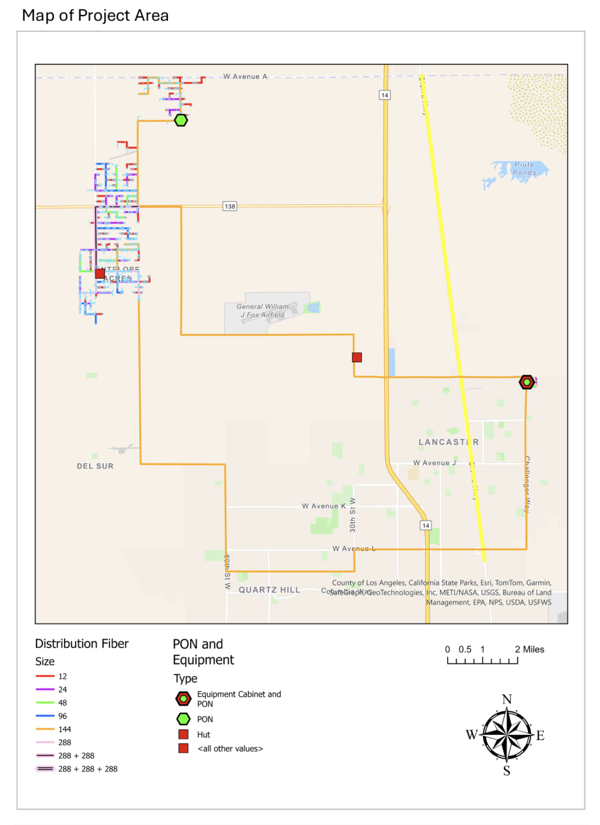
A map outlining proposed network in Vineland NJ

A 2024 city proposal indicates that city leaders want to spend between $35 and $40 million to create a citywide broadband network, starting with a citywide fiber ring. The city paid for a viability study from Bonfire that found that at least 42 percent of the City does not have access to viable, quality, affordable broadband service.

Bountiful, Utah Finishes Muni-Fiber Network A Year Ahead Of Schedule

Officials in Bountiful, Utah say they’ve completed the city’s $48 million open access fiber network a year ahead of schedule, bringing fast, affordable broadband access to the Salt Lake City suburb of 45,000.

“We have completed the Bountiful City fiber project and built out the entire city with an open access network,” Utopia Fiber Executive Director Roger Timmerman recently said at the Fiber Connect Conference in Nashville, Tennessee. “This was a three-year project, and we completed it nearly a full year ahead of schedule.”

In a unanimous city council vote in the summer of 2023, officials approved $48 million in bonds to fund construction of the city-owned open access fiber network. 

Like UTOPIA’s broader network, the city then leases access out to numerous independent ISPs, creating a massive influx of competitive, affordable last mile fiber access.

Image
Bountiful map

The city of Bountiful owns the network while UTOPIA designed, built and manages the network and takes a share of the revenue.

Thanks to the partnership, locals now have access to 14 different competing broadband providers, offering symmetrical and affordable 250 megabit per second (Mbps), 1 gigabit per second (Gbps), 2.5 Gbps, and 10 Gbps tiers – plus a $38 to $44 local network access charge.

UTOPIA officials say the network currently passes around 16,500 addresses, and they’ve been seeing 200 signups per month.

“We need a year to really answer that question,” Timmerman said when asked for specifics on area adoption rates. “In Bountiful we’re confident we’ll get take rates of 40% or higher. There’s a lot of demand there.”

T-Mobile Buys USI Fiber, Digital C Goes to Detroit, and the Technology Spread Coming to BEAD | Episode 119 of the Connect This! Show

Connect This! Show

Catch the latest episode of the Connect This! Show, with co-host Christopher Mitchell (ILSR) joined by regular guests Kim McKinley (TAK Broadband) and Doug Dawson (CCG Consulting) and special guests Gigi Sohn (American Association for Public Broadband) and Josh Etheridge (EPC). Topics include:

Join us live on August 13th at 2pm ET, or listen afterwards wherever you get your podcasts.

Email us at broadband@communitynets.org with feedback and ideas for the show.

Subscribe to the show using this feed or find it on the Connect This! page, and watch on LinkedIn, on YouTube Live, on Facebook live, or below.

Sonoma County, CA To Offer Free Broadband To Low-Income Residents

In the wake of a federal abandonment of most meaningful Internet equality efforts, California municipalities continue to take the fight for equitable broadband access into their own hands. 

That includes Sonoma County, California, where county officials have freshly greenlit expanded plans to provide free broadband access to low income residents.

Image
Map of California that shows Sonoma County on Northern California's coastline

Target: Affordable Housing

The Sonoma County Board of Supervisors recently announced that it has approved a list of new affordable housing sites that are eligible to receive free Internet for one year.

According to the county, 556 low-income Sonoma County households across 10 different housing locations should qualify for the free broadband service.

The deployments are being made possible by the 2021 American Rescue Plan Act (ARPA), which continues to result in some fairly transformative fiber deployments countrywide.

“The Board has prioritized finding creative solutions to broadband infrastructure development in Sonoma County,” Board of Supervisors Chair Lynda Hopkins says of the effort.

“This free internet program is a step toward equity as we continue to pursue public funding and strategic partnerships that can finally close the digital divide facing many of our shared communities.”

High Cost Of The “Bargain:” Trump Administration BEAD Changes Herald Slower, More Expensive Broadband

Recent Trump administration changes to a massive federal broadband grant program are lowering standards for broadband access, shifting the focus away from affordability and equity, and potentially redirecting billions of dollars away from future-proof fiber networks toward slower, more expensive satellite options that don’t seem likely to fix U.S. broadband woes.

But states, worried about losing an historic round of broadband grants, may be too intimidated to be up front about the potential downside of changes the Trump administration calls “the benefit of the bargain.”  

That’s the early story coming out of states like Tennessee, Colorado, and Texas, where state leaders are being forced to dramatically revamp billions of dollars in Broadband, Equity, Access, and Deployment (BEAD) grant planning.

In all three states the changes have introduced new delays and lowered last mile quality control standards. But an early look at the revamped bidding process in all three states shows that billions of dollars are likely being redirected away from locally-owned fiber networks to billionaire-owned low-Earth-orbit (LEO) satellite broadband options insufficient to the task.