
FTTH

Content tagged with "FTTH"

Fiber to the Home
Displaying 101 - 110 of 1307

Montgomery County Maryland Recognized For Broadband Equity Efforts

Montgomery County Maryland has been awarded the “Best Municipal or Public Connectivity Program,” honored as a 2024 Broadband Nation Award winner for its ongoing efforts to expand affordable broadband access and help bridge the digital divide.

Montgomery County has worked extensively for years to connect municipal services and key anchor institutions, but more recently has begun leveraging that infrastructure to expand access to the most vulnerable. The county’s efforts have two key components:

FiberNet is a 650-mile municipal fiber communication network that provides broadband services to 558 County, State, municipal, educational, and anchor institutions.

MoCoNet is the County’s residential broadband network that provides free 300/300 megabit per second (Mbps) Internet service for residents at affordable housing locations. Originally providing a symmetrical 100 Mbps service, the network was recently upgraded to 300 Mbps, and is currently available to low-income housing communities.
Image
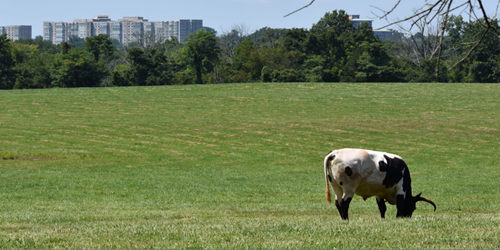
Montgomery County cow in field with tall buildings in background

Montgomery Connects Program Director Mitsuko Herrera tells ILSR that the county just received a $10 million grant from the State of Maryland to expand FiberNet and MoCoNet’s free 300 Mbps offering to 1,547 low-income and affordable housing units at seven properties operated by the County’s Housing Opportunities Commission.

The county’s also in the middle of upgrading its core fiber infrastructure to deliver significantly faster overall speeds.  

Timnath, Colorado Breaks Ground On New $20 Million Fiber Build

Timnath, Colorado officials have broken ground on a new $20 million fiber network that should dramatically expand affordable fiber access to the town of 7,100 residents.

Working in partnership with the city of Loveland’s Pulse Fiber, the project has been several years in the making, and – as with most of the successful municipal operations in Colorado – was fueled by ongoing public frustration with the speed, availability, and cost of monopoly-dominated regional broadband access.

“This project is about more than just Internet access,” Timnath Town Manager Aaron Adams said in a statement.

“It’s an investment in our future, ensuring that we have the infrastructure in place to support economic growth, attract new residents and businesses, and improve quality of life for everyone in Timnath.”

Last year the two cities signed an Inter-Governmental Agreement (IGA) greenlighting the plan to bring ubiquitous, affordable high-speed Internet access to Timnath. Under the arrangement, Tinmath is slated to receive 25 percent of the network’s gross income. That should equate to a 2 to 6 percent return on capital investment over 20 to 30 years, with the network fully paid off in 26 years.

Image
Timnath CO fiber network groundbreaking

Timnath’s project was heavily funded by the town’s capital improvement funds, which were in turn bolstered by broadband grants received via the 2021 American Rescue Plan Act (ARPA).

Southern Ute Indian Tribe ‘In The Driver’s Seat’ As Open Access Fiber Network Transforms Reservation

Among the burgeoning number of Tribal networks being built across Indian Country, a new fiber-to-the-home (FTTH) network spanning the Southern Ute Indian Reservation is unique.

When service was lit up in Ignacio, Colorado in May, the network became the only open access network owned by a Tribal government, providing its residents with a choice between two different Internet Service Providers (ISP) offering lightning-fast connection speeds.

Five years in the making, the Southern Ute network is not only the first Tribally-owned open access network, it is also among the first of the new fiber projects funded by the Tribal Broadband Connectivity Program (TBCP) to start offering services.

Image
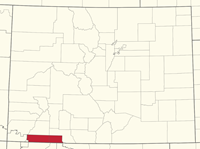
Southern Ute Tribe Reservation map

With a strong commitment from Tribal leadership, savvy decision-making, and strategic vision, the Tribe has been able to fundamentally reshape the broadband market in its region, increasing speeds and competition while lowering prices.

Slow Speeds and High Prices Fuel Mission to ‘Bust That Monopoly’

As with many other Tribally-owned networks, the Southern Ute Indian Tribe’s broadband journey began with a recognition that the existing telecommunications infrastructure on the Reservation simply could not meet the needs of the modern moment.

Tribal Council Chairman Melvin J. Baker tells ILSR that many in Tribal leadership “realized we’ve needed it for quite some time.”

Kendall County, Illinois Builds Its Own Fiber Network After Being Snubbed By Monopolies

Frustrated by years of substandard broadband service from regional telecom monopolies, Kendall County, Illinois residents have joined the growing chorus of Americans that are tackling the problem head on by building their own better, faster, more affordable fiber networks.

The Kendall County network, part of a public-private partnership (PPP or P3) with Pivot-Tech, is being funded by a tax-free revenue bond.

Kendall County officials tell ILSR that the full cost of the network, which will include private investment from Pivot-Tech, is expected to ultimately be $67 million, serving more than 13,000 locations county wide.

Image
Kendall County IL map

The first phase of the network build will consist of a combination of fixed wireless and fiber last and middle middle connectivity, supported by $15 million in state broadband grants made possible by 2021 American Rescue Plan Act (ARPA) legislation. Construction is slated to begin this fall, and officials say the county will own the finished network.  

“The network is a combination of fiber and fixed wireless, with the goal to serve as many customers by fiber as possible,” Kendall County Administrator Christina Burns told ILSR. “The fixed wireless access count planned in phase one will be approximately 1,900. The remainder will be fiber to the premises.”

County officials are still finalizing the selection of a consumer-facing ISP.

“We have identified an ISP and are working through the details,” Burns said. “We do still plan for the network to be open access, hoping to bring more ISPs on in the future.”

Like so many communities we cover, the county’s foray into community broadband was forged by decades of local frustration with limited local broadband competition, high prices, and patchy service, which was painfully highlighted during COVID lockdowns.

Mapping Digital Sovereignty Across Indian Country As Tribal Broadband Soars

In honor of Indigenous Peoples’ Day, ILSR celebrates the growing number of Tribal nations exercising digital sovereignty by building Tribally-owned broadband networks.

Our freshly updated Indigenous Networks map and census highlights the burgeoning Tribal broadband movement, offering a window into this critical work across Indian Country.

Our updates underscore how much has changed since 2020 when ILSR first undertook research on Tribal networks. When we began tracking the development of Tribal broadband, of the 574 federally-recognized Tribes in the nation, there were about 40 Tribal networks offering service.

Four years later, there are now twice as many active networks in operation with 50 more Tribes who have secured funding to build their own networks, thanks in part to unprecedented federal investments in Tribal broadband. An additional four dozen Tribes have expressed interest in following suit, determined to close the digital divide in what has historically been the least connected part of the United States.

Image
Indigenous Networks Map

Many Tribal broadband networks that we previously identified have continued to thrive. Others have been able to upgrade their services to offer fiber service, the gold standard of Internet connectivity.

Meanwhile, a steady stream of new Tribal broadband programs have launched, with networks coming online each year and many others on the horizon, signaling a period of tremendous growth in Tribal broadband.

Two Alabama Cooperatives Win Grant Funding to Expand Fiber Service

Alabama Governor Kay Ivey's office has unveiled a new round of broadband grants that will expand fiber access to unserved homes and businesses across 23 Alabama counties. This latest round of grants should help fund 2,347 miles of new fiber deployment, bringing broadband availability to more than 15,000 locations scattered across the Yellowhammer state.

The funding – made largely possible by 2021 American Rescue Plan Act (ARPA) money that both of the state’s Senators voted against – comes on the heels of another $150 million broadband funding round announced back in February.

“With these latest grants, Alabama takes another all-important step to supplying high-speed Internet availability to more rural Alabama communities and neighborhoods,” Ivey said in a statement. “Upon completion of these projects, more children will have better learning opportunities, more businesses will have greater opportunities to compete worldwide, and emergency response departments and medical clinics will be able to offer improved services.”

Both funding rounds were heavily dominated by large private telecoms like AT&T, Charter, and Brightspeed. But the state has also been doling out some sizable awards to local cooperatives in a bid to shore up rural fiber access.

Vermont Launches New Fiber Optic Apprenticeship Program With ‘Paycheck From The Start’

In a historic effort to blanket Vermont with fiber-to-the-home networks, the Green Mountain State has been banking on a community broadband-driven approach to connect the unconnected through its ten Communications Union Districts (CUDs).

Now, state leaders are adding another community-rooted program to its toolbox that promises to help fill the ranks of the very workforce building the networks.

Earlier this week, the Vermont Community Broadband Board (VCBB) announced the launch of a new Fiber Optic Apprenticeship Program officials say will put “participants to work right away, allowing them to learn on the job and earn a paycheck from the start.”

The workforce development initiative will be a part of the Telecommunications Industry Registered Apprenticeship Program (TIRAP), a “competency-based apprenticeship” sponsored by the Wireless Infrastructure Association (WIA). And in addition to earning a paycheck, apprentices who complete the program will also earn a national credential recognized by the U.S. Department of Labor.

Image
Vermont CCB logo

VCBB Executive Director Christine Hallquist characterized the apprenticeship program as “a huge opportunity for Vermonters to get into a new career without any cost to them that will provide a paycheck from day one and many options for career advancement.”

Choptank Electric Cooperative Accelerates Fiber Broadband Expansion in Rural Maryland

Choptank Electric Cooperative says the Denton, Maryland-based co-op is making significant progress on efforts to deliver fiber access to largely underserved residents of the Old Line State.

In 2021, Choptank decided to begin extending residential fiber broadband service to the cooperative’s 56,000 residential, commercial, and industrial metered accounts scattered across nine counties on Maryland's Eastern Shore. Since that promise, the cooperative says it has passed more than 13,000 locations statewide.

In a meeting with Worcester County Commissioners in early September, Choptank officials stated they’ve delivered fiber to 1,112 locations in Worcester County and have 471 currently active subscribers. Just about 42 percent of county residents that have access to Choptank’s fiber offerings have subscribed. The cooperative has received roughly $1 million in county funds.

Image

Choptank provides residential customers three tiers of fiber service: symmetrical 100 megabit per second (Mbps) fiber for $85 a month; symmetrical 450 Mbps service for $100 a month; symmetrical 1 gigabit per second (Gbps) service for $140 a month; and symmetrical 2.5 Gbps service for $280 a month.

Indio, California Gets $9 Million Grant For Fiber Network

Indio, California has been awarded a $9 million state grant the city will use to expand affordable broadband access. The grant award was made possible by California’s $2 billion Last Mile Federal Funding Account Grant Program (FFA), part of a broader $6 billion California “Broadband For All” initiative aimed at bridging the digital divide in the Golden State.

According to Indio officials and the now-finalized CPUC award, Indio – an incorporated city located in Riverside County and home to 92,000 residents – will receive $8.9 million to deliver gigabit-capable fiber to 479 unserved locations and an estimated 3,632 unserved local residents.

“We are still in the design phase and should release an RFP within the next couple of months for the actual build,” Indio Director of Information Technology Ian Cozens told ILSR.

Image
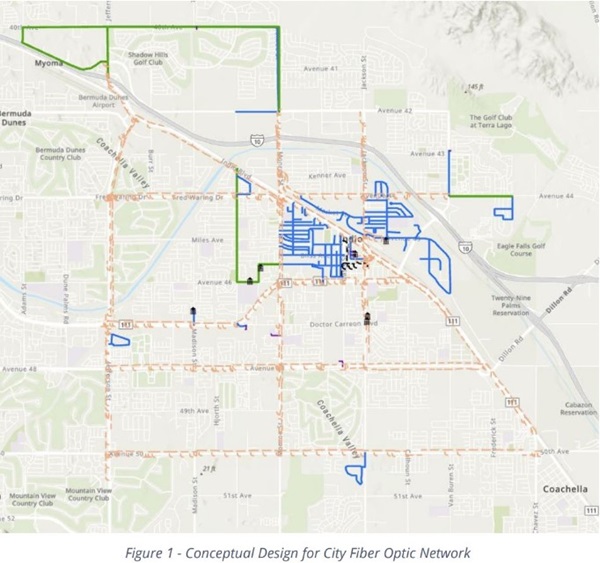
Indio CA fiber map

With 75 percent of the project’s initial target area classified as low-income, city leaders say residents can expect static pricing for at least ten years. The city will also ensure there’s a low-cost option for low-income families left adrift after House and Senate Republicans blocked the funding renewal of the federal Affordable Connectivity Program (ACP).

City officials, however, do not intend to stop there. The plan is to build a citywide fiber network, the full cost of which is estimated to be $35.2 million.

Plumas-Sierra Telecom Nabs $67 Million In FFA Grants Across Four California Counties

A California telecom and electrical cooperative says the state’s ongoing last-mile broadband grant program will help deploy affordable fiber to multiple communities across four heavily unserved and underserved California counties.

Back in July, Imperial, Lassen, and Plumas Counties were the latest to receive broadband expansion grants courtesy of California’s $2 billion Last Mile Federal Funding Account Grant Program (FFA). The program, part of a broader $6 billion California “Broadband For All” initiative, is aimed at boosting broadband competition and driving down costs statewide.

Plumas-Sierra Telecommunications (PST), a subsidiary of Plumas-Sierras Rural Electric Cooperative (PSREC) has been a major early winner in ongoing California FFA awards. The cooperative says it’s poised to receive roughly $67 million in FFA grants to expand affordable broadband to roughly 6,600 unserved and underserved locations across Sierra, Plumas, Lassen, and Nevada Counties.

Image
Plumas-Sierra fiber install in Gold Mountain

California Public Utilities Commission (CPUC) recently announced another $86 million in FFA grants that will help fund broadband expansion across 21 different California towns, cities, counties, and tribal communities. One Plumas grant award is for a $14.5 million project to bring fiber to 834 unserved locations and 1,169 unserved residents across Plumas County.