
education

Content tagged with "education"

Displaying 31 - 40 of 101

What a Lack of Broadband and Telehealth is Doing to Western North Carolina

A new report out by North Carolina's Broadband and Infrastructure Office looks at the ways that broadband and telehealth can solve some of the disparities that disproportionately affect tens of thousands of its citizens living in the western fifth of the state. These “coal-impacted communities,” it argues, would benefit greatly across a host of interventions which would be facilitated by investment in wireline broadband infrastructure, technical assistance, and digital literacy programs. If implemented, they would increase access to medical doctors and mental health professionals for all North Carolinians, eliminate barriers related to transportation, reduce state healthcare costs, increase the speed of intervention and reduce the time to diagnosis, and eliminate unnecessary hospital and emergency room admissions.

Healthcare in the High Country

"Carolina Crosscut: Broadband and Telehealth in North Carolina's Appalchain Coal-Impacted Communities" [pdf] comes out of a $100,000 Appalachian Regional Commission grant given to the Office of Broadband Infrastructure and the Office of Rural Development for two purposes: to figure out broadband availability and adoption as they relate to health disparities across the twenty-county region clustered along the state’s western border, and to map assets and come up with specific policy recommendations for state agencies and lawmakers.

These are North Carolina’s “coal-impacted” communities, which the report defines as those which exhibit a “generational dependence on coal extraction and related supply chains [which] has resulted in personal and community economic devastation.” To be clear and despite its title, the framing here is economic, and not based on the adverse health effects of working in coal extraction. It should also be noted that the economic impact described in the report surely extended beyond the twenty counties at the center of the study.


Homework Gap Hits Communities of Color Harder

Millions of students do not have access to adequate connectivity, but Black, Latinx, and Native children are disproportionately impacted by the “homework gap” — a term that describes the divide between students with access to home broadband and Internet-enabled devices and those without, as well as the challenges that unconnected students face. One study found that children in one out of every three Black, Latinx, and Native American households did not have broadband access at home.

These disparities are even more pressing during the ongoing Covid-19 pandemic, which has turned the homework gap into a chasm. Schools across the country cancelled in-person instruction at the end of the last school year, and many continue to make plans for remote learning in the fall. As the nonprofit Common Sense pointed out in a recent report, “The ‘homework gap’ is no longer just about homework; it’s about access to education.”

School districts, cities, and states across the country are distributing hotspots, deploying wireless LTE networks, and paying for students’ Internet plans, among other efforts to quickly address the homework gap. However, many of these solutions are stopgap answers to a systemic problem.

UnidosUS President and CEO Janet Marguía said in a press release:

The COVID-19 pandemic has exposed the impact of the digital divide on the academic progress of our students, particularly from low-income, Black, Latino, and American Indian households. Roadblocks, including internet connectivity and access to a computer or tablet, have denied students of color the opportunity to meaningfully engage in online learning, resulting in learning loss and widening achievement gaps . . . We cannot continue to overlook the disproportionate impact of this divide.

Mind the Gap

“Doing Schoolwork in the Parking Lot Is Not a Solution,” Says the New York Times — But This Legislation Is

“An adequate connection is no longer a matter of convenience; it is a necessity for anyone wishing to participate in civil society,” wrote the New York Times Editorial Board in an opinion article published on Sunday. Yet, tens of millions of Americans still lack reliable access to broadband connectivity.

The Times editorial echoed the concerns of many digital equity advocates, who have been ringing alarm bells ever since the Covid-19 pandemic moved most aspects of everyday life online, cutting off anyone without a home Internet connection.

To help bridge the gap, many states and localities have deployed free Wi-Fi hotspots to schools, libraries, and other public spaces. But, as the Times points out, this is not enough — the federal government must do more to connect our communities. “[T]he coronavirus has demonstrated that it is time for the federal government to think more creatively and to act more swiftly to deploy broadband service,” argued the editorial, pointing to legislation that would make an impact, including the Accessible, Affordable Internet for All Act and the Rural Broadband Acceleration Act.

Digital Divides Threaten Students’ Education

Inadequate Internet access isn’t only a problem in rural areas, where broadband infrastructure isn’t always available. Many city residents also lack home connectivity, due to the high cost of a subscription. The Times explained:

In urban areas, the struggle to get reliable or affordable Internet service disproportionately affects minorities. The cost of broadband makes it three times more likely that households without Internet service can be found in urban, rather than rural, environments, according to John B. Horrigan of the Technology Policy Institute.

Fiber-to-the-Schoolbus: Ozarks Electric Connects Students During the Pandemic - Community Broadband Bits Episode 411

Ever since the Covid-19 pandemic pushed schools online, rural cooperatives and other local broadband providers have been coming up with innovative ways to connect students during this difficult time. Ozarks Electric Cooperative, with its broadband subsidiary OzarksGo, is one of the co-ops that caught our eye over the past few weeks with its creative solution.

This week, Christopher speaks with Steven Bandy, General Manager of OzarksGo, about the history of the co-op's fiber network and its new efforts to expand broadband access during the pandemic. They discuss the beginnings of Ozarks Electric's Fiber-to-the-Home network and the co-op's plan to connect all of its members in growing Arkansas and Oklahoma communities. OzarksGo has even expanded into a nearby city where it doesn't offer electric service after seeing that the community needed better quality connectivity. Co-op members are extremely enthusasitc about the co-op's fiber network, and Steven explains how people moving to the area target the Ozarks Electric service territory in their home search.

Christopher and Steven also talk about the effects of the pandemic on the co-op's fiber network, which has seen an increase in interest. Steven shares how the cooperative is partnering with a local school district to connect Wi-Fi hotspots on busses and in community buildings with fiber optic backhaul. In addition to bringing broadband access to students in response to Covid-19, OzarksGo has also increased speeds at no cost to subscribers.

This show is 19 minutes long and can be played on this page or via Apple Podcasts or the tool of your choice using this feed

Transcript below. 

We want your feedback and suggestions for the show-please e-mail us or leave a comment below.

Listen to other episodes here or view all episodes in our index. See other podcasts from the Institute for Local Self-Reliance here.

Thanks to Arne Huseby for the music. The song is Warm Duck Shuffle and is licensed under a Creative Commons Attribution (3.0) license.

Minnesota Legislature Considers Broadband Funding in Bipartisan Covid-19 Response

In response to the increased reliance on connectivity precipitated by the Covid-19 pandemic, the Minnesota Legislature is working on legislation to improve access to broadband, online education, and telehealth services throughout the state.

The Senate passed their version of the bipartisan funding bill, SF 4494, earlier this week, and the House has two similar pieces of legislation, HF 1507 and HF 3029, currently under consideration. If the bills are passed and signed into law, there would be a total of $20 million to $27 million (depending on how the different versions are reconciled) available in grants to support distance learning, telemedicine programs, and broadband deployment. Bill authors designed the legislation to prioritize the use of federal money for the grant programs before pulling from the state’s general fund.

Broadband Bills in House and Senate

The Minnesota Senate passed its version of the legislation, SF 4494, on May 4 in a unanimous vote. Representatives in the House have rolled the grant programs into a larger coronavirus relief package that is under consideration, HF 1507. This is in addition to keeping a separate House bill with the broadband funding provisions, HF 3029, alive in case HF 1507 fails to pass.

To Get Students Online, Schools Cover Cost of Comcast Low-Income Plans

Across the country, schools have shifted to distance learning after the Covid-19 pandemic resulted in widespread school closures and stay-at-home orders. But many students still can’t get online to learn. A recent survey of Los Angeles Schools found that 16 percent of students don’t have access to broadband and that 15 percent had not yet spoken with teachers.

To connect students on the wrong side of the digital divide, school districts in a number of cities, including Portland, Oregon and San Francisco, California, are working with Comcast to sponsor the cost of the company’s Internet Essentials program for low-income families in need of home broadband connections during the crisis.

In a press release, Guadalupe Guerrero, Superintendent of Portland Public Schools, said of the program:

As we transition from a traditional brick and mortar school experience to one that takes place online, it is more important than ever that we make every effort to remain connected to our students who rely on us for not only academics, but also essential needs and social and emotional supports. . . This partnership will allow us to stay connected to our students who need us most.

Schools Sponsor Student Service

To help ensure all students can access online education while schools are closed, San Francisco Unified School District (SFUSD) and Portland Public Schools (PPS) plan to pay the monthly cost of Comcast’s Internet Essentials plan for eligible households. The school systems will distribute promotional codes to families who can then contact the company to sign up for broadband access at no cost.

Help PCs for People Connect Students and Give Lonely Office Computers a New Life

Schools across the country have moved instruction online in response to the Covid-19 pandemic, but many students are struggling to log in and learn. We’ve written before about how schools, libraries, and Internet access providers are taking steps to connect students with Wi-Fi hotspots. Still, many kids don’t have access to appropriate devices they can use to complete online schoolwork. According to PCs for People, a digital inclusion nonprofit and computer refurbisher, almost a quarter of students don’t have a computer.

To overcome that barrier, PCs for People partnered with Schoolclosures.org, GoFundMe, and Google Fiber to launch the Give Computers project, which will connect unused computers sitting in empty corporate offices with students in need. The initiative will refurbish computers and other devices donated by businesses and send them to eligible students. Details and donation information are available online.

Donation and Distribution Details

PCs for People and its partners will welcome donations from all businesses, from large corporations to small mom-and-pop shops, as well as from individuals. Accepted equipment includes working and non-working laptops, desktops, tablets, and computer accessories. PCs for People, which has an NAID AAA certification for data sanitization and R2 certification for e-waste recycling, will securely erase any data on the devices and restore the computers to operable condition, recycling any unusable devices or materials. More information is available in the Give Computers FAQ.

Submit an inquiry online if you wish to donate. PCs for People will help set up shipping or a free pickup for the equipment.

Broadband First Responders: Libraries, Schools, and ISPs Open Wi-Fi Hotspots for Students

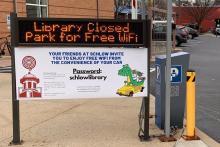
Visitors to libraries across the country are being greeted with signs declaring, “Library Closed,” in an attempt to contain the spread of the novel coronavirus. But increasingly, those words are followed by the ones seen outside Schlow Centre Region Library in State College, Pennsylvania: “Park for Free Wi-Fi.”

As the Covid-19 outbreak pushes almost all daily functions online, libraries, schools, and Internet service providers (ISPs) are finding themselves on the front lines of responding to their communities’ connectivity needs — especially those of students. Nationwide, these broadband first responders are working rapidly to open and deploy public Wi-Fi hotspots that families can access from the safety of their parked cars.

Even before the current crisis, the “homework gap” meant that 7 million school-age children did not have Internet access at home, hampering their ability to get an education. Now, the digital divide is being thrown into even starker relief, as students struggle to access online classes and school districts grapple with equity concerns.

Though it isn’t a permanent solution to the homework gap, these community institutions and providers hope that the emergency Wi-Fi access will give students on the wrong side of the divide a chance to learn while schools are shut down.

Students Trade Desks for Cars

Earlier this week, the American Library Association (ALA) recommended that libraries leave their Wi-Fi turned on and accessible while facilities are closed. In a press release, ALA stated:

"Disconnected" in Rural North Carolina: A Documentary

“While most of us take a high-speed Internet connection for granted, many living in rural areas feel disconnected,” states North Carolina television station WRAL’s new documentary, “Disconnected,” which first aired on March 19.

The documentary features local officials, healthcare professionals, small business owners, and families from across the state discussing the importance of high-quality broadband access and the struggle to connect rural areas. Though “Disconnected” was recorded before the Covid-19 outbreak forced schools and businesses to close nationally, the ongoing crisis further emphasizes the necessity of getting all North Carolinians connected to affordable, reliable Internet access.

“Disconnected” was created with help from the Institute for Local Self-Reliance, the North Carolina League of Municipalities, and Google Fiber. Watch the documentary below or on the WRAL website.

A Tale of Two Cities

To illustrate the importance of connectivity for everything from education to healthcare, “Disconnected” takes viewers to two small North Carolina towns — one with high-speed Internet access and one without.

Image

In Enfield, home to 2,300 people, businesses and residents alike struggle to get connected, and town officials face difficulties attracting new employers to the area. Enfield Middle S.T.E.A.M. Academy reports that about 60 percent of students don’t have Internet access at home. WRAL interviews one student’s family, which only has unreliable satellite connectivity. “It’s a lot of running around,” says Lashawnda Silver, the student’s mother. “If I don’t provide it for her, she’s going to lose out.”

Service Providers Start to Adjust to Increased Demand, New Environment

With everything from shelter-in-place orders to partying on Florida beaches, Internet Service Providers (ISPs) across the country have had to figure out their own responses to Covid-19. We reached out to a mix to get a sense of what they are seeing and how they are adapting.

Some ISPs have cut all installs and have disbanded their offices as much as possible to work remotely and try to prevent spread of the novel coronavirus. Others have detailed new protocols. Almost all are seeing some increases in bandwidth usage. Lots of ISPs have special, temporary offers to get low-income families signed up during this time of need.

Bandwidth Booms

When it comes to usage, we are seeing a lot more activity. We don't have enough evidence to confirm our recent predictions, but things are more or less where we expected. Most networks usually have peak activity in evening prime time hours, and that remains true. The daytime peaks are expanding, but 4K streaming is keeping those evening peaks much larger. 

At Sonic, California's largest independent ISP, they have seen an increase of 25 percent in evening peak, which is remarkable, but well within the capacity of their network to handle it.