
education

Content tagged with "education"

Displaying 11 - 20 of 101

New Study: Digital Equity Requires Local Solutions

Caroline Stratton, Assistant Professor in the School of Information at the University of Florida, has published a new article looking at the digital equity plans of four major U.S. cities with the aim of seeing how policy makers understand the genesis of digital inequity in their cities and how they frame solutions for addressing it. She does so with the hopes of offering recommendations for other cities that will undertake these types of efforts in the near future. To do so, “Planning to Maintain the Status Quo? A Comparative Study of Digital Equity Plans of Four Large US Cities” looks at recent-ish plans published in Portland, Oregon, Seattle, Washington, Kansas City, Missouri, and San Francisco, California.

The first third of the study includes a lot about meaning-making and the social construction of understandings of digital inequity that readers can skip without missing the bread and butter of the piece (which begins on page 51). After that, Stratton highlights a few important points that will be useful for cities embarking on digital equity work for the first time.

A Broken Marketplace Requires Community Solutions

First, she says, an understanding of digital inequity doesn’t offer much chance for change without being accompanied by a vision for solving it. Second, better city plans had larger and more inclusive coalitions from the outset, and were tapped into a variety of constituencies that represented a broader swath of lived experiences in these cities. Third, successful plans relied on the advice and participation of nonprofits, libraries, and other trusted community anchor institutions. 

Importantly, Stratton shows that even though “ISPs’ profit-seeking motive may dictate why particular communities lack Internet service entirely, or service that is high-quality and affordable . . . they are spared scrutiny in plans” in many cases. More than 80 million Americans live in areas with a functional broadband monopoly.

The study also points to the reality that digital equity advocates have been describing for decades - that there are a host of other inequities that perpetuate the digital divide. 

Congress’ Community Broadband Act Gains Support From 45 Organizations

Since it was first introduced in Congress in March, the Community Broadband Act of 2021 has gained widespread support from over 45 organizations representing local governments, public utilities, racial equity groups, private industry, and citizen advocates. 

The legislation -- introduced by U.S. Representatives Anna Eshoo, Jared Golden, and U.S. Senator Cory Booker -- would authorize local communities to build and maintain their own Internet infrastructure by prohibiting laws in 17 states that ban or limit the ability of state, regional, and local governments to build broadband networks and provide Internet services. 

The Act also overturns state laws that restrict electric cooperatives' ability to provide Internet services, as well as laws that restrain public agencies from entering into public-private partnerships.

States have started to remove some long-standing barriers to public broadband on their own. In the last year, state lawmakers in both Arkansas and Washington removed significant barriers to municipal broadband networks, as high-quality Internet with upload speeds sufficient for remote work, distance learning, telehealth, and other online civic and cultural engagement has become essential. 

Community broadband networks offer a path to connect the unconnected to next-generation networks. State barriers have contributed to the lack of competition in the broadband market and most communities will not soon gain access without public investments or, at the very least, the plausible threat of community broadband.

The Many Benefits of Publicly-Owned Networks

Waukegan, Illinois Broadband Task Force Issues RFP for Public-Private Partnership

Less than six months after its creation and a year after the city of Waukegan, Illinois (pop. 89,000) began exploring options to improve connectivity in response to the Covid-19 pandemic, a Request for Proposals (RFP) has been issued by the Waukegan Broadband Task Force in search of qualified applicants to assist in the creation of a broadband master plan. Applications are due June 30th, 2021.

Waukegan is situated about halfway between Chicago and Milwaukee, along the west coast of Lake Michigan. A 2020 initial broadband assessment showed challenges related to price, devices, digital skills for remote learning, and a lack of coordination to get income-qualified residents onto incumbent ISP's low-income plans. The city is served by a patchwork of ISPs, including cable from Comcast, DSL from AT&T and TDS, and fixed wireless from Rise Broadband with starting prices on plans ranging from $30/month to $60/month.

The Task Force website outlines the group's goals and stakes for the community:

There are few cities with the opportunities that exist within Waukegan. However, to truly become a ‘City of Progress’ , Waukegan must take the critical steps necessary to achieve its great potential. While 2020 brought challenges to communities around the globe, it also presented opportunities for innovation, collaboration, change and growth. The Waukegan Community Broadband Taskforce is an open, collective impact inititative of committed community stakeholders for all residents, businesses, institutions interested in working together to create a path to the future.

The RFP calls for solutions addressing access, adoption and utilization, sustainable funding, and communication and community engagement with a particular focus on remote learning, telehealth, and economic development.

The steering committee for the task force is made up of a collection of local nonprofits, the public library, the community center, city officials, and the school district. Funding for the master plan will come from private contributions.

Applicants can direct questions to wbctaskforce@gmail.com by 5pm on June 6th, with full RFPs due by June 30th.

FCC’s Emergency Connectivity Funds Ineligible for School and Library Self-Provisioned Networks

Closing the homework gap has been a top priority for Federal Communications Commission (FCC) acting Chair Jessica Rosenworcel. She has a long track record advocating for Wi-Fi-enabled school buses, lamenting viral images of school children completing homework in fast food parking lots, and making the case that no child should be left offline. At the onset of the pandemic, she pledged to use her influence at the agency to fight to increase the flexibility of the E-Rate program, saying “every option needs to be on the table.”

When the American Rescue Plan Act established the Emergency Connectivity Fund (ECF) in March, a $7 billion program to connect students and library patrons to the Internet at off-campus locations, Rosenworcel had an opportunity to follow through on those promises. She could have seized the moment to steer the program in the direction of allowing schools and libraries to build, own, and operate their own school and community networks (what the federal government refers to as self-provisioned networks). Many schools serving areas with poorly connected students already do this, but without much help from the E-rate program.

But when the rules on how to spend the money were finalized on May 10th, the FCC’s Report and Order declared that schools and libraries could not use Connectivity Funds to build self-provisioned networks, but instead could only use the funds to purchase Wi-Fi hotspots, modems, routers, and connected devices, such as laptop computers and tablets. The one exception in which schools and libraries can use Connectivity Funds to build self-provisioned networks is in “areas where no service is available for purchase,” based on data self-reported by private ISPs. 

Community Networks Borne Out of Covid-19 Continue to Strengthen and Expand

With vaccines rolling out tier by tier, state by state, and restaurants, bars and public spaces starting to reopen one by one, there seems to be a desire to say, “Wow, things are going back to normal!” Unfortunately, the public health crisis exacerbated healthcare, education, and economic inequities that have long existed in low-income and communities of color across the country and have no chance of going away any time soon. But some community leaders have stepped up and come to the table with one piece of the puzzle in bridging these inequities — better Internet access to these communities. 

Over the summer, we covered several communities that jumped to action and came up with quick ways to implement long-term solutions. 

The city of San Rafael, which sits on the coast of northern California in Marin County, continues to strengthen, expand, and research the use of the network it built over the summer and fall for one unserved area hit hard by the economic, education, and health impact of Covid-19. And on the other side of the country, Meta Mesh in Pittsburgh, Pennsylvania continues construction on a pilot project that is hoping to connect unserved families by the end of this summer.

Focusing on the Future

In San Rafael, California, the city, Marin County and a nonprofit organization — the Canal Alliance — all joined forces to bring free Wi-Fi to the Canal neighborhood

Building a Network to Build a Network in Southwest Michigan - Episode 449 of the Community Broadband Bits Podcast

We don’t often get to spend a whole episode diving into the earliest work that communities do to set the foundation for progress in expanding high-quality broadband access down the road, but that’s what we’re talking about today.

This week on the podcast Christopher is joined by Pierrette Renée Dagg, Director of Marketing and Communications for the MERIT Network, and John Egelhaaf, Executive Director of the Southwest Michigan Planning Commission

The two share the history of efforts in Berrien County, Michigan, and how a group of residents and local officials began pursuing better Internet connectivity a few years ago. Pierrette and John share the work that’s gone into the formation of a broadband task force, the identification of avenues and goals, and collaboration with hundreds of community partners along the way.

The story they tell is one of the power of partnerships and outreach groups (like anchor institutions andlibraries, senior centers, HOAs, fraternal orgs, and PTA groups) in contributing to a growing momentum.

This show is 36 minutes long and can be played on this page or via Apple Podcasts or the tool of your choice using this feed

Transcript below. 

We want your feedback and suggestions for the show-please e-mail us or leave a comment below.

Listen to other episodes here or view all episodes in our index. See other podcasts from the Institute for Local Self-Reliance here.

Thanks to Arne Huseby for the music. The song is Warm Duck Shuffle and is licensed under a Creative Commons Attribution (3.0) license.

Going Wireless for Students and Seniors in Tucson

When Collin Boyce, the City of Tucson’s Chief Information Officer, was a young boy, he left his native island country of Trinidad and Tobago with his mother and three brothers and moved to Brooklyn, New York.

“We were poor but what my mother did for us in the summertime is send us to computer camps. And because of those camps three of us are in the IT industry today and the one we call the black sheep of the family is a neurosurgeon,” Boyce said.

He was joking about his neurosurgeon brother of course. But was dead serious about how being introduced to computer technology as a young kid led him into IT work and why it means so much to him to help build Tucson’s new municipal wireless network to provide Internet connectivity for low-income school students and seniors.

“This effort is an opportunity to give back what my mother gave me,” he said.

Tucson has hundreds of miles of fiber connecting the city’s municipal buildings. But, unlike a city like Chattanooga, which operates one of the premier Fiber-to-the-Home networks in the nation allowing America’s first Gig City to provide free high-speed Internet access to 12,000 low-income students in Chattanooga throughout the ongoing pandemic, Tucson has not built a fully fiber-optic municipal broadband network.

As the COVID crisis swept across Arizona and forced students to attend school remotely last spring, Boyce began to look for a way to ensure that the thousands of students who didn’t have Internet access at home wouldn’t be left behind. In a city with a population of about 530,000, an estimated 30 percent of city residents, or about 150,000 Tucsonans, don’t subscribe to wireline broadband, Boyce said.

Standing Up a New Network

“We needed to stand up some wireless technology,” he told us this week.

Join Us February 8th at 3:30pm CST for Connect This! Episode 6: Marketing

Marketing plays a pivotal role in the success of community broadband at every stage of the game: from helping build political will during the initial stages of a project, to driving strong early take rates, to maintaining momentum down the road. Thoughtful and cohesive marketing, outreach, and community education efforts go hand in hand, and help broadband initiatives and networks weather the inevitable challenges that go with major infrastructure projects. 

On Episode 6 of Connect This!, Christopher and Travis Carter (CEO, US Internet) will be joined by Kim McKinley (Deputy Director and Chief Marketing Officer, UTOPIA Fiber) and Kyle Hollifield (VP of Business Development, Magellan Advisors), both veterans with years of experience. The group will talk about all that marketing entails, including what we can learn from those that do it right and what gets left on the table when it's not part of the discussion. 

Join us Monday, February 8th, at 3:30pm CST on YouTube Live with this link, or watch below.

Study Finds Chattanooga Fiber Network 10-Year ROI: $2.69 Billion

For communities across the country considering whether to invest in building a municipal broadband network, a new study published last week on the economic value of the EPB fiber network in America’s first “gig city” is a must-read.

The independent study, conducted by Bento Lobo, Ph.D., head of the Department of Finance and Economics at the Rollins College of Business at the University of Tennessee at Chattanooga, found that the celebrated city-owned fiber network has delivered Chattanoogans a $2.69 billion return on investment in its first decade.

In 2010, EPB Fiber, a division of Chattanooga’s city-owned electric and telecommunications utility formerly known as the Electric Power Board of Chattanooga, became the first city in the United States to build a Fiber-To-The-Home (FTTH) network offering up to 1 Gig upload and download speeds. In 2015, EPB began offering up to 10 Gig speeds.

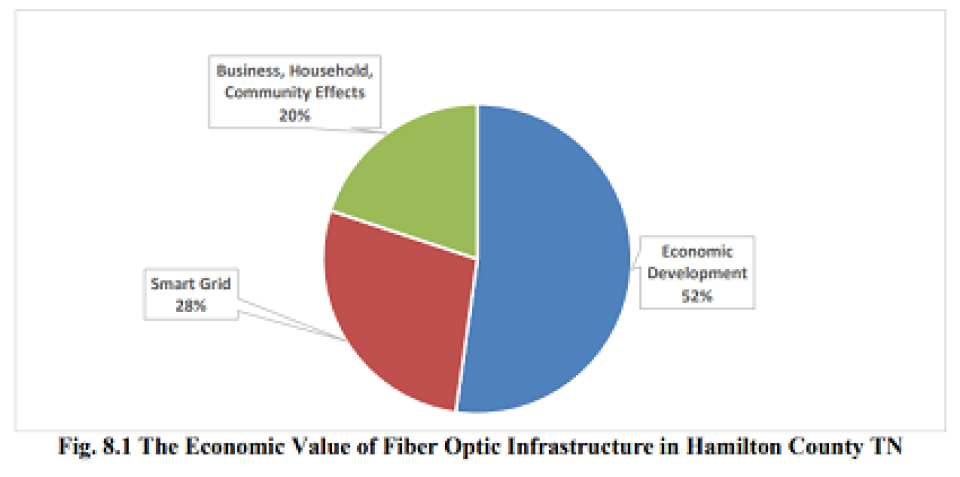
It cost approximately $220 million to build the network, however, “the true economic value of the fiber optic infrastructure for EPB’s customers is much greater than the cost of installing and maintaining the infrastructure,” Lobo said. “Our latest research findings show that Chattanooga’s fiber optic network provides additional value because it provides high speeds, with symmetrical uploads and downloads, and a high degree of network responsiveness which are necessary for the smart grid and other cutting-edge business, educational and research applications.”

Image

Among the study’s key findings:

Building a Bridge over the Digital Divide: Explaining the Affordable, Accessible Internet for All Act - Part 2

Last week we began our broad overview of the Accessible, Affordable Internet for All Act, sweeping legislation that calls for a $100 billion investment in broadband infrastructure in unserved and underserved parts of the country, as well as federal funding and coordinated support to meet the myriad of barriers that prevent tens of millions of Americans from having access to affordable and reliable Internet connectivity.

The bill (H.R. 7302) has already passed in the U.S. House of Representatives led by House Majority Whip James E. Clyburn (D-SC) and members of the House Rural Broadband Task Force. The Senate version of the bill (S. 4131), which was filed by Minnesota Senator Amy Klobuchar, co-chair of the Senate Broadband Caucus, has stalled, thanks to Senate Majority Leader Mitch McConnell who has “has buried the legislation in his graveyard,” in the words of Rep. Clyburn.

In this second-installment of a series of posts exploring the major sections contained in the proposed legislation, we look at the “Title I – Digital Equity” portion of the bill.

Image

New Office of Internet Connectivity and Growth (OICG)