Reports

Profiles of Monopoly: Big Cable and Telecom

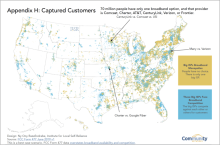
The report explores the extent of monopoly control by the largest Internet Service Providers (ISPs) across the United States, and finds that most Americans have little choice when it comes to broadband where they live. In this version, we updated the maps and other information in the report with the most recent broadband deployment data from the Federal Communications Commission.

Broadband Models for Unserved and Underserved Communities

This paper from US Ignite and Altman Solon covers five approaches that communities can take to improve Internet access, from full private broadband to full municipal broadband with varying types of public-private partnerships in between. Of all the well-connected American cities (where 50 percent of residents have access to 250 Megabits per second broadband speeds), the paper finds that 8% are served a form of municipal network.

Community Broadband: The Fast, Affordable Internet Option That's Flying Under the Radar

New America’s Open Technology Institute has a new report out called “Community Broadband: The Fast, Affordable Internet Option That's Flying Under the Radar.” It offers a brief look at the problem of broadband access across the United States, points out of the many benefits of the community networks which have stepped in to fill the gaps left by private Internet Service Providers (ISPs), and provides a snapshot of a few examples that have overcome legislative hurdles and monopoly ISP lobbying to bring fast, reliable Internet service to people around the country.

How Local Providers Built the Nation’s Best Internet Access in Rural North Dakota

Our case study, How Local Providers Built the Nation’s Best Internet Access in Rural North Dakota, explains how the majority of rural North Dakota has access to gigabit fiber, highlighting how 15 telephone cooperatives and local companies came together to invest in their rural communities and build broadband networks across the state. In the 1990s, those companies united to purchase 68 rural telephone exchanges in North Dakota from regional provider US West (now CenturyLink). Then, they leveraged federal broadband funds to deploy some of the most extensive fiber networks in the country, turning North Dakota into the rural broadband oasis that it is today.

Tribal Technology Assessment: The State of Internet Service on Tribal Lands

Tribal Technology Assessment: The State of Internet Service on Tribal Lands, a report from the American Indian Policy Institute at Arizona State University (AIPI) provides a detailed examination of broadband access, device use, and uses of the Internet by Tribal peoples on Tribal lands. Authors Brian Howard and Traci Morris completed the 2019 report aiming to develop a closer look at the digital divide and "to create a new baseline for future studies with the expectation of potentially measuring growth in coming years."

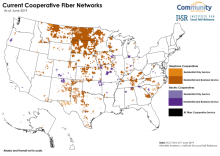
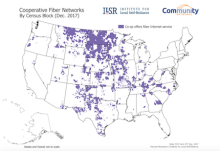
Cooperatives Fiberize Rural America: A Trusted Model For The Internet Era (Updated Dec. 2019)

Originally published in 2017, our report, Cooperatives Fiberize Rural America: A Trusted Model for the Internet Era, focuses on cooperatives as a proven model for deploying fiber optic Internet access across the country, especially in rural areas. An update in the spring of 2019 included additional information about the rate at which co-ops are expanding Internet service. Now we’ve updated the report with a new map and personal stories from areas where co-ops have drastically impacted local life.

Download the updated report [PDF] here.

All versions of the report can be accessed from the Reports Archive for this report.

*We discovered an error in our first release of the December 2019 edition of this report, which we have since corrected. We deeply apologize for the mistake and take this very seriously -- these data are challenging to work with but we are committed to accurately reporting broadband statistics.

Broadband for America’s Future: A Vision for the 2020s

In their report, Broadband for America’s Future: A Vision for the 2020s, Benton Senior Fellow Johnathan Sallet offers insightful recommendations for a new National Broadband Agenda.

Broadband for All Needs a New Approach

As access to high-quality connectivity becomes more critical each day, those without fast, affordable, reliable Internet access lose ground more quickly as time passes. In addition to the opportunities that come with broadband access, lack of adoption translates into lack of technical skills. Innovation isn’t slowing down for folks who don’t have broadband. 

As Sallet notes, access to and adoption of broadband improves our economy, strengthens communities, and empowers American workers. Obtaining that access and expanding that adoption, however, is proving more challenging than it should be.

Download the report, Broadband for America’s Future: A Vision for the 2020s here.

A Public Housing Digital Inclusion Blueprint: Monkeybrains and San Francisco Deliver a Sustainable Gig

Local communities continue to search for ways to tackle the digital divide and in San Francisco, the city is making strides by working with a local Internet access company. The City by the Bay and ISP Monkeybrains have adopted a new model to bring high-quality connectivity to residents in public housing. The approach not only creates new opportunities for people who were once denied economic and educational opportunities, but does so in a way that is financially self-sustaining. With modest maintenance and start-up costs, Monkeybrains and San Francisco has found a way to bring the same high-speed Internet access to low-income households at an affordable rate. Read our new report, A Public Housing Digital Inclusion Blueprint: Monkeybrains and San Francisco Deliver a Sustainable Gig, to learn how the partners found a way to shrink the digital divide in public housing facilities.

Download A Public Housing Digital Inclusion Blueprint: Monkeybrains and San Francisco Deliver a Sustainable Gig [pdf], here.