
new mexico

Content tagged with "new mexico"

Displaying 1 - 10 of 32

Los Alamos County Signs Partner ISPs For Open Access Fiber Network

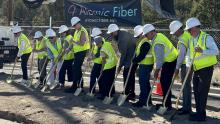
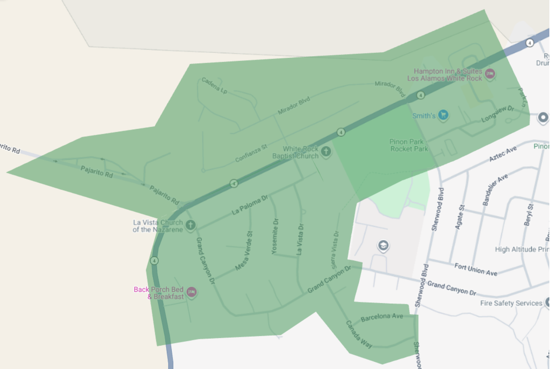
Los Alamos County, New Mexico is inching closer to the launch of its “Atomic Fiber” county-wide open access fiber network, recently announcing they’ve received signed contracts with the partner ISPs that will be tasked with providing affordable fiber access to local residents.

An announcement by the county indicates that they’ve signed agreements with four providers:  XMission, Anthem Broadband, Intellipop, and LANet. The county says network construction is still slated to begin this spring (likely April). Some locals are expected to be connected by the fall of 2026, with network completion expected sometime in 2030.

As with most open access fiber networks, locals will eventually have the option to quickly switch between multiple competing broadband providers in pursuit of the best price, speed, customer service, and performance.

Bonfire Fiber (Bonfire Engineering & Construction LLC) is the primary partner contracted by Los Alamos County to design, build, and operate the Atomic Fiber Community Broadband Network (CBN). County officials previously told ISLR that the total network cost is expected to be around $35 million, and the finished network should pass 10,014 addresses.

A 2023 Strategic Leadership Plan adopted by the County Council identified that broadband is an “essential service,” stating that a county-owned community broadband network would be a top priority to improve economic vitality of the county. So in late 2023, the county issued a project request for proposals (RFP).

With ACP Gone, New Mexico Creates First State-Level Internet Affordability Program

New Mexico Gov. Michelle Lujan Grisham signed into law today new legislation that aims to provide tens of thousands of low-income households in “The Land of Enchantment” an Internet lifeline similar to the now-expired federal Affordable Connectivity Program (ACP).

It makes the state the first to step up in the absence of federal action to support households that just can’t afford to pay for monthly service, and will directly support 173,000 households.

Image
Headshot of NM State Sen Michael Padilla

Senate Bill 152 – first filed on January 26 of this year by State Sen. Michael Padilla, (D) Majority Whip – will update the state’s Rural Telecommunications Act and empower the New Mexico Public Regulation Commission (PRC) to offer up to $30/month for qualified households to pay for Internet service.

The broadband bill, known as the Low-Income Telecommunications Assistance Program (LITAP), passed through the formal legislative session in high-speed fashion. It was first introduced at the end of January, passed by the House, and then the Senate by a 38-0 margin last Thursday (Feb. 12), making its way to the governor’s desk to be signed into law today. That’s a 25-day marathon from legislative start-to-finish.

New Mexico Completes First ARPA Broadband Deployment In Rural Chaves County

New Mexico’s Office of Broadband Access and Expansion (OBAE) has announced the completion of a landmark broadband infrastructure expansion project that delivered affordable next-gen broadband access to dozens of long-neglected homes in a remote subdivision in rural Chaves County.

According to the OBAE announcement, the successful completion of the Chaves County project is OBAE’s first grant project to reach 100 percent completion, and the first Connect New Mexico Pilot Program project funded through the federal American Rescue Plan Act (ARPA) Capital Projects Fund to reach the final stage.

“This project’s completion delivers on the state’s promise to connect New Mexico families in the most remote areas of the state,” said Andy Exell, OBAE’s ARPA Program Coordinator.

“For these dozens of homeowners to finally get high-speed internet is a life changer.”

Image
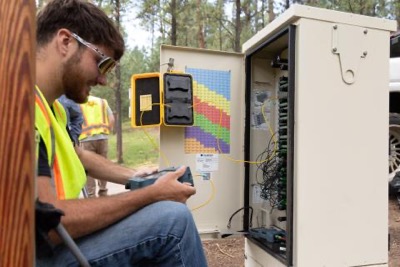
Penasco Valley Telephone Cooperative fiber tech looks inside a roadside fiber cabinet

Like so many rural U.S. communities, residents of Chaves County were often deemed unprofitable to serve by entrenched private phone providers.

That changed in  2023 when OBAE awarded Artesia, New Mexico based Penasco Valley Telephone Cooperative Inc. (PVT) an ARPA grant of $487,000. Officials say construction included roughly 11 miles of pole-attached aerial fiber to the rural residences. With matching PVT funds, the broadband project’s total budget was $649,000.

The U.S. Treasury awarded New Mexico $117 million in grants through ARPA to expand and deploy broadband to unserved and underserved neighborhoods. 

Jemez Pueblo’s JNET Project Celebrated for Expanding High-Speed Internet to Rural Tribal Homes

At the New Mexico Infrastructure Finance Conference last week, the Pueblo of Jemez Tribal community was honored with a Project Excellence Award for its broadband project, building out a fiber network to reach more than 670 unserved or underserved households, Tribal departments, programs, and businesses.

In presenting the award, Jeff Lopez, Director of the New Mexico Office of Broadband Access and Expansion (OBAE), highlighted the transformative work the Tribe has been doing since it received an $8.6 million grant for the $15 million project, courtesy of the American Rescue Plan Act (ARPA) in Nov. 2023.

In accepting the award on behalf of the work being done by the tribally-owned and operated Internet service provider known as JNET, Governor George Shendo Jr. of Jemez Pueblo, said in a statement:

“We are honored to be recognized by the Department of Finance and Administration for its inaugural broadband Project Excellence Award. We are excited to fully realize all the opportunities our broadband project will bring to current and future generations in Jemez and the surrounding communities.”

Since January of 2024, JNET has been constructing its fiber-to-the home (FTTH) network, building-out more than 45 miles of fiber to date. More than 40 homes have already been lit up for service with the project expected to be finished in 2026.

Jemez Pueblo Tribe Seeks ‘Light,’ Fiber Knowledge To Advance Digital Sovereignty

For Angela Diahkah, what started as a self-described “side hustle” is now her full-time job.

Diahkah – or “Ange,” as she sometimes goes by – is five years into serving as Network Operations Supervisor and Digital Navigator Program Manager for JNET, the Tribally-owned broadband provider for the Pueblo of Jemez.

Just 50 miles northwest of Albuquerque, Angela leads the charge in building a new fiber network, the gold-standard of Internet connectivity, that once complete will serve her community (one of the 19 Pueblos in New Mexico).

Last week, she was at the 17th Tribal Broadband Bootcamp (TBB) in Aguana, California in the hills above Temecula Valley, along with a half dozen JNET technicians-in-training and JNET Director Kevin Shendo. The 30 or so other TBB participants – representing broadband leaders from several other federally-recognized Tribes – were also there for the three-day immersive learning experience focused on building and operating Tribal Internet networks.

Held in different tribal regions several times a year since the initiative began in 2021, this most recent bootcamp was back at TBB co-founder Matthew Rantanen’s “RantanenTown Ranch.”

Image
Angela looks at her crew explore fiber splicing equipment on a table outdoors on RantenenTown Ranch in the desert-like foothills of Anguana, Califonia

“We're basically trying to find a light in a dark tunnel and just work with what’s best for us,” Angela told ILSR in describing why she and her JNET crew had come, just as they are in the early stages building out their own fiber-to-the-home network.

“We want to expose them to the network,” literally and figuratively, she said.

Maine, New Mexico Want Starlink Part of the Mix: Balancing Trade-Offs and Concerns

States wary about the restrictions and delays with looming federal broadband grants are poised to put significant taxpayer resources into Starlink and other low Earth orbit (LEO) satellite constellations. The problem: such services often aren’t affordable, raise environmental questions, and may struggle to keep pace with consumer capacity demand.

Back in March, Maine unveiled a $5.4 million initiative to offer Starlink Low Earth Orbit (LEO) terminals to 9,000 state residents outside the reach of broadband from existing terrestrial providers.

An estimated 9,000 locations in the state (1.5 percent of residents) have no access to broadband, mostly peppered across rural Oxford, Penobscot, and Aroostook counties.

While well intentioned, the state’s initiative immediately sparked a debate about whether Starlink is the best use of taxpayer resources.

Starlink May Be Part of Solution

LEO satellite broadband has understandable allure for state broadband offices tasked with showing the federal government they have a solution for every premise – household and business – in the state. Depending on geography and state, some of these locations may require $100,000 for a terrestrial wireline connection.

Many of these unserved locations may be inhabited for a few weeks a year by the family of billionaires or 52 weeks a year by a family barely able to afford the fuel to live there. Spending $100,000 on that household may mean tens of other households see no improvement or have to settle for worse technology. And depending on who you ask, NTIA either demands that the state actually connect that household or simply have a feasible plan to achieve that connection.

Tribes, Cooperatives, and Counties Nab $1.4 Million In New Mexico Grants

The New Mexico Office of Broadband Access and Expansion (OBAE) has awarded $1.4 million in grants to 15 counties, tribal communities, cooperatives, and municipalities for planning, engineering and grant writing to expand broadband access in long-underserved communities.

The funding not only allows these communities to begin analyzing their local connectivity needs in more detail, it potentially opens the door to helping them apply for more than $675 million in BEAD grants the state of New Mexico is poised to receive courtesy of 2021 infrastructure legislation.

The New Mexico Grant Writing, Engineering and Planning Program (GWEP) awards must be used for grant writing, engineering and planning for broadband expansion projects and the development of infrastructure projects. Traditional private ISPs were not eligible.

The first round of awards were announced in June, with a second batch announced in July.

Image
Pueblo of Jemez visitor center

Round one awardees included $100,000 grants to the Village of Pecos, Valencia County, Pueblo of Isleta, Pueblo of San Ildefonso, Pueblo of Laguna, Pueblo of Jemez, and Otero County, and a $90,000 grant to Luna County.

Los Alamos County Edges Closer To Unveiling Planned Open Access Fiber Network

Los Alamos County New Mexico is getting closer to unveiling its finished plan for a county-wide open access fiber network. The effort, should it be approved by county officials in the next few months, should dramatically improve local competition and broadband access quality for the county’s 19,419 residents.

A 2023 Strategic Leadership Plan adopted by the County Council identified that broadband is an “essential service,” stating that a county-owned community broadband network would be a top priority to improve economic vitality of the county.

So last December, the county issued a project request for proposals (RFP), and is currently examining potential partners as well as build and financing options.

County broadband planners tell ILSR they’re hoping to build a county-wide open access fiber network within a budget of $35 million. That network could theoretically pass 10,014 addresses and if open access, could spur meaningful local competition in a predominately rural county where many either don’t have service, or only have access to Comcast cable.

Image
Los Alamos High School Marching Band

Los Alamos County Broadband Manager Jerry Smith told ILSR the county is still working its way through the early preparation stages but the project has not been approved by the Los Alamos County Council yet. While planners are currently in the RFP procurement process, the county isn’t yet in position to share more details publicly.

“We are making progress and are now in the final stages of procurement,” Smith said. “We hope to be able to present to our county council a recommended vendor and negotiated contract within the next few months. If we get an approved and funded project, more specific information can be shared at that point.”

Los Alamos County, New Mexico Issues RFP For Community Fiber Network

Los Alamos County, New Mexico joins the growing list of municipalities looking to explore a community-owned broadband network in a bid to improve resident access to fast, affordable, next-generation fiber.

The request for proposal (RFP), originally issued August 13, called for design, planning, and construction partners for a locally-owned and operated fiber network. An updated RFP was issued on December 12, 2023 stating that applications for phase two of their planned project were deemed “incomplete.” The county has given potential partners until January 12 to respond.

“The county team is now reviewing the submitted proposals,” the county states. “Once one is selected and an agreement finalized, the county will request the council award a contract. This may occur in early 2024.”

Image
Los Alamos Emergency Op Ctr

The RFPs come after county council leaders passed a motion last January declaring “…that high-quality reliable telecommunication including broadband is an essential service.” Los Alamos County officials did not respond to repeated requests for comment asking for more detail on the county’s goals. Local outlets suggest more details should emerge in 2024.

New Mexico is poised to receive more than $635 million in broadband subsidies courtesy of the Broadband Equity Access and Development (BEAD) program, made possible in turn by the 2021 Infrastructure Investment and Jobs Act.

Panhandle Telephone Co-op Will Build Fiber Network in Rural New Mexico With $43 Million Grant

Panhandle Telephone Cooperative Inc. (PTCI) has announced the broadband provider will be dramatically expanding access to its fiber broadband services in New Mexico thanks to a new $43.4 million grant made possible by federal infrastructure legislation.

The Cooperative currently predominately offers fiber broadband, phone, and cellular wireless phone service to subscribers in Oklahoma and Texas. The $43 million cash infusion will allow the cooperative to expand access outside of its existing footprint into rural Union County, in northeast New Mexico.

As per grant rules, the network will deliver speeds of 100 Megabit per second (Mbps) downstream and 20 Mbps upstream, but the cooperative does not yet have a construction timeline or information on planned tiers and pricing.

PTCI’s existing deployments in Texas provide locals with uncapped fiber access at symmetrical speeds of 100 Mbps, 250 Mbps, and 1 Gbps for $60, $86, and $116 per month, respectively. The company stopped offering TV services in 2020, but launched its own cellular network in its existing territories starting in 2021.

Image
Panhandle Telephone Coop HQ building

The project’s $43 million grant for expansion into New Mexico was made possible courtesy of a recently announced fourth funding round for the U.S Department of Agriculture’s ReConnect Program. Last month the program announced another $714 million in grants and loans aimed at shoring up broadband access to long unserved or underserved rural Americans.