
maine

Content tagged with "maine"

Displaying 41 - 50 of 113

Community Broadband Legislation Roundup - May 4, 2021

Snapshot

Nebraska Senate rejects amendment supporting municipal broadband in spending plan

Michigan Governor vetoes bill granting private ISPs property tax exemptions

Montana, Iowa and Maine channel Rescue Plan funds towards new broadband grant initiatives


The State Scene

Nebraska

The Nebraska Senate approved a plan to spend $40 million over the next two years on expanding rural access to high-speed Internet by a unanimous vote on Tuesday, but only after an amendment to L.B. 388 that would have allowed municipalities to offer retail broadband services was rejected.

State Sen. Justin Wayne introduced the amendment, saying that “broadband should be considered a critical infrastructure need and that private telecommunications companies have not stepped up to serve the whole state,” the Lincoln Journal Star reports.

Wayne urged Nebraska Senators “to look to Nebraska's history of public power as a model, as well as to the example of other states that are allowing cities to offer broadband.” The amendment ultimately failed by a vote of 20-24. Wayne assured fellow Senators that he will reintroduce the amendment in the future. 

The bill marked the first time the Nebraska Legislature has suggested using state tax dollars to fund broadband deployment. As it was submitted to Gov. Pete Ricketts for his signature, the bill would annually allocate, until funds run out, $20 million in grants to projects that increase access to high-speed broadband in unserved regions of Nebraska. It would prioritize projects in regions which lack access to Internet service with speeds of at least 25 Megabits per second (Mbps) download/3 Mbps upload. Grant recipients would be required to deploy networks capable of providing service of at least 100/100 Mbps within 18 months. 


Michigan
Community Broadband Legislation Roundup – April 27, 2021

Snapshot

Washington Governor pledges to sign Public Broadband Act

Maine hearing will reveal State Legislature’s willingness to introduce competition to incumbent ISPs

California bill amended to remove bond initiative backing public infrastructure projects of local communities 

The State Scene

Washington

Two pieces of legislation aimed at expanding public broadband authority, H.B. 1336 and S.B. 5383, have been delivered to Washington Gov. Jay Islee to consider signing into law. Rep. Drew Hansen, the primary sponsor of H.B. 1336 recently told GeekWire that he “expects the governor to sign both.”

H.B. 1336 would give Washington’s cities, towns, counties, district ports and Public Utility Districts (PUDs) unrestricted authority to provide Internet services directly to end-users, while S.B. 5383, as a result of a series of amendments, deals largely with what information PUDs and ports have to provide to the state broadband office before offering service in unserved regions. 

There will be a meeting between the governor and the sponsors of the two bills on Thursday, which will likely determine their fate. Although arguments about how the two bills will interplay are continuing throughout the halls of the State Legislature in Olympia, the prevailing legal interpretation is that the finalized versions of the bills do not conflict. If both bills are signed, and discrepancies are later discovered to be an issue, it will prompt the State Legislature to convene in the future to standardize differences between the legislation. 

Resiliency in a Decade-Long Fight to Get Better Broadband - Episode 453 of the Community Broadband Bits Podcast

This week on the podcast, Christopher talks with Belle Ryder, Orono, Maine Assistant Manager and President of the nonprofit OTO Fiber Corporation. The towns of Orono and nearby Old Town began their search for better broadband more than 10 years ago, and have overcome an array of challenges in bringing a pilot project to justify future-proof connectivity to the surrounding area.

Belle shares the origins of local efforts, and how the two communities kept finding themselves stuck with almost every solution too far out of reach. They were too small to entice private ISPs to commit to upgrading local infrastructure or invest in new construction that would bring fast connectivity to the region, but too small to finance a citywide network themselves. In looking for funding help, they found that existing options were considered too fast to qualify them for many opportunities to improve the technology in the ground. But residents were acutely aware that their broadband options were too slow to do more than the bare minimum to get online. 

Christopher and Belle talk about the process of issuing multiple RFPs, working through a challenge by local cable providers, and how allies and local officials worked together to come up with a plan for financial stability and success. OTO Fiber's story is a testament to local resilience and resourcefulness in the face of obstacles and the value of never giving up. 

This show is 47 minutes long and can be played on this page or via Apple Podcasts or the tool of your choice using this feed

Transcript below. 

We want your feedback and suggestions for the show-please e-mail us or leave a comment below.

Listen to other episodes here or view all episodes in our index. See other podcasts from the Institute for Local Self-Reliance here.

Thanks to Arne Huseby for the music. The song is Warm Duck Shuffle and is licensed under a Creative Commons Attribution (3.0) license.

Old Town-Orono Fiber: Poetry in Slow Motion

Born in Orono, Maine, the poet Frances Laughton Mace’s most notable verses were published in 1854 as a hymn entitled “Only Waiting.” Over a century and a half later, residents in her native town – and in the neighboring community of Old Town just four miles up the road – might be inclined to hum a line or two. Not because they are getting religion, but because of the wait in getting Fiber-to-the-Home (FTTH) Internet connectivity.

After a decade of hopeful planning, disappointing setbacks, design work, and putting out multiple RFPs to move the project forward, the nonprofit OTO Fiber Corporation is on the verge of lighting up a six-mile fiber network this summer. With three miles of fiber deployed in Orono, a town of 11,000 residents and home to the University of Maine’s flagship campus, and the other half covering a portion of Old Town, the budding network will provide FTTH service to a limited number of residences and businesses in both towns. It’s a pilot project that, if successful, will serve as a core network which can eventually be extended to cover the entirety of both communities.

“It’s taken us forever to get to this point it seems. We started this process ten years ago and we are still slogging our way through while we’ve seen other communities zip ahead,” Belle Ryder, Orono Assistant Town Manager and President of OTO Fiber, told us this week. “It is really, really, really hard for communities relying on volunteers to pull off the feat of building and operating these networks.”

Ryder wasn’t complaining or exasperated. She was just being candid about the process she and her colleagues at OTO Fiber are committed to see through to the finish. The slog she is referring to goes back a decade when Orono was in the process of putting together a comprehensive development plan.

Families and Fiber, Fits and Starts

With just about half of the town’s population made up of college students living in off-campus apartments and the other half made up of residents 60 and older, “we really needed to draw families back,” Ryder explained. 

Bar Harbor, Maine Considers Building Its Own Network After Charter Spectrum Raises Prices Tenfold

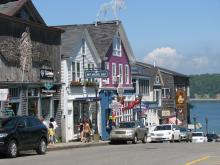
Bar Harbor, Maine (pop. 5,500) has been trying to get a municipal fiber network off (and into) the ground for more than half a decade. If local officials throw weight behind the most recent move, we may see momentum continue to build for faster, more reliable, affordable, and universally available Internet access for government use, commercial development, and maybe, down the road, residents as well. 

We last checked in with the town in 2016, when its franchise agreement with Charter had expired and negotiations for a new agreement had stalled. At the time, Bar Harbor was considering a $100,000 engineering study to flesh out the possibility of a municipal Fiber-to-the-Home (FTTH) network or a $50,000 study to do so for a government-only network, but at the last minute the town’s Warrant Committee and Council decided not to move ahead on either at the last minute. Since then, the situation has remained more or less in stasis.

But with recent changes, Charter has signaled that it will begin to charge Bar Harbor $45,000 a year for access via – a ten-fold increase over the $4,500/year the town currently pays. With the company refusing to negotiate, on December 15 the Town Council, at the recommendation of the Communication and Technologies Committee (CTC), voted unanimously to place a $750,000 proposal to build their own institutional network onto the 2022 budget draft review. The general public will have the chance to vote on the measure in June.

Image

Locally Owned Infrastructure at a Fraction of the Price 

New Governors Association Report Covers Familiar Ground, Lacks Depth

The failure of policy and leadership at the federal level in addressing the digital divide was ever more clearly exposed as Covid-19 restrictions were put into place last spring. And, as the pandemic continues to rage, daunting connectivity challenges remain. 

Yes, the Connect America Fund (CAF) II program has doled out over $11 billion since 2015 in subsidies to the big telcos like AT&T, CenturyLink, Frontier, Windstream, and Consolidated ostensibly to upgrade rural broadband to speeds of at least 10/1 Megabits per second (Mbps). But, as Doug Dawson, president of CCG Consulting notes, it’s been a massive subsidy failure given that “even in 2015, it was ludicrous to spend money to build 10/1 Mbps broadband” – the same year the FCC defined broadband as 25/3 Mbps, which means “the FCC was investing in new Internet infrastructure in 2015 that didn’t qualify as broadband at the time of the award of funding.”

And there is reason to doubt that those subsidized upgrades were even completed, even as the FCC just extended the CAF II program for a seventh year.

So as states — and in many instances, local municipalities — step into the breach, the National Governors Association has released a new report that outlines a list of strategies governors can use to increase broadband access in underserved communities. 

Published just before Thanksgiving, the report first lays out the challenge:

According to the FCC, in 2018, at least 18.3 million people lacked access to fixed broadband in the United States that meets minimum [I]nternet access speed of 25/3. 1 Of those 18.3 million people, representing 6 percent of the total population, 14 million live in rural areas and 1 million live on Tribal lands, which amounts to 22 percent and 28 percent of those respective geographic populations [even as] studies have claimed that the FCC data is undercounting the number of people in the U.S. without fixed broadband access, and that the total may be as high as 42 million people.

Mainers Commit to Broadband Expansion with $15 Million Internet Bond Issue

Maine’s High-Speed Internet Infrastructure Bond Issue, which we first wrote about a month ago, has passed. 76% of voters said yes to Maine Question 1, which authorizes the issuance of $15 million in general obligation bonds to fund projects which will expand broadband access for residents in underserved and unserved areas. Underserved areas are those where less than 20% of the households have speeds of 25 Megabits per second (Mbps) download and 3 Mbps upload. Unserved areas are those where broadband service isn’t offered by provider. The northern and eastern parts of the state suffer from particularly poor connectivity options. The money will join $30 million in additional federal, local, and private money, for a total of $45 million to be invested in the near future.

Where We Go From Here

The ConnectME Authority will administer the grants. It’s a significant injection of funds for the broadband authority, which has given out slightly more than a million dollars a year over the last ten years to build mostly last-mile connections and bridge the broadband gap. Passing the measure makes Maine the first state to bond to fund broadband projects, serving as an example to other states looking for avenues to do the same. 

As it stands, somewhere around 83,000 households lack access, though this doesn’t include those families who can’t afford to subscribe. The impact of this digital divide has become even more starkly outlined over the last six months, and since the future of telework relies on affordable, reliable, high-speed connections, states that don’t commit resources to the problem will fall further behind. 

A Concerted Effort

Maine's Proposed Bond Issue Offers Significant New Funding for Internet Infrastructure

In less than a month Maine will hold a Special Referendum election which includes a measure with significant ramifications for Internet access in the state. On July 14, Mainers will be asked to vote Yes or No on Question 1, a $15 million Internet Infrastructure Bond Issue designed to bring high-speed service to the approximately 85,000 households in unserved or underserved areas.

The $15 million in general obligation bonds would go to the ConnectME Broadband Authority, which administers the state's broadband grants, to provide funding for projects with an emphasis on connecting unserved or underserved areas. This new funding would leverage an additional $30 million in matching federal, private, and local investments.

If voters approve the referendum, Maine will become one of few states (if not the first) to bond to fund broadband deployment, taking advantage of current historically low interest rates.

Meeting a Need

Tens of thousands of homes and businesses in Maine fall short of even the slowest upload and download speeds defined by the FCC as modern broadband. Those in the northern two-thirds of the 35,000-square-mile state deal with particularly poor conditions, with either no connectivity options or maximum download and upload speeds of 10/1 Megabits per second (Mbps). The ConnectME authority has given out $12 million over the last decade to fund projects, with an emphasis on last-mile connections, but broadband gaps still remain.

Nancy Smith, Executive Director of GrowSmart Maine, told WABI:

We know that access to high speed internet is critical for students to access education, even when they're at home. And for all of us to access medical care through tele-health. Investments in broadband are also critical to growing the economy and creating jobs, particularly in rural areas.

Mainers Weigh In

Arrowsic, Maine, Receives Federal Grant to Develop Fiber Network

There is a festive air in Arrowsic, Maine, after Governor Janet Mills announced on January 30th that the community will develop a publicly owned broadband network for fast, affordable, reliable connectivity. The community will receive $1.2 million in combined grant and loan funding from the USDA's ReConnect Pilot Program to connect 237 households, 20 businesses, and four farms with symmetrical fiber optic service of up to 100 Mbps.

This will be a substantial upgrade because Arrowsic currently contends with patchy DSL connections that top out at 10 Mbps download through Consolidated, with upload speeds much slower. Poor connectivity has been affecting the economy at the local level because it's a strike against Arrowsic when people are looking to relocate to the region. Community leaders approached incumbent providers, including Consolidated and Spectrum, but the national companies rejected requests to serve the rural community with a small population of only around 450. Rather than settle for antiquated, poor serve, Arrowsic decided to pursue a community broadband network.

Multi-Community Effort

The 3 Bridged Islands Broadband Initiative (3BIB) is a nonprofit created by the towns of Arrowsic, Georgetown, and Southport. The organization first initiated a feasibility study, explored funding opportunities, and submitted the application for USDA grant to develop the network in Arrowsic. They've worked with Axiom to develop the design for the infrastructure and, according to the 3BIB website, intend work with private sector partners to offer services via the fiber optic infrastructure.

After the approval of USDA grant, the town of Arrowsic is now determined to close the digital divide and expects to do more to boost the local economy. The town is also looking forward to providing telehealth services to older people with chronic illness, increasing students’ ability to do research and complete assignments through better Internet connections. 

D.J. LaVoy, the USDA rural development deputy undersecretary said in his announcement on January 30th

Islesboro Brings Affordable Gigabit to Island Living in Maine

Islesboro Municipal Broadband (IMB) is about to celebrate its second birthday. Instead of two candles on a cake, the community has around 630 lit Fiber-to-the-Home (FTTH) subscriptions to mark the occasion. With more than 90 percent of the premises on the island connected to the network, the community can revel in its accomplishment as it considers the future.

Super Affordable, Super Satisfied

Residents pay only $360 per year to connect to the gigabit service, which has become part of the "fabric of the island" says Roger Heinen, Selectman who's part of the Islesboro Broadband Committee. Property owners also pay a modest increase in property taxes to satisfy the municipal bond the community issued to pay for deployment. In total, most property owners pay less than $85 per month for gigabit connectivity and the optional voice service from GWI. In addition to bringing fast and affordable high-quality Internet access to the community, Roger says that its reliability is so consistent that he thinks people have forgotten what the situation was like before the community network served the island community.

Subscribers report high satisfaction with IMB on biannual surveys. While there are still a few people in the community that have not connected to the IMB, he speculates that those people aren't interested in connecting in any way.

Saving Smartly

Every connection in Islesboro provides gigabit Internet access and, according to Roger, the decision to limit offerings to one tier was a way for the community to reduce costs. There's no need for complicated inventories of different types of gear, they know that every premise has the same gear and level of service, making billing easier and more streamlined, and they received a substantial discount because they bought so many of the same type of electronics. They knew that standardization would simplify and reduce costs and wanted gigabit service because it accommodates future innovation that demands more capacity.