
funding

Content tagged with "funding"

Related Topics
Displaying 11 - 16 of 16

Breaking Down How Communities Can Be Ready to Use the BEAD Program

This week’s episode of our Community Broadband Bits podcast is particularly insightful for communities considering how to leverage the broadband expansion funds embedded in the Infrastructure Investment and Jobs Act (IIJA) passed in November 2021.

Although the funds will likely not be allocated to state grant programs until the end of 2022/early 2023, the time is now for state and local leaders interested in building community-owned networks to best position themselves to take advantage of this once-in-a-generation investment.

Christopher is joined by Nancy Werner, General Counsel of the National Association of Telecommunications Officers and Advisors (NATOA), an under-the-radar organization that advises local government officials on telecommunication issues.

During the conversation, the two talk about NATOA and its role in supporting community broadband projects with a particular focus on how the Broadband Equity, Access and Deployment (BEAD) program contained in the infrastructure bill is structured. Christopher and Nancy zero in on exactly how BEAD grant money can be used. Although the bill was written to first focus on mostly rural communities who do not have access to minimum broadband connections of 25/3 Megabits per second, they delve into the nitty gritty of how the funds can be used to prioritize bringing high-speed Internet access to multi-dwelling units even in densely-populated urban centers.

As Christopher notes:

This is important because this is a question of whether we are going to spend the vast majority of this money in areas that are more rural … or if we are going to spend any money in urban areas ... It is incontrovertible that we have neglected the many more millions of people in urban areas. This is a time to make sure that we are not just picking one or the other.

The show ends with an exploration of the promise and shortcomings of taking a simplified approach to setting Right-of-Way and franchise fees, which are areas that are notoriously difficult waters to navigate as new networks are being built.

Breaking Down BEAD Funding Requirements with Nancy Werner - Episode 498 of the Community Broadband Bits Podcast

This week on the podcast, Christopher is joined by Nancy Werner, General Counsel of the National Association of Telecommunications Officers and Advisors (NATOA). During the conversation, the two talk about NATOA and its role in supporting community broadband projects, how the Broadband Equity, Access and Deployment (BEAD) Act is structured, and how exactly BEAD grant money can be used. They also get into the nitty gritty of funding MDU deployment projects with BEAD money, and what priorities need to be considered to access those funds. The show ends with a discussion about the promise and shortcomings of taking a simplified approach to setting right of way and franchise fees.

This show is 30 minutes long and can be played on this page or via Apple Podcasts or the tool of your choice using this feed

Transcript below. 

We want your feedback and suggestions for the show-please e-mail us or leave a comment below.

Listen to other episodes here or view all episodes in our index. See other podcasts from the Institute for Local Self-Reliance here.

Thanks to Arne Huseby for the music. The song is Warm Duck Shuffle and is licensed under a Creative Commons Attribution (3.0) license.

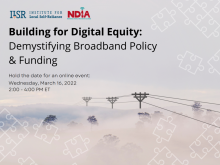
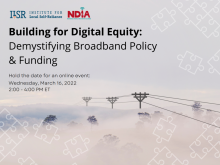
Event: Building for Digital Equity - Demystifying Broadband Policy and Funding

We're living through a time with an unprecedented level of broadband infrastructure funding, fueled not only by the American Rescue Plan, but the Consolidated Appropriations Act, the Coronavirus Capital Projects Fund, and the Infrastructure Investment and Jobs Act. Hundreds of community-driven projects are already underway, but finding solid footing amidst these programs, statutes, and evolving rules is difficult. 

To help, the Institute for Local Self-Reliance is teaming up with the National Digital Inclusion Alliance for a two-hour livestream event to demystify the landscape. On Wednesday, March 16th, from 2-4pm ET, we're hosting an online conversation to bring together local stakeholders, policy advocates, and funding experts in one place. We're calling it Building for Digital Equity: Demystifying Broadband Policy and Funding.

Image

But this isn't your average conference or webinar, with 45-minute panels that make your butt go numb and your eyes glaze over. Oh no. We're aiming for a fast-paced, fun, and most importantly interactive conversation between policy advocates, network builders, local officials, and anyone else interested in learning how we can ensure that the tens of billions in upcoming infrastructure funding goes to solving the connectivity crisis permanently rather than once again disappearing into the pockets of the monopoly Internet Service Providers (ISPs).

Apply for AARP's Community Challenge Grant Program

AARP has announced the latest round of its Community Challenge Grant Program, an effort to direct funding towards building more resilient, livable, equitable communities around the country. Applications for the current round are due March 22nd at 5pm ET.

Part of the AARP's Livable Communities initiative, this is the sixth iteration of the grant program, which led to the funding of more than $9 million in projects across 800 grants to nonprofits and local governments in rural, urban, and suburban areas. This includes everything from improved city infrastructure, to trainings, to new volunteer programs, to the support of local cultural and art initiatives.

Watch a video of the announcement below, or visit here to learn more.

From USDA ReConnect to IIJA: Read This Guide to Federal Broadband Funding Opportunities

It can be difficult to track all of the federal funding opportunities out there these days for communities looking to improve local Internet access. Even more difficult is parsing through all the ways they can be used, and charting a path to successfully weave them together to achieve local broadband goals. To help, we published our "Community Guide to Federal Funding Opportunities" in September, followed up by a look at what the recently passed Infrastructure Investment and Jobs Act (IIJA). 

But Common Sense Media recently put out a Federal Broadband Funding Guide packed with useful information and well worth bookmarking for future use. It breaks down the buckets of broadband money not only in the IIJA, but from the American Rescue Plan, the Consolidated Appropriations Act of 2021, and the other ongoing programs like USDA ReConnect. 

The value of the guide comes from Common Sense including clear and concise descriptions of the legislation, the amount of money allocated in them, who the funds will be flowing to and in what ways, what the deadline is to use the funds, and if they can be dedicated to infrastructure, devices, affordability, or equity and inclusion projects. Check it out here, or download below.

A Local Coalition Gets Organized to Bring Quality Connectivity to Maine’s Midcoast

Five small towns in rural Maine are connecting with one another in a steady grassroots effort to expand broadband access in the Midcoast. After conducting a survey which affirmed the towns’ acute need for better connectivity, a local coalition is navigating state funding and weighing network options. 

In Waldo County, a collection of local officials and community volunteers have formed the Southwestern Waldo County Broadband Coalition (SWCBC) to organize efforts to bring broadband to five towns in rural Maine, clustered about 30 miles east of Augusta. Freedom, Liberty, Montville, Palermo and Searsmont combined have only 3,300 houses along 340 miles of road. The need for better Internet access became particularly visible during the pandemic, as local officials tried to convene online for Selectmen’s meetings. Two selectpersons from neighboring towns connected over this shared need for access, and the coalition grew from there.