
fiber

Content tagged with "fiber"

Displaying 31 - 40 of 213

RDOF Auction Ends but Confusion and Corruption May Just Be Beginning
The FCC's Rural Digital Opportunity Fund results are a puzzle. RDOF was the recent auction for large swaths of rural areas of the U.S. that have no broadband access, in large part because they were the territories of big companies like AT&T, CenturyLink (now rebranding as Lumen in hopes of improving its dismal image among its subscribers), Frontier, Windstream, and others. Up to $16 billion was at stake though the auction will actually disperse some $9+ billion dollars because many areas were bid well below what was expected. 

Please understand that this post is the best I can do right now - this is confusing and we are sorting our way through it. Please let me know if you can help us understand it. See our past coverage for more information.

The auction resulted in far more gigabit - 85% of locations I believe - than anyone expected, at far lower subsidy than expected. However, there is a lot of frustration and confusion because it is not clear that some of the top bidders can deliver. NTCA - The Rural Broadband Association - shared my original enthusiasm for RDOF and our concerns - best articulated over the years by Jon Chambers from Conexon - that the FCC was going to blow this auction by not ensuring those who bid had the capacity to deliver on the promised level of service. Shirley Bloomfield, CEO of NTCA, wrote this and recently tweeted on this:

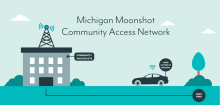
Launch of Michigan Moonshot Community Access Network Brings Wi-Fi to Critically Unserved Areas

A new project borne out out of the Michigan Moonshot Initiative promises to help thousands of families and students without home Internet access get online. Led by the Merit Network, a coalition of partners (including Toyota, Cisco, the Detroit Public Library, the Washtenaw County Broadband Task Force, and county school districts) is installing Wi-Fi hardware at 50 sites around the southeastern part of the state to bring broadband access to thousands. Nine locations are up and running, with more soon to follow. 

The effort is taking place in the cities of Detroit, Inkster, Flint, as well as Washtenaw County. Toyota and Cisco are providing funds and hardware, and the project takes advantage of the Merit Network’s extensive fiber backbone running throughout the state (4,000 miles in total). Wayne State University is also participating, and inviting students and faculty and staff to participate in a broadband survey. Funds are being dispersed in the form of grants which will go to community organizations to boost existing Wi-Fi networks at schools and other anchor institutions across participating areas.

Kansas Announces New Ten-Year, $85-million Broadband Grant Program

The state of Kansas continues to build momentum with the announcement of a new, ten-year broadband grant program designed to drive network expansion in unserved and economically depressed areas. It will go towards connecting tens of thousands of residents in the state who currently have no or few options for Internet access, while bringing commercial development and connecting farms desperately in need. 

The Good

Currently, 3.5% of the state’s population, totaling almost 100,000 people, have no Internet access options at all. Students sent home at the beginning of the Covid-19 pandemic have struggled all summer and fall to get online to do coursework. Both urban and rural areas have continued to face significant challenges over the last decade, and the problem has only increased in recent months. It’s also an issue that has had ramifications for employers like Citizens State Bank in Cottonwood Falls, which has considered cutting local positions and shifting them to places with better Internet access options.

The new Broadband Acceleration Grant Program (BAGP) [pdf] offers lots of provisions for positive progress. It prioritizes low-income, economically distressed areas, as well as those without access to speeds of at least 25/3 Mbps (Megabits per second). This likely means much of the money will end up in the southeastern and southwestern parts of the state (see map). The grant also urges applicants to engage local stakeholders in their communities and build relationships with community anchor institutions, businesses, and nonprofits so as to maximize impact.

West of Lake Placid, Tupper Lake is Tackling Monstrously Bad Service by Building Its Own Network

Residents in the village of Tupper Lake, New York, will soon enjoy a municipally owned broadband option to get online. With the awarding of a grant by the Northern Border Regional Commission matched by local funds, a hybrid Fiber-to-the-Home (FTTH) and fixed wireless network will bring faster speeds and more reliable service to homes and businesses in the northern part of the Empire State by the middle of next summer.

Unreliable Service

Image

The village of Tupper Lake (which sits within the boundaries of the town of Tupper Lake) is located in the foothills of the Adirondack Mountains not too far from Lake Placid. It’s an overwhelmingly rural area, and a little more than 3,500 people call the village home. 

Sacred Wind Goes Technology Agnostic To Serve the Navajo Nation — Episode 435 of the Community Broadband Bits Podcast

This week on the podcast Christopher talks with Catherine Nicolaou, External Affairs and Marketing Manager for Sacred Wind Communications, a rural local exchange carrier in NW New Mexico that has been focused on serving the Navajo Nation communities there. She shares the history of Sacred Wind, from buying copper infrastructure from Century Link 13 years ago in a region where just 26% of the households had Internet access to its 400 miles of fiber infrastructure today, allowing it to bring broadband to more than 92% of those living there.

Catherine tells Christopher how the company has had to rely on the full array of technologies to bring broadband access to families in a large area with particular geographic and topographic challenges, from Citizens Broadband Radio Service (CBRS) to TV White Space (TVWS) to infrared to fixed wireless and, of course, Fiber-to-the-Home (FTTH). They talk about what it means to Sacred Wind’s subscribers that the provider has never raised prices, and the work it’s been doing during the pandemic to make sure everyone gets and stays connected.

Don’t forget to check out our new show, Connect This!, where Chris brings together a collection broadband veterans and industry experts live on Youtube to talk about recent events and dig into the policy news of the day. 

This show is 30 minutes long and can be played on this page or via Apple Podcasts or the tool of your choice using this feed

Transcript below. 

We want your feedback and suggestions for the show-please e-mail us or leave a comment below.

Listen to other episodes here or view all episodes in our index. See other podcasts from the Institute for Local Self-Reliance here.

Thanks to Arne Huseby for the music. The song is Warm Duck Shuffle and is licensed under a Creative Commons Attribution (3.0) license.


Kansas Sees Boost with Establishment of Broadband Office and Tens of Millions in Grants

Tens of thousands of homes, businesses, farms, schools, and community anchor institutions in the Sunflower State will see better connectivity options over the next few years. A recent executive order [pdf] establishing a Kansas Office of Broadband Development followed by the announcement of more than $49 million in grants to 67 projects around the state means a host of Fiber-to-the-Home (FTTH), fixed wireless, and institutional networks will break ground in the near future. The measure comes in response to the ongoing Covid-19 pandemic.

A Broadband Office and Grant Program

The new Office of Broadband Development has been placed in the state’s Department of Commerce, and given the task of promoting networks of all kinds — municipal, cooperative, private, and nonprofit — as well as supporting regional initiatives, developing a better broadband map, and removing policy barriers to fast deployment. 

The state actually has two grant programs ongoing at the moment as part of the connectivity program approved the state’s Strengthening People and Revitalizing Kansas (SPARK) Taskforce and the State Finance Council. The Broadband Partnership Adoption Grants (BPAG) are designed to help low-income Kansans pay for service with existing plans. The large pot of grant money just announced, on the other hand, is part of the Define Connectivity Emergency Response Grant (CERG), which will use CARES funding to facilitate new builds between now and the end of the year.

Broadband Communities Summit 2020 Goes Virtual, Running September 22-24

This year’s Broadband Community Summit has gone digital to adapt to the ongoing public health crisis, but will still offer a wealth of information on and seasoned experts speaking to all sorts of topics relevant to community broadband networks. It runs this week from Tuesday to Friday, and interested parties can register here.  

Something for Everyone

Note that the Coalition for Local Internet Choice program has two panel sessions on partnerships of all colors and one on federal and state incentives on the first day of the summit. Other topics include:

  • Financing
  • Public-Private and Public-Public Partnerships
  • Telehealth
  • Funding Opportunities
  • Broadband Mapping

Speakers

Image
The program also features a wide-ranging list of industry folks, equipment manufacturers, consultants and legal advisors, and others experts. See the full list here, but some notable names include:
  • Deb Socia — President CEO, The Enterprise Center
  • Roger Timmerman — CEO, UTOPIA Fiber
  • Jim Baller — President, CLIC
  • Dorothy Baunach — CEO, DigitalC, Cleveland, Ohio
  • Matt Dunne — Founder and Executive Director, Center on Rural Innovation
  • Ben Fineman — President & Co-Founder, Michigan Broadband Cooperative
  • Nancy Werner — General Counsel, National Association of Telecommunications Officers Advisors
  • Dr. Christopher Ali, PhD — Assistant Professor, Department of Media Studies, University of Virginia

What is Chris Up To?

Tri-County Rural Electric is Going Big as First Electric Cooperative To Do Fiber in Pennsylvania

When Craig Eccher, CEO Tri-County Rural Electric Cooperative, joined Christopher on the podcast last fall, he had an exciting project to talk about: the electric cooperative, after strong calls from its membership asking their utility to deliver broadband, stepped up and committed to an $80 million, 3,250-mile fiber build across the rugged terrain of rural Pennsylvania, the first leg propelled by $52.6 million in federal and state grants. Tri-Co Connections, the subsidiary building the network and serving as provider, has begun connecting residents in an aggressive plan to serve 10,000 users in the next three years. The move makes Tri-County the first electric co-op in Pennsylvania to enter the fiber space, and it's doing so in dramatic fashion.

More Humble Beginnings

New Study Shows State Barriers to Community Networks Decrease Broadband Availability

That community networks act as a positive force in the broadband market is something we’ve covered for the better part of a decade, but a new study out in the journal Telecommunications Policy adds additional weight (along with lots of graphs and tables) which shows that states which enact barriers to entry for municipalities and cooperatives do their residents a serious disservice. 

“State Broadband Policy: Impacts on Availability” by Brian Whitacre (Oklahoma State University) and Robert Gallardo (Purdue University), out in the most recent issue of the journal, demonstrates that enacting effective state policies have a significant and undeniable impact on the pace of basic broadband expansion in both rural and urban areas, as well as speed investment in fiber across the United States. 

Digging into the Data

The research relies on the State Broadband Policy Explorer, released in July of 2019 by Pew Charitable Trusts, and focuses on broadband availability across the country from 2012-2018. Whitacre and Gallardo control for the other common factors which can affect whether an area has broadband or not (like household income, education, and the age of the development), and combine the FCC’s Form 477 census block-level data along with county-level data to explore expansion activities over the seven-year period. By making use of an analytical model called the Generalized Method of Moments, Whitacre and Gallardo are able to track all of these variables over a period of time to show that there is a statistically robust connection between specific state policies and their influence on the expansion of broadband Internet access all over the United States. 

Millions of Americans Left Behind as Monopoly ISPs Refuse to Compete in 2020 Report, Profiles of Monopoly

We published our first profile of the largest cable and telecom providers in 2018, where we detailed the lack of real choices most Americans had when it came to high-quality, reliable broadband. At the time, we found that for the largest Internet Service Providers (ISPs) investment was correlated to competition rather than the regulatory environment. Monopoly ISPs expanded their Fiber-to-the-Home networks only in areas where they faced competition, and rural Americans were left behind as a result.

Our 2020 report, Profiles of Monopoly: Big Cable and Telecom finds that these key points remain true, and the report includes a host of new maps to show it. From the report:  

  • Comcast and Charter maintain an absolute monopoly over at least 47 million people, and another 33 million people only have slower and less reliable DSL as a “competitive” choice.
  • The big telecom companies have largely abandoned rural America — their DSL networks overwhelmingly do not support broadband speeds — despite many billions spent over years of federal subsidies and many state grant programs. The Connect America Fund ends this year as a failure, leaving millions of Americans behind after giving billions to the biggest firms without requiring significant new investment.
  • At least 49.7 million Americans only have access to broadband from one of the seven largest cable and telephone companies. In total, at least 83.3 million Americans can only access broadband through a single provider.

Read the 2020 report Profiles of Monopoly: Big Cable and Telecom [pdf].