
consolidation

Content tagged with "consolidation"

Displaying 11 - 20 of 49

CityLink Telecommunications in Albuquerque Prefers Open Access - Community Broadband Bits Podcast 208

A small telecommunications company in Albuquerque embodies much of the philosophy that has powered the Internet. And CityLink Telecommunications President John Brown credits Vint Cerf for some of that inspiration. John Brown joins us for episode 208 of the Community Broadband Bits podcast, where we talk not just about how enthusiastic he is for open access, but how he writes open access requirements into contracts to ensure CityLink would continue to operate on an open access basis even if he were struck down by an errant backhoe. We also discuss the Internet of Things and security before finishing with a discussion of how he thinks the city of Albuquerque should move forward with his firm to save money and improve Internet access across the community. We also touch on Santa Fe's decision to work with a different company in building their short spur to bypass a CenturyLink bottleneck.

This show is 36 minutes long and can be played on this page or via Apple Podcasts or the tool of your choice using this feed

Transcript below. 

We want your feedback and suggestions for the show-please e-mail us or leave a comment below.

Listen to other episodes here or view all episodes in our index. See other podcasts from the Institute for Local Self-Reliance here.

Thanks to Forget the Whale for the music, licensed using Creative Commons. The song is "I Know Where You've Been."

Glenwood Springs Shares Lessons Learned - Community Broadband Bits Podcast 206

Last week, while at my favorite regional broadband conference - Mountain Connect, I was asked to moderate a panel on municipal fiber projects in Colorado. You can watch it via the periscope video stream that was recorded. It was an excellent panel and led to this week's podcast, a discussion with Glenwood Springs Information Systems Director Bob Farmer. Bob runs the Glenwood Springs Community Broadband Network, which has been operating for more than 10 years. It started with some fiber to anchor institutions and local businesses and a wireless overlay for residential access. Though the network started by offering open access, the city now provides services directly. We discuss the lessons learned. Bob also discusses what cities should look for in people when staffing up for a community network project and some considerations when deciding who oversees the network. Finally, he shares some of the successes the network has had and what continues to inspire him after so many years of running the network.

This show is 21 minutes long and can be played on this page or via Apple Podcasts or the tool of your choice using this feed

Transcript below. 

We want your feedback and suggestions for the show-please e-mail us or leave a comment below.

Listen to other episodes here or view all episodes in our index. See other podcasts from the Institute for Local Self-Reliance here.

Thanks to Forget the Whale for the music, licensed using Creative Commons. The song is "I Know Where You've Been."

Meeting the American Cable Association - Community Broadband Bits Podcast Episode 202

The American Cable Association (ACA) represents over 800 small and medium-sized cable companies around the United States, including many municipal cable and fiber-optic networks. This week, we talk with ACA President and CEO Matt Polka about what they do and how small cable companies are vastly different from the big companies like Comcast and Charter. We spoke after it was clear Charter's merger with Time Warner Cable would be approved, but before this article in Ars Technica effectively missed the point of Matt Polka's objection to the competition requirement in the merger. In our interview, we discuss the larger problem - that the federal government consistently puts its thumb on the scale to benefit the biggest cable companies at the expense of smaller ones. Forcing Charter to compete with Comcast would be a far bigger benefit to communities than having it take over small cable networks. We wrap up with a discussion about how smaller companies, which includes all municipal networks, are disproportionately impacted by regulations that do not distinguish between the biggest providers (that tend to cause the majority of problems) and the smaller providers (that bear the brunt of regulations designed for reigning in the problems caused by the big carriers). 

This show is 29 minutes long and can be played on this page or via Apple Podcasts or the tool of your choice using this feed

Transcript below. 

We want your feedback and suggestions for the show-please e-mail us or leave a comment below.

Listen to other episodes here or view all episodes in our index. See other podcasts from the Institute for Local Self-Reliance here.

Thanks to Forget the Whale for the music, licensed using Creative Commons. The song is "I Know Where You've Been."

UC2B At A Crossroads, Partner Selling Assets

In late February, private Internet service provider, Countrywide Broadband (CWB), announced that it and Seaport Capital together would acquire assets belonging to iTV-3, Inc. In addition to fiber networks developed in Peoria, Bartonville, and Bloomington, iTV-3 is deeply involved in bringing connectivity to the Urbana-Champaign community. The company leases fiber on the UC2B network, has expanded the network by deploying its own fiber off the UC2B fiber rings, and promised to expand the Fiber-to-the-Home (FTTH) network across the community.

In the agreement with iTV-3, the UC2B nonprofit has a right of first refusal to purchase any local iTV-3 assets deployed if iTV-3 is purchased by another company. In short, UC2B has 60 days from the date of the CWB and iTV-3 purchase agreement to decide if they want to purchase the iTV-3 fiber expansions. If the nonprofit decides not to purchase the fiber, it will continue to own the UC2B rings and CWB will own the expansion fiber.

It was only a few weeks ago that we wrote about the upcoming sale of Bristol's BVU Optinet. It is important for communities to recognize that as these networks are built, they are targets for purchase and consolidation. Fiber networks are a hot commodity and local governments may be tempted to plug short term financial problems with a sale that has implications for decades – long after those elected officials have left office. 

They Chose iTV-3

The open access (FTTH) network, one of the few last-mile projects awarded funding during the first round of the American Recovery and Reinvestment Act (ARRA), cost $26 million to deploy. The network offered affordable access to residents - as low as $19.99 per month. At first, UC2B operated the network, but the organization later sought a private partner to manage and provide services. In 2014, UC2B chose iTV-3, Inc. as a partner to offer triple-play and to expand the network.

Open Access Engineering Options - Community Broadband Bits Podcast 172

The holy grail of Internet access for many of us continues to be a situation in which multiple providers can compete on a level playing field, which should lower costs to subscribers and encourage innovation. Often called open access, this may involve a municipality building a fiber optic network and making it available on a wholesale level - a model that has been tried to various degrees of success. 

This week, we talk with Tim Pozar, a long time Internet entrepreneur and community network enthusiast, about why he supports that model and his ideal method of engineering such a network. We talk about different possibilities for how to design the network and trade-offs involved with those choices. Tim has worked for many years to encourage this model in San Francisco, which already has some of the locally rooted ISPs that we would hope would ultimately thrive if the City had that type of network available. 

This show is 30 minutes long and can be played on this page or via Apple Podcasts or the tool of your choice using this feed.

Transcript below.

We want your feedback and suggestions for the show-please e-mail us or leave a comment below.

Listen to other episodes here or view all episodes in our index. See other podcasts from the Institute for Local Self-Reliance here.

Thanks to bkfm-b-side for the music, licensed using Creative Commons. The song is "Raise Your Hands."

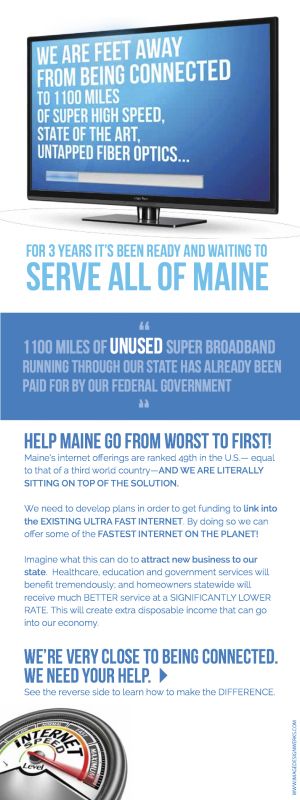
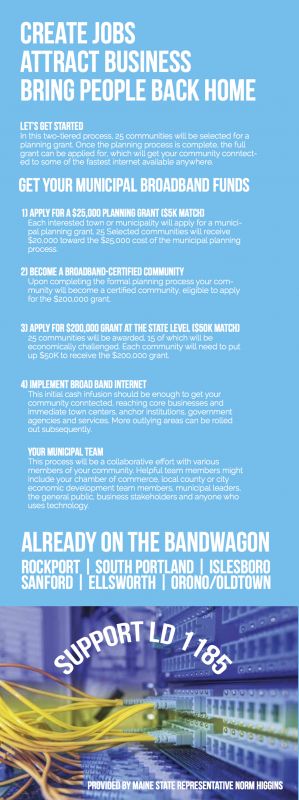
Graphic: LD 1185 Proposes Planning Grants for Munis in Maine

In late April, LD 1185 and several other broadband bills came before the Maine House Energy, Utilities, and Technology Committee. We have seen a flurry of activity in Maine this year as local communities deploy networks, develop plans, or begin feasibility studies. Likewise, the state legislature has been active as House and Senate members try to defibrillate the barely beating heart of the state listed as 49th for broadband availability.

The national providers in Maine - Time Warner Cable and FairPoint have little interest or capacity to invest in high quality services in Maine. Time Warner Cable is more focused on major metros and being acquired. FairPoint is laying off workers and also, positioning itself to be acquired. Fortunately, these big companies aren't the only option for improving Internet connectivity in Maine.

LD 1185, presented by Representative Norm Higgins, seeks to establish $6 million this year in funds for local communities that wish to deploy municipal networks. Maine already has the middle mile Three Ring Binder in place; the focus of this proposal is to help communities get the infrastructure they need to connect to it. In an effort to get the word out about the bill and grow support, Higgins and his team created this graphic explaining the proposal (a 2-page printable edition of the graphic is available for download from the link below):

LD 1185 Graphic

LD 1185 Graphic

Comcast Merger Wrap-up and Anti-Monopoly Policy - Community Broadband Bits Episode 148

In the aftermath of the Comcast/TWC merger being effectively denied by the Department of Justice and Federal Communications Commission, we thought it was a key moment to focus on antitrust/anti-monopoly policy in DC. To discuss this topic, we talk this week with Teddy Downey, Executive Editor and CEO of the Capitol Forum as well as Sally Hubbard, Capitol Forum senior correspondent and expert on antitrust. 

We start off with the basics of why the Comcast takeover of Time Warner Cable posed a problem that regulators were concerned with. From there, we talk more about the cable industry and whether other mergers will similarly alarm regulators. We end with a short discussion of what states can do to crack down on monopolies and the abuse of market power. 

Along the way, we discuss whether DC is entering a new era of antimonopoly policy or whether this merger was just uniquely troubling. We learned about Teddy and Sally from Barry Lynn at the New America Foundation, who we had previously interviewed for one of my favorite shows, episode 83

This show is 24 minutes long and can be played on this page or via Apple Podcasts or the tool of your choice using this feed.

Transcript below.

We want your feedback and suggestions for the show-please e-mail us or leave a comment below.

Listen to other episodes here or view all episodes in our index. See other podcasts from the Institute for Local Self-Reliance here.

Thanks to Persson for the music, licensed using Creative Commons. The song is "Blues walk."

Our Totally Not Ironic Letter of Support for the Comcast/TWC Merger

Last week, the New York Times reported that the “outpouring of thoughtful and positive comments” Comcast has received for their Time Warner Cable proposed merger is much more than it’s cracked up to be. We are shocked, shocked, to learn that organizations receiving a lot of Comcast charity are endorsing its merger plans.

After a hasty staff meeting, we decided that for a mere $250,000 we too, could see the benefits of this monopolistic mega-merger. We know they ghostwrite many of their most favorable letters, but we want to save them the trouble, by providing our own glowing endorsement. 

Dear Chairman Wheeler,

After careful consideration,  we wish to share our strong support for the Comcast/Time Warner Cable merger. Firstly, we want to make absolutely clear that our endorsement of this union has absolutely nothing to do with $250,000 generously donated to our organization, no strings attached, by Comcast. After years critiquing  their slack customer service, their perennially rising prices, and their lobbying to prevent real competition, we now think a merger between the two most hated companies in America is a way awesome idea!

We support the company’s efforts to announce gigabit speeds while charging high enough prices to ensure no one calls their bluff. We hope that the merger doesn’t distract Comcast from its efforts in Philadelphia to never pay municipal property taxes or to ensure low wage workers have no sick days in the City of Brotherly Love. 

Comcast Ghostwrites Letters From Elected Officials to FCC

It is common knowledge that Comcast and a number of political leaders enjoy special relationships. Nevertheless, it was still a bit shocking to see the level at which Comcast's army has infiltrated the political process as uncovered in a recent Verge article.

Comcast, Time Warner Cable, AT&T, and CenturyLink lawyers and lobbyists often write legislation for lawmakers to introduce. This past summer, the puppetry went one step further when Comcast crafted letters supporting the Comcast/Time Warner Cable merger. Those letters were then submitted to the FCC from the offices of a number of politicians known to receive support from the cable giant. We applaud both Comcast and their pet lawmakers for their efficiency!

The Verge was also able to obtain email threads that document how lobbyists drafted letters of support and sent them on to local elected officials, who then made insignificant changes in the signature line or transferred the exact language on to official stationery before sending it on to the FCC.

We have taken the liberty of presenting some of the letters below. You can see a few email exchanges that detail the conversation between Comcast lobbyists and political staff.

The Verge spoke with Michal Copps, former FCC Chairman, who now advises at Common Cause:

"When a mayor of a town or a town councilman or a legislator writes in — we look at that, and if someone is of a mind already to approve something like this they might say: ‘ah-ha, see!’" says Copps, who is now an advisor at Common Cause and opposes the merger. "These letters can be consequential, there’s no question about that."

The comment process has been tainted because Comcast has also used gentle nudging to obtain support from organizations benefitting from its charitable foundation. Columbia Professor Tim Wu has studied the potential merger:

"I think they have failed to meet their burden of persuasion that this will make life better for the average American consumer…What does the average American consumer care about? They care about prices being too high. Comcast could have said this merger will lower prices and committed itself to lower prices but it has made no sign that it will do this." 

Cities in Kentucky and Massachusetts Want a Say In Comcast/Time Warner Cable Merger

As the feds continue to evaluate the wisdom of the Comcast/Time Warner Cable merger, local communities in several states are attempting to throw a wrench in the federal approval machine.

In Worcester, Massachusetts, the City Council recently refused to approve the transfer of the city's cable television license to Comcast. In order to sweet-talk the federal agencies concerned the merger may create too much market concentration, Comcast has worked out a deal with Charter Communications to transfer customers in certain geographic areas. Charter is the current incumbent in Worcester. 

According to a Telegam & Gazette article, the City Council does not need to approve the transfer for it to take affect. Nevertheless, the City Council voted 8-3 on October 14 to urge City Manager, Edward M. Augustus Jr., not to approve the transfer of the license. If Augustus makes no determination, the transfer will automatically be approved.

The city can only examine the transfer based on four criteria including company management, technical experience, legal experience, and financial capabilities. Management and poor customer service are the sticking points for Worcester:

District 5 Councilor Gary Rosen said the City Council should not welcome Comcast to Worcester because of its "deplorable and substandard" customer service across the country. 

"It's a terrible company," he said. "In my opinion, they should not be welcome in this city. Comcast is a wolf in wolf's clothing; it's that bad. They are awful, no doubt about it. Maybe we can't stop it, but that doesn't mean we shouldn't speak out." 

A similar scenario is playing out in Lexington, Kentucky. The community is the second largest city served by Time Warner Cable in the state. They are concerned existing customer service problems will worsen if Comcast becomes their provider.

The Urban City Council drafted two resolutions denying the transfer. The resolutions had first reading on October 9. Customer service is, again, a point of contention.