
California

Content tagged with "California"

Displaying 21 - 30 of 266

Who Benefits from this Bargain? | Episode 118 of the Connect This! Show

Connect This! Show

Catch the latest episode of the Connect This! Show, with co-hosts Christopher Mitchell (ILSR) and Travis Carter (USI Fiber) joined by regular guests Kim McKinley (TAK Broadband) and Doug Dawson (CCG Consulting) and special guest Heather Mills (Tilson) to talk about the FCC giving out participation trophies to the monopoly providers, how state offices are responding to the BEAD guidance changes, disaster response and resilient Internet networks, and more. The full list of topics includes:

Join us live on July 24th at 2pm ET, or listen afterwards wherever you get your podcasts.

Email us at broadband@communitynets.org with feedback and ideas for the show.

Subscribe to the show using this feed or find it on the Connect This! page, and watch on LinkedIn, on YouTube Live, on Facebook live, or below.

California’s Affordable Broadband Bill At Risk Of Being Destroyed By Lobbying

California lawmakers’ efforts to pass a new law mandating affordable broadband access is at risk of being destroyed by industry lobbying. California insiders say the changes are so dramatic they may wind up making broadband affordability in the state worse – undermining years of digital equity activism and discarding a rare opportunity to bridge the digital divide.

The California Affordable Home Internet Act (AB 353), introduced by Assemblymember Tasha Boerner last January, would require that broadband providers in the state provide broadband at no more than $15 per month for low-income households participating in a qualified public assistance program.

The original legislation mandated that state residents should be able to receive $15 for all ISPs for broadband at speeds of 100 megabit per second (Mbps) downstream, 20 Mbps upstream. The proposal mirrored similar efforts by New York State which opened the door to other state efforts after the Supreme Court recently refused to hear a telecom industry challenge.

Image
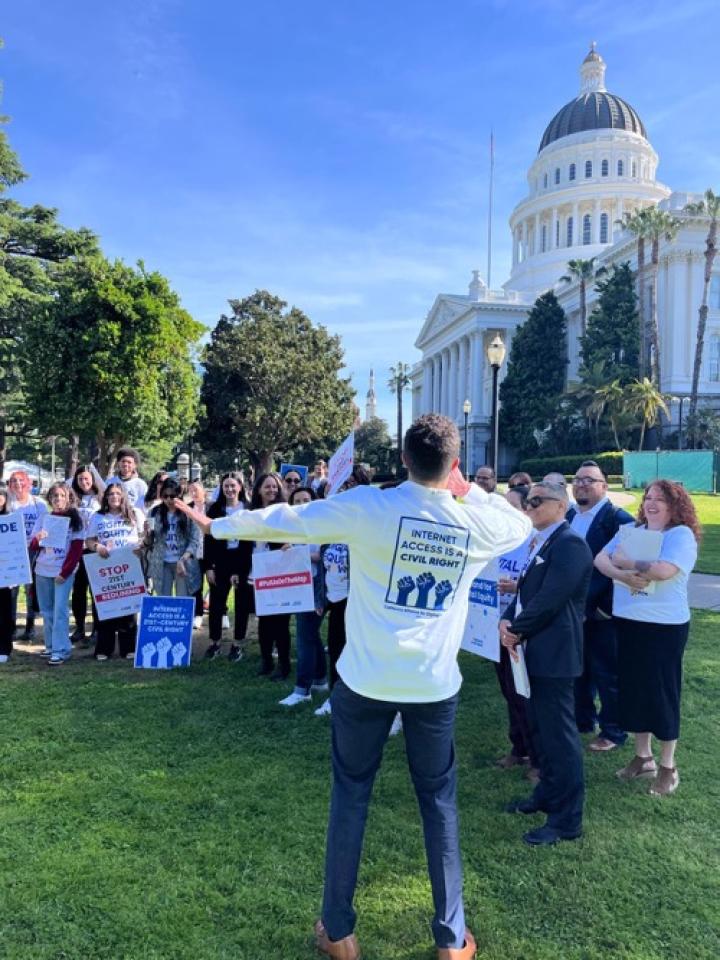
Several dozen digital equity advocates hold a rally on the lawn of the California statehouse

“I want to get something fair and reasonable that helps those who need it most,” Boerner said in a press release. “AB 353 will fill the gap and ensure our children can turn in their homework, families can get access to telehealth, and apply for jobs online.”

On June 4 a vote moved the legislation through the state Assembly and on to the state senate by a 52-17 margin.

The Future of Active Ethernet | Episode 117 of the Connect This! Show

Connect This! Show

Catch the latest episode of the Connect This! Show, with co-hosts Christopher Mitchell (ILSR) and Travis Carter (USI Fiber) joined by regular guests Kim McKinley (TAK Broadband) and Doug Dawson (CCG Consulting) and special guest Roger Timmerman (UTOPIA Fiber) to talk about right-of-way fees, electric cooperatives, and the future of active Ethernet networks in the United States.

Join us live on July 3rd at 2pm ET, or listen afterwards wherever you get your podcasts.

Email us at broadband@communitynets.org with feedback and ideas for the show.

Subscribe to the show using this feed or find it on the Connect This! page, and watch on LinkedIn, on YouTube Live, on Facebook live, or below.

California's Affordable Broadband Play and Wi-Fi Under Threat | Episode 116 of the Connect This! Show

Connect This! Show

Catch the latest episode of the Connect This! Show, with co-hosts Christopher Mitchell (ILSR) and Travis Carter (USI Fiber) joined by regular guests Kim McKinley (TAK Broadband), Doug Dawson (CCG Consulting) and special guest Shayna Englin (California Community Foundation) to talk about all the recent broadband news that's fit to print. Topics include:

Join us live on June 20th at 2pm ET, or listen afterwards wherever you get your podcasts.

Email us at broadband@communitynets.org with feedback and ideas for the show.

Subscribe to the show using this feed or find it on the Connect This! page, and watch on LinkedIn, on YouTube Live, on Facebook live, or below.

Oakland Unveils Ambitious Plan to Build City-Owned Open Access Network

Just 40 miles north of the heart of Silicon Valley, the City of Oakland has its sights set on implementing an ambitious Broadband Master Plan.

Dubbed the OaklandConnect project – unanimously approved on May 20 by the Oakland City Council – the plan calls for the construction of a city-owned open access fiber network to expand affordable broadband connectivity to over 33,000 households that city surveys indicate are languishing without home Internet service.

While Oakland is served by Comcast and AT&T mostly (with a smattering of Sonic and T-Mobile hotspots), the service in many areas is substandard, expensive, or both – in a city where surveys indicate affordability as the primary reason so many do not have home Internet service.

Image
Oakland fiber map

Once the East Bay city of 436,000 completes network construction, it would be one of the largest publicly-owned open access networks serving a major metro area in the nation – and may serve as inspiration for other large cities to follow suit with a model that’s been proven to bring affordable local Internet choice in monopoly-dominated markets.  

Crews Begin Work On Ft. Bragg, California’s Long-Awaited Muni-Fiber Network

Construction crews have begun work on Fort Bragg’s long-awaited municipal fiber network, which will ultimately bring affordable fiber to the California city of 7,000.

The total cost of the project is estimated to be $17 million. Of that, $10 million will be paid for by a Last Mile Federal Funding Account (FFA) grant from the California Public Utilities Commission (CPUC), awarded in February to help fund the construction of a Middle Mile Broadband Network (MMBN) that will run directly through the heart of Ft. Bragg.

The remaining project costs will be paid for by a $7 million, 20-year loan at 4.85 percent from EverBank, recently approved by the Fort Bragg city council.

“This project is a cornerstone for the future of Fort Bragg,” City Manager Isaac Whippy said of the milestone. “Reliable, high-speed internet is no longer a luxury – it’s a necessity. With this investment, we’re closing the digital divide and making Fort Bragg a more connected, competitive, and inclusive community.”

According to a city announcement, Ft. Bragg’s citywide fiber network, 170 miles north of San Francisco, is being designed with a centralized data hub and 15 Distribution Areas (DAs). Using horizontal directional drilling, crews will install conduit and fiber underground – primarily beneath sidewalks and alleys – connecting to a fiber terminal located near the edge of the city’s right-of-way at each property.

New Resource: Community Networks in California’s Federal Funding Account Broadband Grant Program

When California announced in 2021 that it would open a last-mile broadband grant program seeded with $2 billion, it was something of a watershed moment.

The Last-Mile Federal Funding Account (FFA) broadband program,* as it was called, instantly became one of the largest state-administered broadband grant programs ever. Along with other broadband programs overseen by the California Public Utilities Commission (CPUC), the FFA program sought to significantly close the digital divide by ensuring that at least 98 percent of households had broadband access.

Municipalities, cooperatives, Tribal entities and community-based nonprofit networks seized this opportunity to take charge of their digital futures, submitting nearly one hundred applications in more than 40 counties across the state.

As grant announcements began rolling out in June of 2024, the Institute for Local Self-Reliance (ILSR) began tracking where that money was going and, specifically, the kinds of applicants that were successful in the program. What emerged was indisputable: California’s Federal Funding Account broadband program was an unprecedented success for community networks.

At communitynetworks.org, we have published numerous stories highlighting innovative and successful applications, including projects by Plumas-Sierra Telecommunications, the City of Huntington Park, the City of Oakland, Cold Springs Rancheria, and the City of Indio.

Today we are releasing a new two-part dashboard based on the CPUC’s data that helps visualize the success of community-based projects in this transformative state program. (The CPUC also has a very helpful interactive dashboard with more detail on each project, but it does not share our focus on community networks). Hover on each visualization within this dashboard for additional detail.

Massachusetts Lawmakers Hold Hearing Today on Affordable Broadband Bill

Legislation that would require ISPs operating in Massachusetts to offer qualifying low-income households high-speed Internet service for $15 per month is set to have its first legislative hearing.

The hearing is slated to run from 11 am to 1 pm ET today before the Massachusetts Legislature’s Joint Committee on Telecommunications, Utilities, and Energy. Committee members will hear testimony on multiple bills, including two companion pieces of legislation known as An Act Preserving Broadband Service for Low-income Consumers – S.2318 (filed by State Sen. Pavel Payano) and H.3527 (filed by State Rep. Rita Mendes).

The proceedings can be viewed here.

Inspired by New York Law

The hearing in Massachusetts comes as similar legislation is being considered by state lawmakers in Vermont and California – all three of which are modeled on New York’s Affordable Broadband Act which, after numerous legal challenges, went into effect in the Empire State in January of this year after the US Supreme Court declined to intervene and overturn a U.S. Appellate Court ruling that upheld the law.

Like the New York law, the bill being proposed in Massachusetts requires ISPs operating in Massachusetts to offer qualifying low-income households high-speed Internet service for $15 per month.

However, the Massachusetts bill set the minimum speed at 100 Megabits per second (Mbps) download to mirror the increased FCC definition for minimum broadband speeds that had been raised from the previous benchmark of 25/3 Mbps, which was the federal standard when the New York law was written.

Comcast Poised To Acquire San Bruno, California’s Municipal Fiber Network

Comcast says it’s acquiring San Bruno, California’s CityNet, a municipally owned and operated broadband, video and voice network that currently serves over 5,400 residents and businesses.

San Bruno’s $8 million sale to Comcast was prompted by $21.5 million in debt and what the city says was surging operating costs. Unlike many municipal broadband providers, San Bruno also provided television services, which many smaller providers and communities are moving away from due to soaring programming costs and dwindling and unsustainable profit margins.

“Rates simply were not keeping pace with costs,” Bruno city manager Alex McIntyre wrote in a January report to the City Council. “CityNet has grown increasingly technologically obsolete over the past decade.”

Despite increasing service rates between 9 and 12 percent, the city says it saw operating losses of  $794,852 in 2023 and $859,995 in 2022.

Originally founded in 1972 as San Bruno Cable TV, the pioneering cable broadband operator (with some scattered fiber development) struggled with modernizing its coaxial network to fiber, something city leaders refused to fund.

“A significant City-funded capital investment would be required to bring CityNet’s technology and operations up to current industry standard, as well as rate adjustments,” McIntyre wrote. “The Council declined to authorize this capital request in April 2023.”

Carson, California Breaks Ground On New Municipal Fiber Network

Leveraging years of regional fiber collaboration, Carson, California has broken ground on a municipal broadband pilot network city officials hope will someday be expanded to bring affordable fiber optic broadband to the entire city of 95,558, situated just 13 miles south of downtown Los Angeles.

Carson is looking to leverage $8 million in federal and state grant money to connect 1,000 unserved households and 372 businesses, with City Hall, the Civic Center and Cal State Dominguez Hills serving as anchor institutions for the new network. A new city announcement says construction has begun, with the pilot construction phase to be completed in 18 months.

“This visionary project is set to transform Carson into a cutting-edge digital hub, revolutionizing broadband access for residents, businesses, and city services,” the city said in a statement announcing the groundbreaking.  

The new network deployment comes as the Los Angeles area prepares to host the 2026 FIFA World Cup, and is being built on the back of previous collaborative fiber deployments amid the state of California’s landmark effort to boost statewide broadband competition.

Image
Street rail overpass in Carson with the city name spelled out on side of overpass by spraypaint

“This project represents a major milestone for Carson,” Carson Mayor Lula Davis-Holmes said of the new deployment. “By investing in our own fiber network, we are creating a foundation for enhanced connectivity, economic growth, and future smart city initiatives. This is just the beginning of a transformative journey for our community.”