
anchor institutions

Content tagged with "anchor institutions"

Displaying 11 - 20 of 142

Weaving a Fiber Net Through Oregon’s Silicon Forest: Hillsboro’s Municipal Network Goes Live

HiLight — Hillsboro, Oregon’s (pop. 105,000) citywide Fiber-to-the-Home (FTTH) network — has officially launched and begun connecting its first subscribers. After five years of consideration and planning, it’s an exciting moment, with hundreds of homes and businesses brought online over the last few months. Over the next seven years, at least $28 million will be put towards the rollout, bringing the municipal network to tens of thousands of locations across the city.

Hillsboro sits just outside of Portland, and has been looking for better connectivity options for years. A large proportion of its population is comprised of tech workers and residents with advanced degrees; the city, in fact, anchors the state’s Silicon Forest, so named for the group of technology firms employing tens of thousands of workers across three Intel campuses as well as operations by Oracle, Salesforce, Epson, and Synopsis. A citywide fiber network serves to provide competition and capacity to keep them in the area:

Hillsboro is the tallest tree in the Silicon Forest and the center of Oregon’s high-tech cluster. With an affordable high-speed network, Hillsboro’s homegrown talent — our students and entrepreneurs — will be better positioned to lead the world in innovating for the future. Hillsboro will continue to attract and retain talent and be a hub for innovation.

But Hillsboro also faces a stark digital divide fueled by economic inequality, and bridging it has been one of the city council’s (and now the network’s) main agenda items. This has driven the project’s second focus: bringing affordable, high-quality access to economically vulnerable residents stuck with no quality options today. It’s why the city has introduced one of the fastest low-cost access program we’ve seen established by any broadband network in the United States, with qualifying families getting access to symmetrical gigabit service for $10/month.

Putting Glass in the Ground
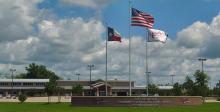
Digging IT in Dayton, Texas

DayNet, a new Internet utility emerging in Dayton, Texas, is looking to lasso a broadband-minded boss for this small East Texas city of approximately 7,200, about 37 miles east of Houston.

Applications are being accepted for a Broadband Manager/Head Network Engineer to oversee the business and technical operations of DayNet as the city has begun construction of a citywide Fiber-to-the-Home (FTTH) network.

In addition to hiring a Broadband Manager/Head Network engineer, the city is banking on the project to “increase competition and choice . . . while having a positive impact on economic development, education, and the technology amenities that are available to citizens and businesses.”

Good Credit, Better Broadband

To finance the construction, the Dayton City Council approved a $13.7 million bond issuance at a 2.56% interest rate, thanks to the city’s rising credit rating. Network construction began at the start of the year. And when the network is fully built, which is expected to be complete by 2023, 110 miles of fiber will criss-cross the city’s 11 square miles, passing every home, business, and anchor institution in Dayton.

Big Bucks for Broadband in the Balance: Explaining the Affordable, Accessible Internet for All Act - Part 4

If you have been following our series on the Accessible, Affordable Internet for All (AAIA) Act, you already know the proposed legislation calls for a $100 billion investment in expanding broadband access and affordability in unserved and underserved parts of the country. In this fourth installment of the series, we explore the part of the bill that contains the bulk of the funding. Of the $100 billion proposed in the bill, $85 billion of it can be found in the Title III - Broadband Access section.

Amending the Communications Act of 1934, Section 3101 of the bill appropriates $80 billion for “competitive bidding systems” to subsidize broadband infrastructure. That is to say, it requires the Federal Communications Commission (FCC), and states, to use “competitive bidding systems” for Internet Service Providers (ISPs) to bid on broadband deployment projects in “areas with service below 25/25 Megabits per second (Mbps), and areas with low-tier service, defined as areas with service between 25/25 and 100/100 Mbps.” The term “competitive bidding” seems to suggest a reverse auction process, though it hardly makes sense for each state to set up such a system given the logistical challenges. A legislative staffer responded to our email earlier this year saying he believed that language would allow for state programs that solicited applications from ISPs and scored them for evaluation, much like Minnesota’s Border-to-Border Broadband program operates. However, he noted that the FCC would interpret that language ultimately. More on this below. 

Prioritizing Higher Upload Speeds

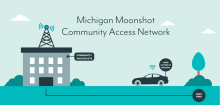
Launch of Michigan Moonshot Community Access Network Brings Wi-Fi to Critically Unserved Areas

A new project borne out out of the Michigan Moonshot Initiative promises to help thousands of families and students without home Internet access get online. Led by the Merit Network, a coalition of partners (including Toyota, Cisco, the Detroit Public Library, the Washtenaw County Broadband Task Force, and county school districts) is installing Wi-Fi hardware at 50 sites around the southeastern part of the state to bring broadband access to thousands. Nine locations are up and running, with more soon to follow. 

The effort is taking place in the cities of Detroit, Inkster, Flint, as well as Washtenaw County. Toyota and Cisco are providing funds and hardware, and the project takes advantage of the Merit Network’s extensive fiber backbone running throughout the state (4,000 miles in total). Wayne State University is also participating, and inviting students and faculty and staff to participate in a broadband survey. Funds are being dispersed in the form of grants which will go to community organizations to boost existing Wi-Fi networks at schools and other anchor institutions across participating areas.

Kansas Announces New Ten-Year, $85-million Broadband Grant Program

The state of Kansas continues to build momentum with the announcement of a new, ten-year broadband grant program designed to drive network expansion in unserved and economically depressed areas. It will go towards connecting tens of thousands of residents in the state who currently have no or few options for Internet access, while bringing commercial development and connecting farms desperately in need. 

The Good

Currently, 3.5% of the state’s population, totaling almost 100,000 people, have no Internet access options at all. Students sent home at the beginning of the Covid-19 pandemic have struggled all summer and fall to get online to do coursework. Both urban and rural areas have continued to face significant challenges over the last decade, and the problem has only increased in recent months. It’s also an issue that has had ramifications for employers like Citizens State Bank in Cottonwood Falls, which has considered cutting local positions and shifting them to places with better Internet access options.

The new Broadband Acceleration Grant Program (BAGP) [pdf] offers lots of provisions for positive progress. It prioritizes low-income, economically distressed areas, as well as those without access to speeds of at least 25/3 Mbps (Megabits per second). This likely means much of the money will end up in the southeastern and southwestern parts of the state (see map). The grant also urges applicants to engage local stakeholders in their communities and build relationships with community anchor institutions, businesses, and nonprofits so as to maximize impact.

Kansas Sees Boost with Establishment of Broadband Office and Tens of Millions in Grants

Tens of thousands of homes, businesses, farms, schools, and community anchor institutions in the Sunflower State will see better connectivity options over the next few years. A recent executive order [pdf] establishing a Kansas Office of Broadband Development followed by the announcement of more than $49 million in grants to 67 projects around the state means a host of Fiber-to-the-Home (FTTH), fixed wireless, and institutional networks will break ground in the near future. The measure comes in response to the ongoing Covid-19 pandemic.

A Broadband Office and Grant Program

The new Office of Broadband Development has been placed in the state’s Department of Commerce, and given the task of promoting networks of all kinds — municipal, cooperative, private, and nonprofit — as well as supporting regional initiatives, developing a better broadband map, and removing policy barriers to fast deployment. 

The state actually has two grant programs ongoing at the moment as part of the connectivity program approved the state’s Strengthening People and Revitalizing Kansas (SPARK) Taskforce and the State Finance Council. The Broadband Partnership Adoption Grants (BPAG) are designed to help low-income Kansans pay for service with existing plans. The large pot of grant money just announced, on the other hand, is part of the Define Connectivity Emergency Response Grant (CERG), which will use CARES funding to facilitate new builds between now and the end of the year.

California South Bay Cities Finish Fiber Network, Look to Smart Traffic Applications

A group of 15 cities in Los Angeles County, California, are closing in on the completion of the South Bay Fiber Network. The project, managed by the South Bay Cities Council of Governments (SBCCOG), will bring better connectivity to community anchors and enterprise customers in the region through a public-private partnership with American Dark Fiber (ADF).

According to a recent press release [pdf] from SBCCOG, some public facilities are already connected to the fiber ring, and the partners expect to finish the rest of the network by the end of the month. Once completed, the local governments hope that the SBFN will enable smart city applications, like traffic signal coordination, as well as telehealth services and remote learning and working.

Christian Horvath, Redondo Beach Councilmember, said in the press release:

The SBFN will allow us to serve all our residents better and improve their quality of life on so many levels including real-time transportation/traffic control connectivity . . . The Covid-19 pandemic has proven to any doubters that access to affordable and reliable high-speed Internet is even more important as it will allow the increasing numbers of city workers and local residents to efficiently work from home.

Public-Private Partnership

SBCCOG began its efforts in 2016 and has been working with consulting firm Magellan Advisors to plan the fiber network, which will be a mix of newly constructed infrastructure and leased fiber.

The SBFN will connect the cities of Carson, El Segundo, Gardena, Hawthorne, Hermosa Beach, Inglewood, Lawndale, Lomita, Manhattan Beach, Palos Verdes Estates, Rancho Palos Verdes, Redondo Beach, Rolling Hills, Rolling Hills Estates, and Torrance in Los Angeles County. Local institutions and government authorities are also participating in the fiber project, including the Beach Cities Health District, Los Angeles County Metropolitan Transportation Authority (LA Metro), Los Angeles County Department of Public Works, Lundquist Institute, South Bay Workforce Investment Board, and West Basin Municipal Water District.

Project THOR Public-Private Partnership Hammers Out Path to Better Connectivity in Colorado

There’s a new Thor in town, but instead of lighting up the night sky like the Norse god of thunder, it’ll be lighting up communities in rural Colorado with fiber optic connectivity.

A group of local governments and private partners, led by Northwest Colorado Council of Governments (NWCCOG), recently completed the first phase of Project THOR, a middle mile fiber network that will enable better connectivity in the participating towns, cities, and counties. The network, owned by NWCCOG, provides backhaul to local governments looking to connect public facilities, schools, hospitals, and other community anchor institutions. It’s also available to Internet service providers (ISPs) to serve residents and businesses.

Project THOR brings much needed redundancy to the region’s broadband infrastructure, where previously a single fiber cut could take entire communities’ health and public safety services offline. It also promises great cost savings for localities and ISPs. Perhaps most importantly, the new network gives communities the necessary leverage to improve local connectivity beyond begging the incumbent providers for better broadband. Jon Stavney, executive director of NWCCOG explained on Community Broadband Bits episode 406:

This project allows these local governments to actually have a lever to pull to hopefully affect local service, however they can do that, with whatever partners come to the table . . . They’re able to actually act.

Building Toward a Network

NWCCOG, which is composed of member governments in and around Eagle, Grand, Jackson, Pitkin, and Summit Counties, coordinated broadband efforts in the region even before Project THOR began. A number of years ago, the council invested in a regional plan and hired a broadband coordinator, Nate Walowitz, to offer technical assistance to the member governments.

Heroic Partners Bring Middle Mile Fiber to Northwest Colorado With Project THOR - Community Broadband Bits Episode 406

The breathtaking mountains of northwest Colorado have long attracted skiers and hikers, but broadband providers haven't found the region's rugged landscape and sparse population as appealing. Enter Project THOR, a middle mile fiber network developed out of a collaboration among local governments and private companies led by the Northwest Colorado Council of Goverments (NWCCOG). Over the last few years, the partners strung together more than 400 miles of fiber to provide reliable and affordable backhaul to municipal facilities, public schools, healthcare systems, and Internet access providers.

This week on the Community Broadband Bits podcast, Christopher talks with Jon Stavney, executive director of NWCCOG, and Evan Biagi, executive vice president of business development for network operator Mammoth Networks, to learn more about the recently completed project. Jon describes past broadband efforts in the region that led into Project THOR. The pair explain how the new middle mile network will allow localities to connect municipal facilities and anchor instutions and how broadband providers or the communities themselves can build off the network to serve residents and businesses. This will improve broadband reliability and affordability in the region, which had previously been plagued by network outages that cut access for hospitals and 911 calls.

Jon and Evan also discuss how the partners lowered project costs by leveraging existing infrastructure. They share some of the challenges involved in designing a network with so many partners. At the end, Jon explains how Project THOR will give communities more opportunities to take action on local connectivity instead of just impatiently waiting for better broadband.

This show is 33 minutes long and can be played on this page or via Apple Podcasts or the tool of your choice using this feed

Transcript below. 

We want your feedback and suggestions for the show-please e-mail us or leave a comment below.

Listen to other episodes here or view all episodes in our index. See other podcasts from the Institute for Local Self-Reliance here.

Thanks to Arne Huseby for the music. The song is Warm Duck Shuffle and is licensed under a Creative Commons Attribution (3.0) license.

Broadband for America’s Future: A Vision for the 2020s

Image

The Benton Institute for Broadband & Society has a reputation for looking at today’s reality with an eye toward tomorrow’s needs. In their report, Broadband for America’s Future: A Vision for the 2020s, Benton Senior Fellow Johnathan Sallet continues that perspective and offers insightful recommendations for a new National Broadband Agenda.

Download the report, Broadband for America’s Future: A Vision for the 2020s here.

Broadband for All Needs a New Approach

As access to high-quality connectivity becomes more critical each day, those without fast, affordable, reliable Internet access lose ground more quickly as time passes. In addition to the opportunities that come with broadband access, lack of adoption translates into lack of technical skills. Innovation isn’t slowing down for folks who don’t have broadband. 

As Sallet notes, access to and adoption of broadband improves our economy, strengthens communities, and empowers American workers. Obtaining that access and expanding that adoption, however, is proving more challenging than it should be.

In his report, the author reviews in detail the barriers that have prevented the U.S. from achieving its goal of ubiquitous access and adoption of broadband. He’s able to make recommendations based on four key policy areas:

Deployment of networks where adequate broadband does not exist;

Competition to increase choices and spur lower prices and better-quality service to their residents;

Affordability and Adoption for those who wish to have broadband in their homes but lack the means or the skills to acquire it; and

Community Anchor Institutions, such as schools and libraries, that increasingly serve their users wherever they are. 

"The Same Fabric of Truth-Seeking"