
affordability

Content tagged with "affordability"

Related Topics
Displaying 121 - 130 of 285

New York Announces $70 Million For Municipal Broadband Projects

As states gear up to administer federal BEAD funds from the bipartisan infrastructure law, a handful of states are already making significant investments in municipal broadband using federal Rescue Plan dollars.

California, Maine, Vermont, and New York have each established grant programs that center municipal broadband projects (mostly fiber builds) – with New York being the most recent state to announce more than $70 million in grant awards through its ConnectALL Municipal Infrastructure Grant Program (MIP).

Courtesy of the U.S. Treasury’s Capital Projects Fund, the awards are part of a $228 million initiative to bring high-quality Internet connectivity and consumer-friendly choice to New York communities long-stranded on the wrong side of the digital divide.

New $8.9 Million State Grant Boosts Dryden, NY Muni Fiber Network Build and Expansion Into Neighboring Caroline NY

The towns of Dryden and Caroline, New York have been awarded a new $8.9 million broadband grant courtesy of the New York State ConnectALL program. The award will help deliver affordable fiber capable of symmetrical speeds up to 10 gigabits per second (Gbps) to residents of both towns, which until now, had been trapped on the wrong side of the digital divide.

Launched two years ago, Dryden officials have told ISLR they’re making steady inroads on municipally-owned fiber deployment to the town of 14,500. Now they’re looking to expand the popular local broadband network further into the town of nearby Caroline.

According to an announcement by Dryden Fiber, this latest grant award will help fund the construction of over 125 miles of new fiber to reach 2,650 new residences in Dryden and Caroline. The first customers in Caroline are expected to be online sometime within the next twelve months.

Image
Dryden fiber groundbreaking

“I find a real partnership between the Town of Dryden, Town of Caroline, and the New York State ConnectALL Office,” Dryden Fiber Executive Director, David Makar says of the award. “Years of hard work and seed planting from elected officials, citizen volunteers, and private partner businesses are now showing up ready to provide top-tier quality broadband service for the residents of Dryden and Caroline.”  

$25 Million Lamoille County, Vermont Fiber Build Gets Underway

Last October, Vermont CUD (Communications Utility District) Lamoille FiberNet greenlit a $25 million public partnership with Consolidated Communications. The goal: to finally bring affordable fiber broadband access to 4,170 locals in Lamoille County. Eight months later and locals say network construction is finally getting underway.

According to the Lamoille County News And Citizen, Consolidated trucks have started to appear in towns like Stowe, Johnson, Eden, Cambridge, Belvidere and Waterville as Phase 1 of the network build gets underway.

Consolidated crews plan to deploy more than 400 miles of fiber this summer, providing locals with speeds up to 10 gigabits per second (Gbps).

Image
Lamoille CUD map

“It’s been a Herculean effort for more than three years, so we’re all very excited to see the trucks rolling this summer,” Lamoille FiberNet Executive Director Lisa Birmingham told the outlet.

Ting Brings Competition, Fiber Service and Microtrenching to Centennial, Colorado

The City of Centennial, Colorado is making steady inroads bringing affordable fiber Internet service to the city of 106,000, leveraging its city-owned fiber backbone and a partnership with the Charlottesville, VA.-based fiber provider Ting.

Just south of Denver – in a city known for its high-tech industry, craft breweries, and family-friendly neighborhoods – voter-approved efforts to get out from under the thumb of regional monopolies has driven a surge of competition, most recently exemplified by Ting’s continued delivery of affordable gigabit fiber.

Ting Public Affairs manager Deb Walker told ISLR that while the company couldn’t break out specific details on the number of passed fiber locations in the Centennial market, they’re making inroads on fiber deployments across Colorado.

“Now that Ting has city-wide networks built or under construction in three markets in the Denver region (Centennial, Greenwood Village and Thornton), and they share certain operational resources, we report progress on those markets together in our quarterly Ting Build Scorecard,” Walker said.

Image
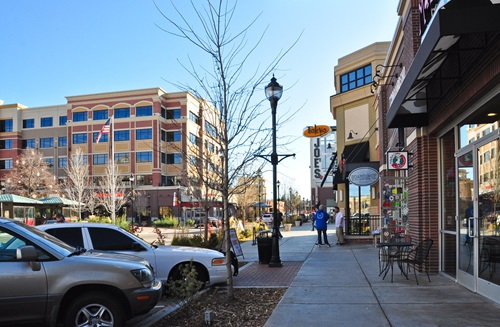
Streets at SouthGlenn in Centennial Co

“At the end of the first quarter of 2024, we had almost 31,000 serviceable addresses in the region, mostly in Centennial as we’re just starting the other two markets,” she added.

In 2021 Ting also unveiled the construction of a new 16,000 square foot office complex and data center, Walker said. Ting is also collaborating with Colorado Springs Utilities, which is building a fiber network throughout the city and connecting local homes and businesses.

Massachusetts’ Gap Networks Program Awards Verizon $37 million; One Muni Network Gets $750K

State broadband officials in Massachusetts have announced over $45 million in grant awards from the state’s Broadband Infrastructure Gap Networks Program with the lion’s share going to Verizon to “expand high-speed broadband [I]nternet infrastructure to underserved homes, business, and community anchor institutions across the state.”

State broadband officials say the $45.4 million in grant awards will be coupled with $40 million in matching funds from the awardees to expand broadband access to approximately 2,000 locations in 41 Massachusetts communities.

In 2022, as we previously reported here, Massachusetts was allocated a total of $145 million in federal Rescue Plan dollars to fund the Bay State program. With the state’s first round of funding from the Gap Networks Program awarding $45 million to four applicants, about $100 million is left in the pot for future funding rounds. Massachusetts has yet to receive its $147 million share of federal BEAD funds from the bipartisan infrastructure law, the spending rules for which are much more stringent than the more flexible CPF funding rules.

CBRS Spectrum: A Potential Boon To Community Broadband

Recent federal government efforts to expand use of public Citizens Broadband Radio Service (CBRS) spectrum could be of significant help to municipalities and local communities looking to bridge the digital divide with the increasingly popular wireless technology.

CBRS spectrum refers to 150 MHz of spectrum in the 3.5 GHz band. In 2015, the FCC adopted rules for shared commercial use of the band, creating a three-tiered structure to avoid interference with military radar during collaborative use of the spectrum.

For municipalities, the spectrum has already proven to be a valuable way to deploy wireless access to the public. In Syracuse, New York, the city last fall launched a new public wireless network on the back of CRBS. In Longmont, Colorado, the St. Vrain Valley School District used CBRS to build a private LTE network connecting 4,000 students in partnership with NextLight, which operates Longmont's city-owned municipal fiber network.

Not all community deployments of CRBS have delivered satisfactory results for municipalities, however. The STEM Alliance in Westchester County, New York retired their efforts to deploy a CBRS network in Yonkers after they struggled with urban capacity constraints and low usage.

San Francisco Wins National Award For Providing Free High Speed Internet Service To Affordable Housing Residents

As the Affordable Connectivity Program (ACP) is now bankrupt and no longer helping low-income households pay for home Internet service, the City of San Francisco is being honored with the 2024 Community Broadband Project of the Year Award by the National Association of Telecommunications Officers and Advisors (NATOA) for its Fiber to Housing (FTH) program.

Built on the back of the city’s municipally-owned fiber optic network – which since 2002 has been used to connect city and public safety facilities, hospitals, libraries and street lights – California’s fourth most populous city is well on its way to extending the city-owned network to deliver free high-speed Internet service to 30,000 affordable housing units across the city.

Image
San Francisco technicians deploying fiber across roof

The program currently serves over 14,300 affordable housing units in the city, as well as 1,500 beds at homeless shelters across 115 sites, city officials say. An additional 10,000 residential units are expected to be connected in the coming fiscal year, with the aim of serving 30,000 units by July 2025.

According to the city’s website, the program has connected 52 public housing locations across the city to “fiber-optic and Ethernet cabling in every housing unit.” An additional 63 housing locations are getting free Internet through onsite Wi-Fi with download speeds ranging from 60 to 120 Mbps (Megabits per second), which exceeds the 50 Mbps service Comcast’s Internet Essentials offers.

New York State Is Trying To Make It Easier For Municipal Broadband To Succeed

In March, Charter Communications tried (and failed) to include a poison bill in New York State’s budget bill that would have hamstrung community broadband. In stark contrast, a New York legislator this month introduced new legislation he says would make it easier than ever for New York state municipal broadband projects to thrive.

State Senator Jeremy Cooney of Rochester has introduced the Broadband Deployment Assistance Act of 2024 (S9134), which would streamline the permitting process for municipal broadband projects by "amending the general municipal law, in relation to requiring substantially similar permits for broadband deployment to be processed together at the same time and on an expedited basis."

“With a quicker timeline and more efficient process for local governments, we can create affordable options for New Yorkers that empower them to take control of their digital destiny,” Cooney wrote in an editorial published at Syracuse.com.

Image
New York State Seal

Cooney says he was motivated by a lack of broadband competition in New York State. New York is dominated by Charter Communications, which was almost kicked out of the state in 2019 for poor service and  misleading regulators about broadband deployment conditions affixed to its 2016 purchase of Time Warner Cable.

Building For Digital Equity 'Pathways To Affordability' Reprise

In case you missed it, on Monday we streamed our second Building for Digital Equity (#B4DE) event of the year. The focus this time: "Pathways To Affordable Connectivity" in the absence of the Affordable Connectivity Program (ACP).

You can watch the livestream in its entirety below.

As expected, the agenda delivered a number of gems for those working in the trenches to bridge the digital divide.

Image
GPSN

Co-hosted once again by Pamela Rosales with the National Digital Inclusion Alliance (NDIA) and Director for the Institute for Local Self Reliance (ILSR) Community Broadband Networks Initiative Christopher Mitchell, #B4DE began with a concise and candid acknowledgement of the moment: namely, the collapse of the ACP.

However, despite the challenge the loss of that program poses, #B4DE offered a lineup of digital inclusion practitioners providing a grounds-eye view of how they and their organizations are continuing the work of knocking down affordability barriers.

The three lightning round speakers covered devices and the creation of "device ecosystems." Attendees heard from Dave Sevick, Executive Director of the Pennsylvania-based Computer Reach; Ashley Martinez, Digital Equity Manager with Free Geek in Portland, OR; and Scot Henley, Executive Director of Digitunity based in North Conway, NH. Click on their names below to see their slide decks.

Houston, Missouri’s Municipal Fiber Network Revs Up City’s Economic Development Engine With Big City Connectivity

In the Show Me State – cradled in the center of the Ozarks – Houston, Missouri is the biggest small city in Texas County.

And what local officials have shown its 2,100 or so residents over the last four years is that it can build its own modern telecommunication infrastructure to help spark economic development and offer big city Internet connectivity at affordable rates.

It began with a citizen survey in 2019, asking residents if they would be interested in a municipal broadband service, given the inadequate offerings of the big incumbent providers. Since then – not only has the city built an 18-mile fiber ring for an institutional network (I-net) to connect the city’s facilities – it has built a fiber-to-the-home (FTTH) network that now covers 95 percent of the 3.6 square-mile county seat.

Image
Houston MO fiber cabinet

“The project started in 2020 and we went live in the spring of 2021,” Randon Brown, Technology Director for the City of Houston Fiber Department, tells ILSR. “Construction of the project has taken approximately four years. (Today) 95 percent of the town (network) is operational and can be serviced.”

The city has spent $3 million of its own money to fund construction of the aerial fiber network, Brown said.

The network passes 1,200 premises with 272 subscribers now getting service from Houston Fiber, “which encompasses a mixture of residential and business customers” – though that number will soon rise to 364 (30 percent take rate) in the near future as more residents and businesses are in the pipeline waiting to be connected, he added.