
open access

Content tagged with "open access"

Displaying 21 - 30 of 483

New York Announces Another $140 Million in Municipal Broadband Grants

New York’s Municipal Infrastructure Program (MIP) continues to provide grant funds to build municipal broadband networks across the state, as state broadband officials recently announced the program’s largest round of funding to date.

As we reported in June, the MIP program – specifically designed to fund municipally-owned networks as part of the Empire State’s $1 billion ConnectALL initiative – awarded $70 million to a half dozen projects earlier this summer.

Then, earlier this month, another $140 million in grant awards were announced for an additional six projects, promising to deliver “more than 1,200 miles of publicly-owned fiber optic infrastructure and wireless hubs, connecting (passing) over 60,000 homes and businesses with affordable, symmetric service – offering equal download and upload speeds at rates below regional averages.”

Image
NY ConnectALL logo

The funding will be used to expand broadband infrastructure (and seed competition) in the Central New York, Finger Lakes, Mohawk Valley, North Country, Mid-Hudson and Western New York regions.

In a prepared press statement, New York Gov. Kathy Hochul characterized the grants as “a transformative step forward in our mission to connect every New Yorker to affordable, high-speed Internet.”

Open Access ErieNet Fiber Network Gets Underway In Western New York

Erie County, New York’s ErieNet broadband initiative is poised to begin construction in Buffalo, NY, after the Buffalo Common Council recently passed a resolution approving the Telecommunications License Agreement with ErieNet LDC. The approval is a major step toward bringing affordable next-gen broadband access to long-neglected parts of Western New York.

ErieNet is a nonprofit, local development corporation (LDC), launched in September 2022, designed to construct and manage a municipal-based open-access fiber optic backbone. ECC Technologies has been chosen to handle sales, marketing, and tech support operations for the network.

“Construction has already begun for ErieNet with underground conduit installations, and utility work necessary to make utility poles ready for ErieNet fiber optic cable attachments,” ECC Technologies’ VP Matthew Crider tells ISLR. “We expect segments of our network to come online beginning in March of 2025; and have the ErieNet 400+ mile open access network substantially built by the end of 2025.”

Image
ErieNet map

“Bringing high-quality broadband to Erie County begins in the City of Buffalo, and the Common Council’s approval opens up the way to make that happen,” Erie County Executive Mark Poloncarz said in a prepared statement.

Crider told ILSR that the current construction budget for the network is approximately $34 million, funded through American Rescue Plan Act (ARPA) broadband grants.

Bell Canada’s Ziply Acquisition Raises Questions About Open Access In The Pacific Northwest

Canada’s biggest telecom giant has acquired Ziply Fiber – and a sizable swath of municipal operation agreements for open access fiber scattered across the Pacific Northwest. Bell Canada and Ziply’s joint announcement indicates that the full deal will be around $5 billion Canadian, plus an additional $2 billion in acquired debt.

The acquisition could help accelerate Ziply’s planned expansion across the Pacific Northwest, where the company’s fiber network currently passes 1.3 million locations across Montana, Idaho, Oregon, and Washington State.

At the same time, Bell Canada’s history of anti-competitive behavior could herald a culture shift at the ascending provider. Ziply and Bell Canada’s rapid-fire acquisition of smaller providers across the Pacific Northwest could also risk undermining the pro-competitive benefits of the kind of open access policies Ziply previously embraced.

Image
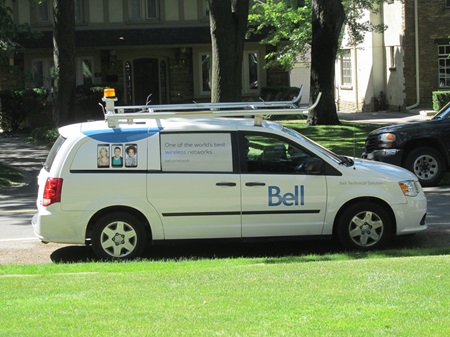
Bell Canada service vehicle

Ziply was formed when WaveDivision Capital purchased Frontier Communications’ Pacific Northwest operations in 2020. It has quickly become a major player across the four states thanks in part to numerous public private partnerships with municipalities, and a 2022 announcement of $450 million in new private sector funding.

Survey Shows Rising Broadband Costs, Broad Support For Government Help

A recent U.S. News And World Report survey of U.S. broadband subscribers shows that Americans are increasingly paying more money for broadband access.

The survey also indicates broad public support for the recently defunded Affordable Connectivity Program (ACP), and other government-backed efforts to cap soaring broadband subscription costs.

The organization surveyed 2,500 adults from the country’s five most populous states; 500 broadband subscribers each in California, Texas, Florida, New York, and Pennsylvania.

Not too surprisingly, the survey found that consumers consistently are paying more for broadband than the advertised price, either thanks to steady rate hikes, or the broad use of often sneaky, hidden fees to jack up the advertised cost of service.

Image
Monopoly Book and Money Stack

Most Americans remain trapped under a monopoly or duopoly for next-generation broadband (broadband defined as faster than 100/20 megabits per second, or Mbps) access. This lack of competition results in high prices, slow speeds, spotty access, substandard customer service, and an increased occurrence of net neutrality, privacy, or other anti-consumer violations.

The survey found the average U.S. subscriber bill at sign up is now $81 – up from the $77 average monthly price seen in the outlet’s April 2024 survey report. But the average broadband subscription cost when the bill actually arrives was now $98 per month; up from $89 just six months earlier. For most, $100 broadband access is right around the corner.

Placerville, California Strikes Gold With New Grant to Build City-Owned Open Access Fiber Network

Placerville, California will soon be a place with a municipally-owned open-access fiber network as the city of 10,000 looks to provide its residents and businesses with local choice and more affordable broadband service.

The years-long effort was launched after frustration with what the city’s 2021 Broadband Master Plan described as the “equivalent of an ISP (Comcast) Monopoly.”

“Because of this,” the plan noted, “residents and businesses in Placerville are exposed to the common limitations of monopolies” – a high-priced reality that prompted 98 percent of city survey respondents to say “yes” to a municipally-owned network.

Now, three years after that report was published – and thanks to a $20.1 million award from the California Public Utilities Commission (CPUC) Last Mile Federal Funding Account (FFA) grant program – a city that was once nicknamed “Hangtown” is now set to cut the noose of the ISP monopoly.

Southern Ute Indian Tribe ‘In The Driver’s Seat’ As Open Access Fiber Network Transforms Reservation

Among the burgeoning number of Tribal networks being built across Indian Country, a new fiber-to-the-home (FTTH) network spanning the Southern Ute Indian Reservation is unique.

When service was lit up in Ignacio, Colorado in May, the network became the only open access network owned by a Tribal government, providing its residents with a choice between two different Internet Service Providers (ISP) offering lightning-fast connection speeds.

Five years in the making, the Southern Ute network is not only the first Tribally-owned open access network, it is also among the first of the new fiber projects funded by the Tribal Broadband Connectivity Program (TBCP) to start offering services.

Image
Southern Ute Tribe Reservation map

With a strong commitment from Tribal leadership, savvy decision-making, and strategic vision, the Tribe has been able to fundamentally reshape the broadband market in its region, increasing speeds and competition while lowering prices.

Slow Speeds and High Prices Fuel Mission to ‘Bust That Monopoly’

As with many other Tribally-owned networks, the Southern Ute Indian Tribe’s broadband journey began with a recognition that the existing telecommunications infrastructure on the Reservation simply could not meet the needs of the modern moment.

Tribal Council Chairman Melvin J. Baker tells ILSR that many in Tribal leadership “realized we’ve needed it for quite some time.”

Exploring BEAD Blueprints and Tribal Broadband Initiatives - Episode 617 of the Community Broadband Bits Podcast

In this episode of the podcast, Chris is joined by colleagues Ry Marcattilio and Jessica Auer to discuss the latest developments in broadband policy. The team delves into the BEAD (Broadband Equity, Access, and Deployment) program, highlighting recent blueprints that offer insights into low-cost plan requirements for ISPs, state-driven policies, and the challenges of implementing affordable broadband solutions across diverse communities.

Jess shares her work on tribal broadband networks, providing updates on the significant progress made by Native American tribes in establishing and operating their own networks. The conversation also touches on the complexities of rate regulation, the varying approaches states have taken to low-cost plans, and the implications for rural and tribal communities.

Tune in to hear about innovative approaches, including open-access networks, and a growing focus on equitable internet access for underserved communities. 

This show is 31 minutes long and can be played on this page or via Apple Podcasts or the tool of your choice using this feed.

Transcript below.

We want your feedback and suggestions for the show-please e-mail us or leave a comment below.

Listen to other episodes or view all episodes in our index. See other podcasts from the Institute for Local Self-Reliance.

Thanks to Arne Huseby for the music. The song is Warm Duck Shuffle and is licensed under a Creative Commons Attribution (3.0) license

Oakland Secures $15 Million Grant To Bring Broadband Into Underserved Neighborhoods

After two years enmeshed in the unglamorous work of coalition-building, speed test data collection, and pushing state leaders to invest in better telecommunication infrastructure across Oakland’s most disadvantaged neighborhoods, digital equity advocates in the East Bay city are finally seeing the fruits of their labor pay off.

The city was recently awarded a $15 million grant from the state’s $2 billion dollar Federal Funding Account, administered by the California Public Utilities Commission (CPUC).

The grant will fund the construction of a city-owned, open-access, hybrid middle mile/last mile fiber network – one of a half-dozen grant awards the CPUC approved in the first round of funding, most of which went to support community broadband initiatives.

Courtesy of federal Rescue Plan dollars, the infusion of cash will allow the city to deploy nearly 13 miles of new middle mile 144-count fiber, upgrade almost 12 miles of existing city-owned fiber, and add 9 miles of new last mile fiber connections. As the city’s network is built, it will be connected to the state’s new massive open access middle mile network now under construction.

The FFA grants are part of California’s larger Broadband For All initiative, a $6 billion effort aimed at seeding competition and expanding broadband access across the Golden State.

The Oakland project not only paves the way for the city to connect 14 community anchor institutions (CAIs) and nine public safety buildings, it will also expand high-speed Internet access to thousands of unserved and underserved addresses in West and East Oakland.

Brownsville, Texas is Lit and Ready To Launch Into The Future

U.S. News & World Report recently ranked Brownsville, Texas as one of best places to live in the Lone Star State and as one of the most affordable places to retire.

Now – as the border city continues to make progress on an ambitious revitalization initiative – it is adding to its “best, most affordable” resume by transforming the digital landscape with a citywide fiber network to bring fast, reliable, and affordable Internet service to its nearly 200,000 residents.

The effort is being launched on the back of a city-owned middle mile fiber backbone and partnership with Lit Fiber to build out last mile service, operating as Lit Fiber BTX.

“We just lit up our first subscriber and will have 10,000 locations-passed by the end of the year,” Rene Gonzalez, Lit Fiber’s Senior Vice President of Policy and Regulatory Affairs, told ILSR this week.

“Brownsville was a place that had been neglected. But now, SpaceX is here. We are here. It’s exciting.”

The excitement was palpable last week at the BTX Demo Center in downtown Brownsville where city and Lit Fiber officials held a “special community social” to celebrate service getting turned on for the first LIT Fiber BTX subscriber and to showcase what the network will offer city residents and businesses moving forward.

Building a Superior Network Together - Episode 612 of the Community Broadband Bits Podcast

In this episode of the podcast, Chris speaks with Stephanie Becken, the Broadband Manager for the City of Superior, Wisconsin. Stephanie shares her journey from moving to Superior to becoming a key figure in the Connect Superior initiative, a project aimed at improving broadband access in the city and surrounding areas.

They discuss the unique qualities of Superior, a city of 26,000 people located on the shores of Lake Superior, and the challenges and opportunities that come with expanding broadband in a region with such a large footprint. Stephanie explains the phased approach to building an open access fiber network, the city's recent formation of a broadband utility, and the collaboration with local and regional service providers.

The conversation also touches on the importance of connectivity for local businesses, residents, and essential services, and the excitement surrounding the initial phase of fiber installation. Stephanie expresses her enthusiasm for the project's potential to transform the community and looks forward to a future where reliable, high-quality internet is the norm for all Superior residents.

Tune in to hear more about this inspiring local initiative and the drive to bring top-notch connectivity to the people of Superior.

This show is 24 minutes long and can be played on this page or via Apple Podcasts or the tool of your choice using this feed.

Transcript below.

We want your feedback and suggestions for the show-please e-mail us or leave a comment below.

Listen to other episodes or view all episodes in our index. See other podcasts from the Institute for Local Self-Reliance.

Thanks to Arne Huseby for the music. The song is Warm Duck Shuffle and is licensed under a Creative Commons Attribution (3.0) license