
NEK Broadband

Content tagged with "NEK Broadband"

Related Topics
Displaying 1 - 6 of 6

Vermont’s ‘Long’ Reach Toward Affordable Broadband

As states struggle to readjust their plans to expand high-speed Internet access in the wake of the Trump administration “termination” of the Digital Equity Act, Vermont is working to address the multi-million dollar shortfall by aligning the state’s Digital Empowerment initiative with its newly established Affordable Long Drop Program.

The Affordable Long Drop Program was established to provide grants to eligible Internet service providers (ISPs) in order to cover the connection costs for Vermonters whose homes are beyond standard drop distances.

Typically, an ISP will pay for a standard drop, which is the final external link that connects a provider's distribution network to the end-user's location – a distance that most often spans a couple hundred feet or less.

In rural areas around the country, community-minded operators like telephone and electric cooperatives will often cover the first quarter of a mile. This has also been the case in Vermont, where many of the state’s Communications Union Districts (CUDs) have been footing the bill to cover as much as the first 2,000 feet of drop distance. But, as with any predominantly rural state, there are a number of homes located just beyond that 2,000 foot range.

The construction costs of extending fiber lines can get pricey the further the home is away from the main fiber routes. Vermont’s Affordable Long Drop Program aims to help pay for the drops costs of the last mile networks that are currently being built across the state to help ensure residents in harder-to-reach locations can still get Internet access.

AAPB and ILSR Prepare For Inaugural ‘Future of Public Broadband’ Conference

Some of the nation’s leading thinkers and doers in the community broadband sector will connect and collaborate in the nation’s capital for the inaugural Community First: The Future of Public Broadband Conference and Hill Day next week.

Slated for May 14 and 15, the two-day conference is being hosted by the American Association for Public Broadband (AAPB) and New America Open Technology Institute (OTI), in partnership with ILSR's Community Broadband Networks Initiative, the Benton Institute for Broadband & Society, and the Community Broadband Action Network.

The in-person gathering will bring together public broadband champions, community leaders, policymakers, and industry experts to focus on strategy and advocacy in the face of potentially dramatic changes to the $42.5 billion BEAD program – the single-largest federal investment to ensure every household in the nation has access to high speed Internet connectivity.

Registration and tickets are still available here.

Image
Gigi Sohn AAPB

With the rise of community-owned broadband networks and cooperatives now flourishing across the nation, organizers are hoping to create “an essential space to share best practices, discuss financing, shape public policy, and support the development and expansion of public broadband networks.”

NEK Broadband’s Big Merger and Bold Vision - Episode 627 of the Community Broadband Bits Podcast

In this episode of the podcast, Chris is joined by Ry Marcattilio and Christa Shute, Executive Director of NEK Broadband, to discuss the evolving landscape of community broadband in Vermont. They explore the transformative merger of NEK Broadband and CVFiber, now covering 71 towns, and the innovative ways the organization is bridging connectivity gaps in one of the most rural and economically challenged areas of the state.

The conversation highlights NEK’s strides in workforce development, with local job training programs for broadband installation and maintenance, as well as partnerships with the Vermont Community Broadband Board and state funding efforts that have secured over $100 million in grants. Christa shares the importance of affordability programs like the NEK Digital Equity Pilot to sustain connectivity for low-income residents following the end of the Affordable Connectivity Program.

This show is 30 minutes long and can be played on this page or via Apple Podcasts or the tool of your choice using this feed.

Transcript below.

We want your feedback and suggestions for the show-please e-mail us or leave a comment below.

Listen to other episodes or view all episodes in our index. See other podcasts from the Institute for Local Self-Reliance.

Thanks to Arne Huseby for the music. The song is Warm Duck Shuffle and is licensed under a Creative Commons Attribution (3.0) license

Neighborly Networks: Vermont's Approach to Community Broadband

Image
Neighborly Networks report

In partnership with the Benton Institute for Broadband and Society, today ILSR releases a new report examining how the state of Vermont is supercharging its telecommunications infrastructure efforts to reach the unconnected by puttings its weight behind community broadband-driven efforts.

The report - Neighborly Networks: Vermont's Approach to Community Broadband [pdf] - traces the emergence of a unique public-public partnership arrangement that first appeared in the Green Mountain State in 2008. The Communications Union Districts (CUD) model first emerged more than a decade and a half ago among a coalition of towns in the eastern part of the state long-ignored by for-profit Internet Service Providers. There, a collection of community broadband champions came together to prove that the solution to the broken marketplace lay internal to east-central Vermont. ECFiber, a publicly owned, nonprofit ISP was borne of that effort, and began bringing affordable, fast, reliable service to households in the region.

Image
CUD models

Ten years later, when the state began formulating a plan for the future of Internet access, the progress made by and lessons learned from ECFiber drove a landmark shift in public policy in the state. Volunteers emerged, towns voted, and CUDs were placed at the center of Vermont’s effort to bridge the infrastructure gap in the state. Today, there are ten CUDs covering 216 towns across the state, and Vermont’s leaders have put the lion’s share of public funds behind the communications union district model.

New Report: Neighborly Networks - Vermont's Approach to Community Broadband

In partnership with the Benton Institute for Broadband and Society, today ILSR releases a new report examining how the state of Vermont is supercharging its telecommunications infrastructure efforts to reach the unconnected by puttings its weight behind community broadband-driven efforts.

The report - Neighborly Networks: Vermont's Approach to Community Broadband [pdf] - traces the emergence of a unique public-public partnership arrangement that first appeared in the Green Mountain State in 2008. The Communications Union Districts (CUD) model first emerged more than a decade and a half ago among a coalition of towns in the eastern part of the state long-ignored by for-profit Internet Service Providers. There, a collection of community broadband champions came together to prove that the solution to the broken marketplace lay internal to east-central Vermont. ECFiber, a publicly owned, nonprofit ISP was borne of that effort, and began bringing affordable, fast, reliable service to households in the region.

Image
CUD models

Ten years later, when the state began formulating a plan for the future of Internet access, the progress made by and lessons learned from ECFiber drove a landmark shift in public policy in the state. Volunteers emerged, towns voted, and CUDs were placed at the center of Vermont’s effort to bridge the infrastructure gap in the state. Today, there are ten CUDs covering 216 towns across the state, and Vermont’s leaders have put the lion’s share of public funds behind the communications union district model.

Tracing the history of this effort from 2008 to today, this report breaks down the conditions that led to this sea change, where the CUDs are at today, and how we might learn from the Vermont case to improve Internet access elsewhere across the country.

NEK Broadband Expands Access To Affordable Fiber In Rural Vermont

NEK Broadband continues to bring affordable fiber access to the long-neglected corners of the Green Mountain State. According to the latest update by NEK Broadband, a recently completed rollout has delivered affordable fiber access to 700 new addresses across multiple rural Vermont communities.

NEK Broadband is one of nine Communications Union Districts (CUDs) scattered across the state of Vermont. NEK Broadband alone represents 45 Vermont communities across Caledonia, Essex, Orleans and Lamoille Counties in the northeast part of the state (see the full list of communities here).

The CUD’s latest expansion plan primarily focused on bringing fiber access to parts of Danville, Kirby, Lyndon, St. Johnsbury, Walden and Wheelock, Vermont. With this latest expansion, NEK Broadband now provides fiber access to 2,100 predominantly rural Vermont residents in total, many of which only received broadband for the first time last year.

“We’re so pleased to end 2023 by giving more residents of the NEK access to high-speed internet,” Christa Shute, NEK Broadband’s Executive Director, said in a prepared statement. “We plan to bring even more residents online in early 2024.”

Image
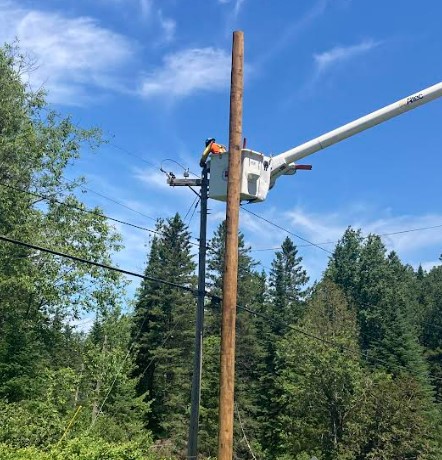
NEK Broadband hanging fiber

The CUD currently provides upgraded users with access to speeds that exceed those provided by cable and DSL providers, even in many more urban markets.

NEK Broadband currently offers four tiers of broadband service: symmetrical 50 megabit per second (Mbps) service for $80 a month; symmetrical 250 Mbps service for $103 a month; symmetrical 500 Mbps service for $135 a month; and a symmetrical gigabit per second (Gbps) offering for $250 a month.