
smart city

Content tagged with "smart city"

Related Topics
Displaying 1 - 10 of 15

Fort Pierce, Two Years Later: Fiber, Smart City, and Steady Growth - Episode 677 of the Community Broadband Bits Podcast

In this episode of the podcast, Chris reconnects with Jason Mittler, manager of FPUAnet at the Fort Pierce Utilities Authority, for a two-year update on the city’s smart city broadband strategy.

Since their last conversation, Fort Pierce has continued expanding its municipally operated fiber network — now passing thousands of parcels and accelerating construction toward a long-term goal of serving its electric territory. 

Jason shares how the phased, measured deployment approach has allowed the utility to learn, refine operations, and balance broadband expansion alongside major infrastructure investments like a new wastewater treatment facility.

The episode dives into Fort Pierce’s Lincoln Park Smart Neighborhood initiative, where fiber deployment, public Wi-Fi, and community partnerships aim to close persistent digital equity gaps. 

While subscription take rates have proven challenging in lower-income areas, expanded free Wi-Fi in public housing and parks has delivered immediate access benefits. 

Jason also explains how owning the fiber backbone enables Fort Pierce to support police cameras, smart grid infrastructure, and municipal networking at lower long-term cost.

Beyond infrastructure, the conversation highlights the broader value of municipal broadband: local technical expertise, collaborative planning with city and county partners, and reinvesting revenue back into the community. 

The episode closes with a notable milestone — FPUAnet recently lowered its broadband rates, reinforcing its commitment to affordability while continuing steady network growth.

This show is 32 minutes long and can be played on this page or via Apple Podcasts or the tool of your choice using this feed

You can also check out the video version via YouTube.

Transcript below.

We want your feedback and suggestions for the show-please e-mail us or leave a comment below.

Listen to other episodes or view all episodes in our index. See other podcasts from the Institute for Local Self-Reliance.

Thanks to Arne Huseby for the music. The song is Warm Duck Shuffle and is licensed under a Creative Commons Attribution (3.0) license

Chattanooga’s Municipal Fiber Network Has Delivered $5.3 Billion in Community Benefits, New Study Finds

For years, it’s been known as “America’s first Gig City,” thanks to its city-owned fiber network. 

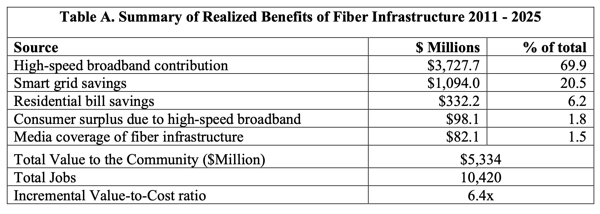
That same infrastructure has positioned Chattanooga to potentially become the nation’s first “Quantum City,” according to a new economic impact analysis showing EPB Fiber and the utility's smart-grid systems has generated $5.3 billion in net community benefits for Hamilton County since 2011. 

The city is now poised to enter the Quantum realm.

The research builds on an earlier 10‑year return‑on‑investment analysis – published in August 2020 – that showed the city’s publicly-owned fiber network had delivered $2.69 billion in value over its first decade. 

The new follow-up study – From Gig City to Quantum City: The Value of Fiber Optic Infrastructure in Hamilton County, TN 2011-2035 – expands the time horizon and finds that over 15 years the total community benefit has grown to $5.3 billion, illuminating how the long‑term value of municipal broadband can really pay-off.

A Massive Economic Boost

Image
A table shows data from the study explained in the accompanying story

Conducted by researchers at the University of Tennessee at Chattanooga, the study finds that the municipal fiber network has dramatically reshaped the regional economy, supporting 10,420 jobs from 2011 to 2024 – about 31 percent of all net new jobs created locally over the past decade.

The return on investment has been extraordinary: the network has delivered 6.4 times the value of its original $396 million investment, the study indicates.

Fort Collins Connexion Unveils New SmartHome Network Management Tools

Fort Collins, Colorado’s popular Connexion municipal broadband network has unveiled SmartHome, a new network management app that can help the ISPs customers better manage the security and bandwidth-consumption of their home networks.

SmartHome lets users see every connected device, set parental controls, prioritize bandwidth for work or entertainment, and guard against online threats through integrated security services like ExperienceIQ and ProtectIQ. The expanded new functionality is being bundled with the ISPs Enhanced 2-Gig and Premier 10-Gig plans.

Connexion currently offers locals three tiers of fiber service: a symmetrical 1 gigabit per second (Gbps) option for $70 a month; a symmetrical 2 Gbps option for $100 a month; and a symmetrical 10 Gbps offering for $200 per month.

Image
Fort Collins Connexion HQ

Fort Collins, Colorado has repeatedly won awards for being a trailblazer in the municipal fiber space, and local subscribers continue to take notice. The city-owned and operated Connexion network operation just announced it has passed the 20,000 subscriber mark, after nabbing a significant new wave of state and federal funding for expansion early last year.

Fort Collins began thinking about a citywide fiber deployment as early as 2012. By 2015, locals had voted to exempt the city from a counterproductive state law restricting communities from building their own broadband networks.

Webinar Redux: Why Cities Can’t Afford to Wait on Smart Infrastructure

Two city utility managers, an economist, and a fiber technologist walk into a virtual webinar …

And what followed was a deep dive into why delaying investment in smart city infrastructure is increasingly costly.

The hour-long livestream event  – co-hosted by the Institute for Local Self-Reliance (ILSR) Community Broadband Networks initiative and the American Association for Public Broadband (AAPB) – brought together municipal utility managers, an economist, and a leading fiber technologist to explore how cities can future-proof themselves with digital infrastructure.

Guests who appeared on “Building Smarter Cities and the Cost of Doing Nothing” today emphasized how “smart cities” are built on fiber networks and what city investments in the gold-standard of Internet connectivity can do to boost economic development while improving the quality of life for local residents and businesses.

They highlighted the real costs of inaction, pointing to slower economic growth and lost municipal revenue opportunities as something many cities or towns overlook when thinking about local infrastructure.

Image
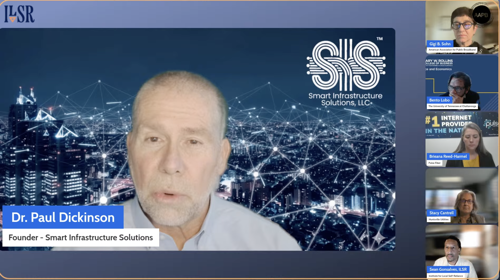
Screenshot of the panelists talking during the webinar

The webinar featured Huntsville Utilities VP of Engineering Stacy Cantrell who provided key insights into the public-private partnership Huntsville Utilities struck with Google Fiber and what it has meant to “Rocket City.”

Another virtual case study was provided by Brieana Reed-Harmel, Broadband Manager for Pulse Fiber, discussing how the city’s fiber network is propelling economic revitalization efforts in Loveland and how the success of the network is now being extended into neighboring communities.

Webinar To Explore ‘Smart City’ Infrastructure and the Costs of Ignoring It

Once again, the Community Broadband Networks team at the Institute for Local Self-Reliance (ILSR) will team up with the American Association for Public Broadband (AAPB) to host another thought-provoking webinar – “Building Smarter Cities and the Cost of Doing Nothing.”

Moderated by AAPB Executive Director Gigi Sohn and ILSR’s Sean Gonsalves, the livestreamed discussion will bring together community-driven broadband champions who are redefining what it means to be a “smart city” — and what communities risk when they fail to invest in modern connectivity.

Slated for November 20th starting at 12 noon ET, interested attendees for the free 60 minute webinar are invited to register now here.

From Huntsville’s groundbreaking public–private partnership with Google Fiber to Loveland’s city-owned-and-operated Pulse Fiber, network operators in those communities will share real-world lessons on how they were able to turn infrastructure into opportunity. 

The livestreamed webinar will feature Stacy Cantrell, Vice President Engineering for Huntsville Utilities; Brieana Reed-Harmel, Broadband Manager for Pulse Fiber; and will also include expert insights from Dr. Bento Lobo (University of Tennessee at Chattanooga) who will unpack the economic data behind smart city investments, while Paul Dickinson (Founder of Smart Infrastructure Solutions) will offer a glimpse into the next generation of intelligent infrastructure.

As the panel dives into the why and how communities are transforming their local digital landscapes, the forum will explore the technologies, policies, and partnerships powering the cities of tomorrow — and why doing nothing is the most expensive choice of all.

The Potential of Fiber: Smart Cities, BEAD, and Municipal Broadband Financing - Episode 636 of the Community Broadband Bits Podcast

In this episode of the podcast, Chris and Sean dive into the latest developments in broadband policy and fiber technology. They discuss California’s investment in tribal broadband, the exciting capabilities of fiber optic sensing for smart cities, and the ongoing debate around BEAD funding and fiber prioritization. 

The conversation highlights how fiber can revolutionize municipal infrastructure by detecting traffic, preventing water leaks, and improving urban planning.  

They also preview an upcoming webinar co-hosted by Sean and Gigi Sohn of the American Association for Public Broadband, focused on financing municipal broadband projects. 

Featuring insights from industry experts, the webinar aims to help local governments navigate funding options for community-owned networks.  

Tune in for a thought-provoking discussion on broadband’s future, policy challenges, and the innovative potential of fiber infrastructure. 

This show is 27 minutes long and can be played on this page or via Apple Podcasts or the tool of your choice using this feed.

Transcript below.

We want your feedback and suggestions for the show-please e-mail us or leave a comment below.

Listen to other episodes or view all episodes in our index. See other podcasts from the Institute for Local Self-Reliance.

Thanks to Arne Huseby for the music. The song is Warm Duck Shuffle and is licensed under a Creative Commons Attribution (3.0) license

Frontiers in Fiber Optic Sensing | Episode 107 of the Connect This! Show

Connect This! Show

Catch the latest episode of the Connect This! Show, with co-hosts Christopher Mitchell (ILSR) and Travis Carter (USI Fiber) joined by regular guests Kim McKinley (TAK Broadband) and Doug Dawson (CCG Consulting) along with special guest Paul Dickinson (Dura-line, Fiber Optic Sensing Association, and Aii) to talk about the future of fiber optic sensing to do everything from avoid fiber cuts from construction equipment to monitor traffic to detect pipeline leakages. They also hit a grab-bag of other topics, including:

Join us live on February 7th at 2pm ET, or listen afterwards wherever you get your podcasts.

Email us at broadband@communitynets.org with feedback and ideas for the show.

Subscribe to the show using this feed or find it on the Connect This! page, and watch on LinkedIn, on YouTube Live, on Facebook live, or below.


This show was more technical than is usual, even for Connect This!. See transcript below. Some additional resources mentioned in the episode include:

Smarter Infrastructure through Distributed Fiber Optic Sensing with Paul Dickinson

Fiber Broadband Association Awards Concepts that Advance Subscriber Experience at Fiber Connect 2024

G.652.D vs G.657.A1 vs G.657.A2 Fiber Optic Cabling: What’s the Difference?

A New Class of Sensing Products for DAS – AcoustiSens® Wideband Vibration Sensor Fibers and Cables

AcoustiSens® Wideband Vibration Sensor Fiber

The Alliance for Innovation and Infrastructure

Common Ground Alliance

Fiber Deployment Cost Annual Report, 2024

Meet the crypto officers: How the internet is controlled by 14 people with seven secret keys

Lincoln Park and Smart City Initiatives in Fort Pierce with Jason Mittler - Episode 590 of the Community Broadband Bits Podcast

This week on the podcast, Christopher is joined by Jason Mittler, the manager of the Fort Pierce Utilities Authority Network. The FPUA Network is a fiber optic network in Fort Pierce, Florida. Jason details the FPUA and their multifaceted use of their fiber network, which not only provides Internet and utility services but also facilitates smart grid solutions and smart city services.

Chris and Jason also discuss updates regarding the Lincoln Park Smart Neighborhood, which is a collaborative project that aims to address low broadband adoption rates to a historic community in Fort Pierce. This would provide residents in Lincoln Park with the essential connectivity they need by offering 100 Mbps symmetrical service at $31 per month. The FPUA Network also provides additional services for those who required higher speeds.

The conversation concludes with Chris and Jason sharing valuable advice for those venturing into the ISP market. They emphasize the importance of collaboration with consultants, building partnerships with municipalities and organizations to learn from industry peers, and staying informed about the evolving landscape of Internet services.

This show is 29 minutes long and can be played on this page or using the podcast app of your choice with this feed.

Transcript below.

We want your feedback and suggestions for the show: please e-mail us or leave a comment below.

Listen to other episodes here or see other podcasts from the Institute for Local Self-Reliance here.

Thanks to Arne Huseby for the music. The song is Warm Duck Shuffle and is licensed under a Creative Commons Attribution (3.0) license.

Connecting the Last Twenty Percent in Newark - Episode 587 of the Community Broadband Bits Podcast

Newark, New Jersey (pop. 307k) has been operating a dark fiber network for more than a decade. In recent years, the city has expanded its efforts to leverage those assets in an incremental effort to improve connectivity and competition for local business and residents, while also building out a robust Wi-Fi network. The goal: build a portfolio of approaches to connect the last twenty percent of the city that doesn't have access today. 

This week on the podcast, Christopher is joined by Aaron Meyerson, Chief Innovation Economy Officer and Director of Broadband, and Anthony Avent, Technical Operations for City of Newark, to talk about the project. From reinvigorating the city's infrastructure with a new public-private partnership, to connecting almost a hundred large business locations, to enabling innovative smart-city applications to fight heat and pollution, to supporting more than 7,200 active Wi-Fi users every day, Newark isn't just sitting around waiting for someone to help solve local challenges. They're stepping up to the plate and tackling them themselves.

This show is 28 minutes long and can be played on this page or using the podcast app of your choice with this feed.

Transcript below.

We want your feedback and suggestions for the show: please e-mail us or leave a comment below.

Listen to other episodes here or see other podcasts from the Institute for Local Self-Reliance here.

Thanks to Arne Huseby for the music. The song is Warm Duck Shuffle and is licensed under a Creative Commons Attribution (3.0) license.

West Des Moines, Iowa is a Model for Open Access Conduit Networks - Episode 573 of the Community Broadband Bits Podcast

A little more than three years ago, the city of West Des Moines, Iowa announced that it would build a citywide open access conduit system to lower the cost of new broadband deployment to facilitate better connections at lower costs for residents. GFiber (formerly Google Fiber), Mediacom, Lumen (formerly CenturyLink), and local ISP Mi-Fiber have since signed on as providers. 

This week on the podcast, Deputy City Manager Jamie Letzring and city Innovations Consultant Dave Lyons join Christopher to talk about overcoming design and legal challenges of building an infrastructure system that remains relatively unique, and the commitment the city has made to reach economically disadvantaged households to make sure everyone has a quality and affordable connection. Finally, they share a little about how the city has been taking steps to use the new conduit system to supplement its already-robust fiber network for government facilities, smart-city initiatives, and more.

This show is 36 minutes long and can be played on this page or via Apple Podcasts or the tool of your choice using this feed

Transcript below.

We want your feedback and suggestions for the show-please e-mail us or leave a comment below.

Listen to other episodes here or view all episodes in our index. See other podcasts from the Institute for Local Self-Reliance here.

Thanks to Arne Huseby for the music. The song is Warm Duck Shuffle and is licensed under a Creative Commons Attribution (3.0) license.