
transparency

Content tagged with "transparency"

Related Topics
Displaying 1 - 10 of 35

Broadband 'Nutrition Labels': Easily Missed, Never Seriously Enforced

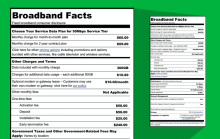
In late 2024 the Biden FCC implemented a new rule requiring that broadband providers include a “nutrition label for broadband,” making any fees, restrictions, usage caps, or other limits clear at the point of sale. The proposal was mandated by Congress as part of the 2021 bipartisan infrastructure law to try and ensure the quality of taxpayer-subsidized broadband.

The proposal was well-intentioned. It mandated a certain level of transparency on telecoms to ensure that consumers knew exactly what kind of broadband connection they were buying. The effort attempted to counter historically dodgy practices by bigger providers to jack up their advertised prices using sneaky and misleading below-the-line fees.

But four years after Congress proposed the idea, studies began making it clear that ISPs weren’t seriously adhering to the rules, and regulators weren’t really interested in enforcing them anyway.

This joint study out of York and Michigan State University found that out of 35 monitored ISPs, only sixteen properly placed labels at the point of sale as required. Not a single ISP received full marks for completely adhering to the FCC’s requirements. Only six ISPs received a full ten-star ranking for proper formatting.

“The average across the sample was 5.2/10 stars,” the authors noted. “Across the 15 large ISPs assessed the average score was 5.8/10. Across the 12 medium ISPs assessed the average was 5.4/10 stars, and the average across the eight small ISPs, the average score was 3.75/10 stars.”


Trump FCC Votes To Weaken Broadband ‘Nutrition Label’ Rule That Already Saw Mixed Compliance

Last year the Biden FCC implemented a new rule requiring that broadband providers include a “nutrition label for broadband,” making any fees, restrictions, usage caps, or other limits clear at the point of sale. The proposal was mandated by Congress as part of the bipartisan infrastructure law.

But four years after Congress proposed the idea, a new study indicates that many ISPs aren’t doing a great job adhering to the rules. The Trump FCC has also announced that it's taking formal steps to weaken or eliminate the rules as part of the agency’s broad, frontal assault on consumer protections.

The new academic study (first reported on by Broadband Breakfast) by York University researchers Jonathan A. Obar and Boxi Chen gave 35 different U.S. ISPs a ten-star based grade on how well they are adhering to the FCC broadband label requirements, including label placement, standardized formatting, machine-readable data files, and required policy links.

The results weren’t pretty: only sixteen ISPs properly placed labels at the point of sale as required, and not a single ISP received full marks for completely adhering to the FCC’s requirements. Only six ISPs received a full ten star ranking for proper formatting.

Building Better Middle Mile Networks

On the most recent episode of the Connect This! Show, the panel was joined by California-based Internet Exchange builder Matt Peterson of SFMIX. Matt has been in the broadband space for many years on the deployment and operations side of the wholesale and peering system, and joined the show today to talk about the need for better, more practical, more forward-thinking middle mile networks across the United States. However the federal Broadband Equity, Access, and Deployment program (BEAD) ultimately ends up, if we want to see more competition and the most efficient use of public dollars there is no doubt that we will need additional infrastructure connecting those last-mile networks that hook up businesses, residents, and community anchor institutions around the country.

These are the networks that connect our networks back to the larger Internet; they traverse county roads and state highway systems. Some are owned by and exclusive to the largest providers, like AT&T. Others, like Project THOR in Colorado, were collectively built to increase resiliency for the public good, as well as stimulate last-mile retail service in underserved and unserved parts of the country. California is in the midst of multi-billion dollar middle mile endeavor, and a handful of others states are likewise making significant investments. 

So the question is: are we building enough middle mile in the United States, and equally importantly, are we building it correctly? With all sorts of public and private interests involved, and networks that are often measured in the thousands of miles (or tens of thousands of route-miles of fiber), often with public money, it's an important thing to get right.

We wanted to underline the importance of these things by featuring this segment of the show. The panel talks about the consequences of decisions about everything from where these networks are built, how they are funded, transparency and marketing, and the importance of talking to the last-mile operators that will be interconnecting with them. 

Watch Christopher Mitchell (ILSR) and Travis Carter (USI Fiber) with regular guests Kim McKinley (UTOPIA Fiber) and Doug Dawson (CCG Consulting), joined by special guest Matt Peterson (SFMIX) talk about it all below. 

The middle-mile discussion starts at the 36:00 mark.

Broadband Labels Help Transparent Providers Show Off Their Service

The Federal Communication Commission (FCC) recently published rules for its broadband nutrition label provides a partial victory for Internet subscribers and a potential marketing advantage for fiber providers – but may pose a challenge for wireless Internet service providers.

Though the new rules were finalized in October, Internet Service Providers (ISPs) have until April 10, 2024 to publish their broadband labels, though providers with 100,000 or fewer subscriber lines have until October 10, 2024.

Just like the label on the back of packaged food in grocery stores helps shoppers understand the nutritional value of the food they are buying, the broadband label requires ISPs to disclose their broadband pricing and service information (at the point of sale) to help potential subscribers make informed decisions about the service they are signing up to get.

Transparency on Display

Though the label is just another red-tape requirement for some providers, others see it as an opportunity to show off the quality of their services.

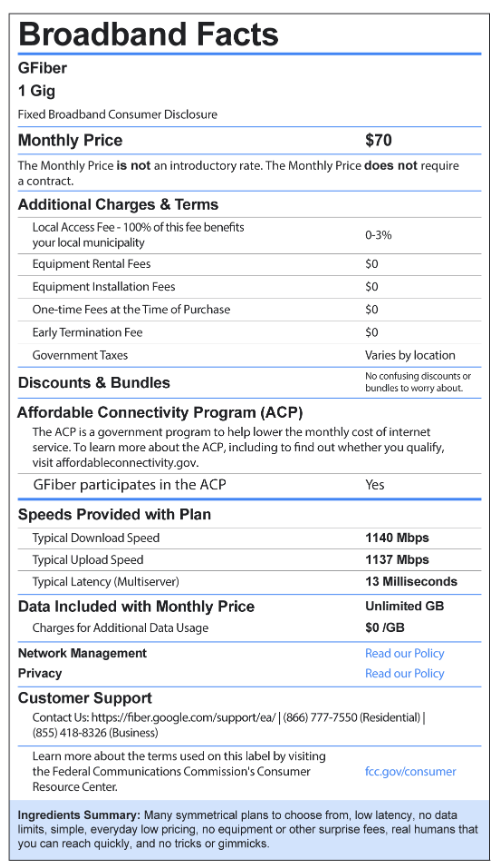
Image
Google broadband nutrition label

Google Fiber, for example, published via social media and its blog a preliminary version of its own broadband consumer label, just days after the final rule was published, and six months before its deadline.

A Nutrition Label for Broadband Service: Where Are We Now?

In November 2021, Congress passed the Infrastructure Investment and Jobs Act (IIJA) which, in addition to funding the single largest federal investment in broadband infrastructure expansion, also mandated the implementation of a broadband nutrition label.

Similar to the nutrition label on the back of packaged food in grocery stores, the broadband label requires the transparent disclosure of broadband pricing and service information to help customers make informed decisions about service.

In November of 2022, the FCC issued a Notice of Proposed Rulemaking detailing how the label will be implemented. Industry and consumer advocates alike submitted nearly 250 filings during the public comment period, which ended in March 2023.

Most recently, the FCC released an Order of Reconsideration in response to three petitions it received from coalitions pushing back on or clarifying the rules outlined in the proposed rulemaking.

FCC Says 'Up To' Amounts Not Transparent Enough

The first petition was submitted by a broad swath of trade groups – including ACA Connects, America’s Communications Association; NTCA, The Rural Broadband Association; NCTA, The Internet & Television Association; The Cellular Telephone Industries Association; and USTelecom, The Broadband Association – and specifically pushed back on the FCC’s proposed requirement that ISPs disclose every one of their fees on the label, as well as requesting permission to list “up to” amounts for fees, citing the amount of administrative work it would take to comply with the requirement.

Maps, Maps Everywhere - Episode 528 of the Community Broadband Bits Podcast

This week on the podcast, Christopher is joined by Dustin Loup, Project Manager of the National Broadband Mapping Coalition, housed at the Marconi Society. Dustin joins us to talk about the new national Federal Communications Commission broadband maps, currently under construction and intended to replace the current and hopelessly broken one to prepare for tens of billion in federal broadband funding.

There will hopefully be many improvements in the new maps, the first version of which is due out this month (we're not holding our breath): more granular data, more precision, and a better picture to drive future infrastructure investment in smart, efficient ways. Christopher and Dustin talk through what they hope to see, before turning to some of the problems the see emerging. This includes the frustrating walls already placed around the (tax dollar-funded) data, almost entirely restricting access to researchers and policy makers for accountability purposes, the probability of abuse by large providers, and the troublingly large $50-million contract to ConstQuest proposed in a recent announcement by NTIA to get access to something the federal government has already paid for, to administer the $42.5 billion BEAD program.

This show is 18 minutes long and can be played on this page or via Apple Podcasts or the tool of your choice using this feed

Transcript below. 

We want your feedback and suggestions for the show-please e-mail us or leave a comment below.

Listen to other episodes here or view all episodes in our index. See other podcasts from the Institute for Local Self-Reliance here.

Thanks to Arne Huseby for the music. The song is Warm Duck Shuffle and is licensed under a Creative Commons Attribution (3.0) license.

Following Through on Transparency: A Broadband Nutrition Label Status Report

Nearly one year ago on November 15, 2021, Congress passed the Infrastructure Investment and Jobs Act (IIJA), which contained significant legislation around broadband. One piece, which the Institute for Local Self-Reliance (ILSR) has studied closely over the past year and a half, is the implementation of a broadband nutrition label which would require the transparent disclosure of broadband pricing and service information.

While this issue gets very little news coverage, it is an important undertaking as the big providers have a long-established habit of hiding pricing and speed information from subscribers, which prevents them from making informed choices and can leave them vulnerable to exploitation. Our advocacy for the label, and the original research behind our position, can be found here. The FCC is now under deadline to release an order to “promulgate regulations to require the display of” the label by November 15 of this year. We’ve taken a moment here to re-access the issue, offer a few updates, and highlight the ingredients of a strong broadband nutrition label. 

Pushing for Clarity, Easy Accessibility, and Enforcement

ILSR, along with 30 other digital equity organizations, recently filed a letter to the FCC supporting the creation of the broadband consumer label and advocating that it be published in a way that makes it clear and easily accessible for customers. While ILSR believes the label is a key decision-making tool and should be published at the point of sale, we reject proposals to limit the label’s display to the point-of-sale only. We emphasize in this letter that the label should also be published on the monthly bill to provide an additional provider accountability mechanism that allows customers to understand what they're paying for.  

Bottlenecks in the Affordable Connectivity Program - Episode 522 of the Community Broadband Bits Podcast

This week on the podcast, Christopher is joined by Jessica Engle, Director of Community Outreach at Althea to talk about the Affordable Connectivity Program, the $14-billion fund that provides a $30 monthly service benefit ($75 on Tribal lands) to help defray the cost of Internet access to qualifying families around the country. It's a large and complicated program, and Jessica and Christopher talk about some of the bottlenecks that are causing friction both for households and for Internet Service Providers (ISPs). This includes verifying eligibility in a timely fashion, modifying administrative and accounting systems, a lack of information transparency from USAC and the FCC, and the seeming lack of mechanisms for an audit should it become necessary down the road.

Jessica has started a Discord to help navigate the ACP

How much money is going out the door each month to pay for the Affordable Connectivity Program? Where have funds been spent at the state and zip code level? When will the money run out? Check out our dashboard at ACPdashboard.com.

This show is 17 minutes long and can be played on this page or via Apple Podcasts or the tool of your choice using this feed

Transcript below. 

We want your feedback and suggestions for the show-please e-mail us or leave a comment below.

Listen to other episodes here or view all episodes in our index. See other podcasts from the Institute for Local Self-Reliance here.

Thanks to Arne Huseby for the music. The song is Warm Duck Shuffle and is licensed under a Creative Commons Attribution (3.0) license.

Fort Collins' Connexion Continues to Expand and Adds Construction Projections for Residents

With a little less than a year left in its projected build schedule, Fort Collins (pop. 168,000) continues to make progress on its municipal fiber-to-the-home (FTTH) network, while also releasing new resources to help keep citizens informed and help households with affordability challenges stay online. 

When we last checked in on Fort Collins' Connexion a little more than a year ago, the network was nearing a milestone, having spent roughly 49 percent of its construction budget. Today, the network is well over the halfway point of its $142 million-dollar build. In fact, it expects to be done placing vaults and with boring work in July.

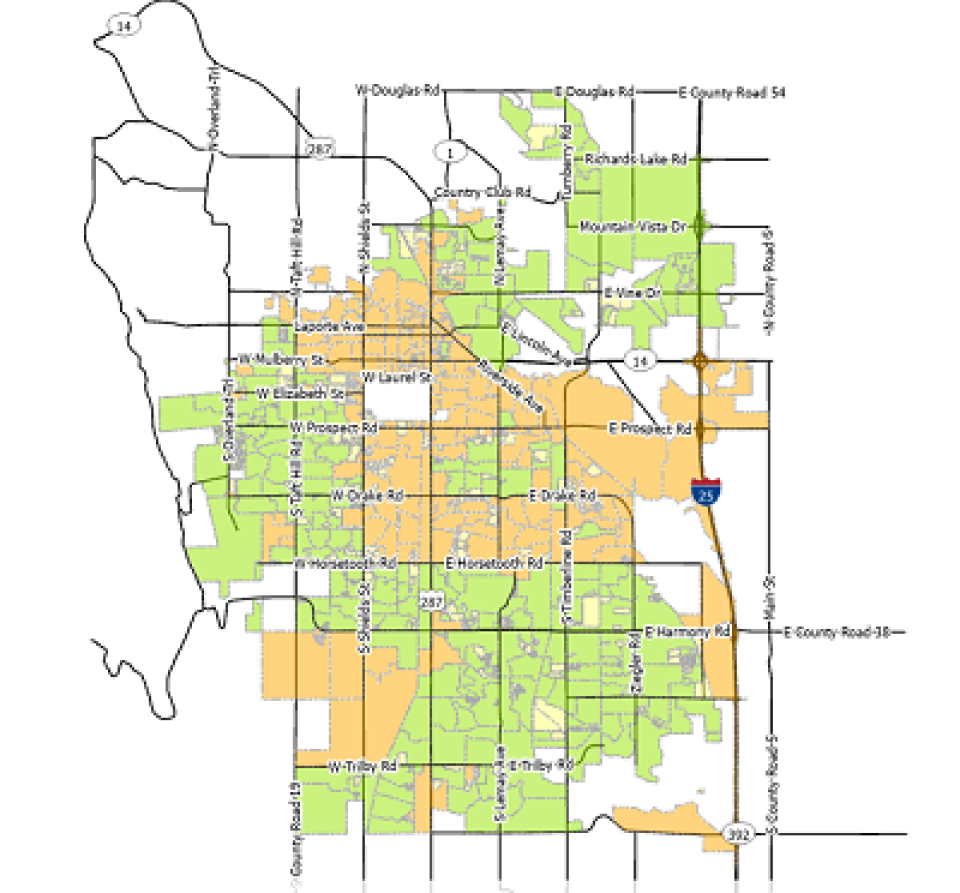
Along the way, local officials have taken steps to increase transparency and improve communication with local residents. Last summer, it released a construction map of the networks' anticipated 357 fiberhoods, delineating which areas were in design, under construction, or fully lit.

Image

In addition, at the end of November of 2020 the network released a Network Status tracker so that users could see in each of the four quadrants of the city if connections were down. 

[Updated Report] Shopping for Broadband: Failed Federal Policy Creates Murky Marketplace

In November, the Institute for Local Self-Reliance published a report examining the transparency practices of Internet Service Providers (ISPs). Shopping for Broadband: Failed Federal Policy Creates Murky Marketplace [pdf] identified locally-controlled broadband networks as the most transparent around key service details.

Large ISPs, however, were found to be more likely to make information like upload speed and pricing difficult or impossible for potential customers to find. 

After the report’s original publication, a WISP advocate suggested that our fixed wireless sample may not appropriately represent the industry and requested that we review and re-issue our analysis with an alternative list of ISPs that have been more aggressive in pursuing federal funding and spectrum opportunities. These WISPs greatly outperformed our original sample, which was selected based on those claiming the largest population coverage.

New Set of WISPs Shows Better Transparency 

While many of the original WISPs failed to disclose basic pricing and service information, only two of the second set offered less than excellent information in all categories. The second set had less poor quality information and slightly more missing information than our set of cooperatively-run networks. Municipal networks remained the most transparent. 

Though many of the fixed wireless providers originally studied do seem to claim the greatest number of potential customers, we agree with some reviewers that they are not actually among the largest fixed wireless ISPs with the most subscribers. The new list of WISPs, which is included alongside the original one on the Broadband Transparency Rule Compliance Scorecard, may be a more accurate representation of providers’ transparency practices in this industry.