

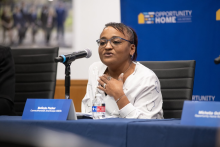
The first time Belinda Parker-Mendoza set foot on the campus of San Antonio College was to get her cap and gown for graduation, having earned her Associate’s Degree in Business Administration.
It was not only a first for her. She was the first person in her entire family to earn a diploma of any kind.
The gateway to that moment, the 45-year-old mother says, came in 2022, when she signed up for a digital skills training course offered through AmeriCorps VISTA at one of the city’s Opportunity Home apartment complexes where she lives on San Antonio’s cultural and historic East Side.
“If I didn’t have a laptop and the Internet, none of that would’ve happened,” she explains, sitting in her fourth-floor apartment before diving into a writing assignment for one of her classes as she works towards her bachelor’s degree.
She does her school work on a laptop – a refurbished Dell computer she earned through the digital skills training program. Before that, she didn’t have a computer or Internet access at home. The class provided her a laptop and through the Americorps program, she was able to enroll in the now-expired Affordable Connectivity Program (ACP), which allowed her to get home Internet service for the first time.
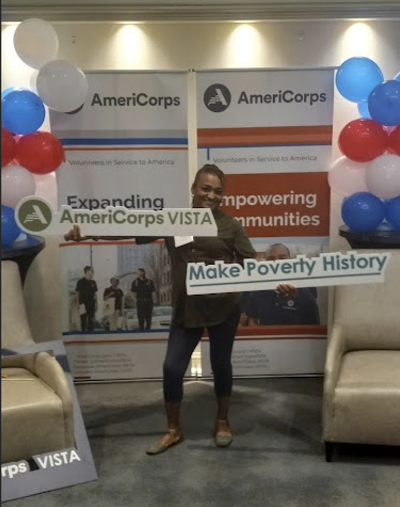
“Thank God,” she says. “Because when the ACP ended, I was working in the (Americorps) program – and getting paid – so it worked out.”
For millions of others, it did not.
When the ACP expired in 2024, roughly 23 million households lost the subsidy that had made home Internet service affordable, forcing many households to either downgrade service or lose their service entirely. For families already walking a financial tightrope, the end of the program didn’t just mean losing a discount. It meant losing access to education, telehealth, job opportunities, and the modern tools of daily life – despite the fact that studies have shown how the ACP generated more savings for taxpayers than it cost.
The program cost $7.3 billion annually – though studies indicate that price tag was more than compensated by the $28.9 to $29.5 billion taxpayers would save from access to remote telehealth visits alone, which are estimated to be 23 percent less expensive than in-person visits.
Necessity, Not Luxury
Belinda knows how close she came to being one of the millions left on the wrong side of the digital divide. But the transformation she experienced wasn’t just about access to technology. It was about everything that came with it.
Growing up as one of ten children, Belinda says educational achievement was rare in her family. Her mother never finished high school. Her father graduated from high school, but then went straight to work. Of all her siblings, Belinda was the only one to earn a high school diploma – and now, the only one with a college degree.
“If I didn't have a laptop and Internet, I wouldn’t know about a lot of stuff. I didn’t have anyone to ask about things people take for granted. Even something like – what do you wear to graduation? Should I wear heels? Those little things matter when you’re the first.”
Access to a laptop and the Internet didn’t just help her complete assignments – it filled in the gaps in other areas of life.
“It goes beyond having a laptop in front of you,” she says. “It’s a support system. The knowledge of how to use it – that’s not a luxury. It’s a necessity.”
That idea – that meaningful participation in our digital economy requires more than just an Internet connection – sits at the heart of another federal effort abruptly ended by the Trump administration when, within months of taking office, the President unilaterally declared in a social media post the Digital Equity Act was being "terminated."
Designed to fund digital skills training, devices, and community-based support programs like the one Belinda participated in, the law embodied a recognition that closing the digital divide would require not just investment in infrastructure, but in people.
Legal challenges to the termination of an act passed by Congress under the Biden administration are still making its way through the courts. And for people like Belinda – and the opportunity for millions of other disproportionately disconnected Americans to take part in a rapidly evolving digital world – the fate of the “covered populations” enumerated in the Digital Equity Act (which includes veterans, rural communities, and senior citizens) now hangs in the balance.
Equitable Pathways to Opportunity (and Workforce Development)
Still, even when the now-dwindling offerings of digital skills training were more widely available, the path wasn’t straight-forward or easy, Belinda says. After the loss of both her parents, she fell into a deep depression.
“I would just go downstairs to check the mail,” she recalls. “One day someone said, ‘It’s good to see you – do you want to help pass out flyers?’”
That small invitation turned into volunteering at community events, which led to a part-time role as a resident apprentice. What was supposed to be a six-month position turned into a program coordinator encouraging her to apply for AmeriCorps VISTA.
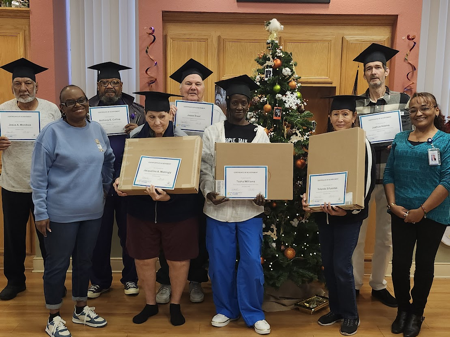
She did – and stayed for three years.
During that time, Belinda not only learned digital skills – from basic computer use to Microsoft Excel and telehealth platforms – she began teaching others, eventually training the trainers.
At first, it came with hesitation.
“The digital world can be intimidating. And when you feel like you’re the only one in the room who doesn’t know something, you stay quiet,” she says, adding how that changed over time.
“Now I’m the first one to ask questions,” she says, laughing. “And people will whisper to me after: ‘Thank you for asking that.’”
What once felt like a barrier had become a source of confidence – not just for herself, but for those around her.
“No one else in my world has done this before ... now there’s so many eyes on me,” she says. “Not just my family, but other people that live here. They don’t just see me – they see the technology and a person who has answers and confidence.”
Today, she uses that same approach to help others overcome their own technophobia.
“The way I describe it,” she says, “I compare a laptop or computer to something they already know – like your phone or your flat screen TV. Even in pitch black, you know how to use those. These buttons on the computer will do the same kind of things. Once people see that, it’s not as intimidating.”
That confidence translated directly into her academic success. With a laptop at home, she could check grades, study at night, and complete coursework without needing to be physically on campus.
She graduated from San Antonio College with a 4.0 GPA, earning her way into multiple honor societies, including Phi Theta Kappa, the National Society of Leadership and Success, and Tri-Alpha – an honor society recognizing first-generation college students.

Now enrolled at Palo Alto College, having transferred her San Antonio College credits, she is working toward a Bachelor’s Degree in Applied Technology in Operations Management – on track to graduate in 2027. Along the way, she has already earned a Business Operations Certificate, an Occupational Skills Award, and an Operations Leadership Certificate.
The impact of her journey is rippling outward.
“My younger sister is 42 and is getting her high school diploma because she saw me get my first degree,” she says. “It’s shifting the direction of our entire family. My daughter – I pushed her – and now she has her associate degree and is working toward her bachelor’s.”
Beyond Belinda’s immediate family, even her neighbors have taken notice.
“Someone told me, ‘I remember how sad you used to look walking to your car… and now I see you smiling.’ That meant everything to me.”
With her AmeriCorps service completed as of early April, she’s preparing for her final year as a full-time student – and looking forward to something she hasn’t had much time for: simply being present.
“I want to spend time with my husband,” she says. “He’s my biggest cheerleader. I want to show him – and myself – that we’re okay.”
Looking ahead, what excites her most isn’t just a degree – it’s possibility.
“What excites me,” she says, “is now I have options. Before, I just had ideas – like, if I could be that supervisor, I’d be so much better. And now I can. I’ve got education, and I can support my family because of technology.”
How to Make ‘Lollipop Moments’
The college paper Belinda is currently working on draws from a TED Talk story she found online – about a small act of kindness that changed the course of someone’s life. She calls it a “lollipop moment.”
“That moment made someone believe they could keep going,” she says. “And it changed everything.”
She wants to be that moment for others.
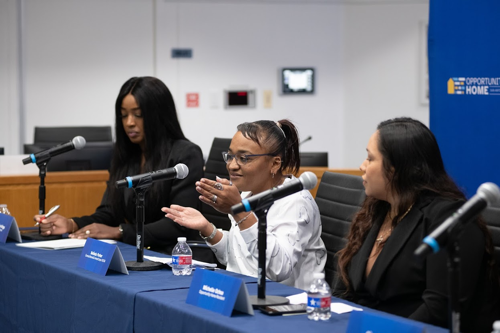
“How many times have you been that lollipop moment for someone else and didn’t even know it?” she asks.
Belinda’s story is what the Affordable Connectivity Program and the Digital Equity Act were designed to make possible. She is proof of what works.
Without corrective action by Congress, the short-sighted political calculation that let the Affordable Connectivity Program collapse and allowed the Digital Equity Act to be cancelled means fewer “lollipop moments” for the millions left disconnected – just as AI threatens to exponentially expand the gap between the digital haves and have-nots.
What it requires is the same sentiment Belinda first learned about herself and went on to offer students she ended up teaching in the Americorps VISTA program who were, like her, initially anxious about learning how to use what have become necessary digital tools.
“It’s never too late. You don’t have to sprint. You don’t even have to jog. If you can’t walk – crawl. Just start.”
Header and inline images courtesy of Belinda Parker-Medoza